
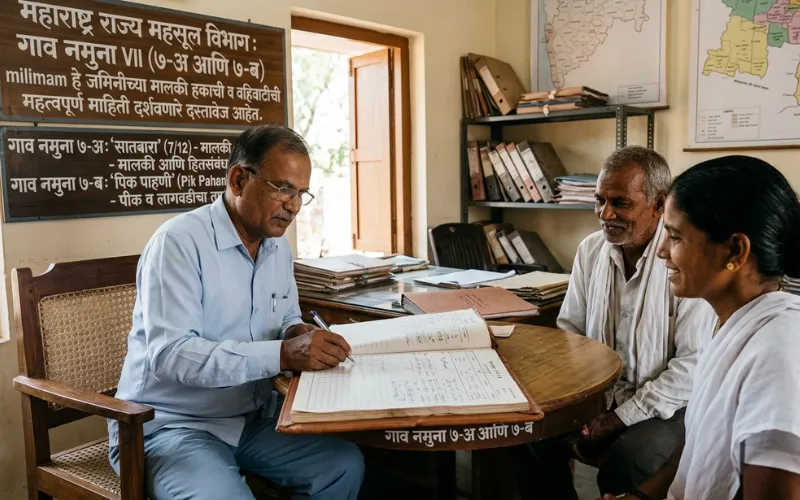

Every piece of agricultural land in Pakistan has a paper trail that begins with one foundational document. That document is Village Form VII, and if you have ever dealt with land records in rural Pakistan, you have almost certainly come across it, perhaps without knowing exactly what it is or why it carries so much legal weight.
The Document That Defines Ownership
Village Form VII is the official ownership record maintained at the village level within Pakistan’s land revenue system. It is part of a family of village forms used by the Patwari to record every aspect of land use, rights, and transactions within a revenue estate. Form VII specifically deals with ownership, possession, and the rights attached to each survey number or Khasra number in the village.
The form exists in two parts, 7-A and 7-B, and each part captures a different dimension of the ownership picture. Together they form what revenue officials refer to as the core ownership register of a Deh or revenue village.
What Village Form 7-A Records
Form 7-A is the primary ownership column. It records who holds the legal title to each parcel of land within the revenue estate. This is not simply a list of names. It is a structured register that captures the full ownership profile of every survey number in the village.
The information recorded in Form 7-A includes the following entries for each landholding:
- The name of the owner and their parentage (father’s name and caste or tribe)
- The nature of ownership, whether sole, joint, or shared among co-owners
- The owner’s fractional share in jointly held land, expressed as a numerical ratio
- The survey number and area of the holding
- The mode by which ownership was acquired, such as purchase, inheritance, gift, or court decree
- Any encumbrances or liabilities attached to the land, such as a mortgage
When a mutation is processed and approved, the change in ownership is first reflected in Form 7-A before it flows into the Jamabandi, which is the consolidated record of rights prepared every four years. Understanding why Jamabandi is made helps clarify why Form 7-A is so central: it is the source data that feeds into Jamabandi at each revision cycle.
What Village Form 7-B Records
Form 7-B records the possession column. While 7-A deals with legal ownership, 7-B records who is actually in physical possession of the land, which is not always the same person.
In Pakistan’s land revenue law, ownership and possession are treated as two distinct legal facts. A landowner may lease out their land to a tenant, or a plot may be in the possession of a mortgagee while the mortgage is active. Form 7-B captures this gap between legal title and physical reality.
The entries in 7-B include:
- The name of the person in possession and their relationship to the owner (tenant, mortgagee, lessee)
- The nature of the possessory right, whether cultivating tenant, non-cultivating tenant, or mortgagee in possession
- The area under possession for each possessory right
- The duration or conditions of the tenancy or mortgage where applicable
This distinction matters enormously in legal disputes. A person recorded in 7-B as a long-term tenant may have acquired occupancy rights under the land tenancy laws, which can complicate the owner’s ability to reclaim possession. Revenue courts refer to Form 7-B in cases involving land disputes over tenancy rights and adverse possession claims.
How Form VII Fits Into the Broader Revenue Record System
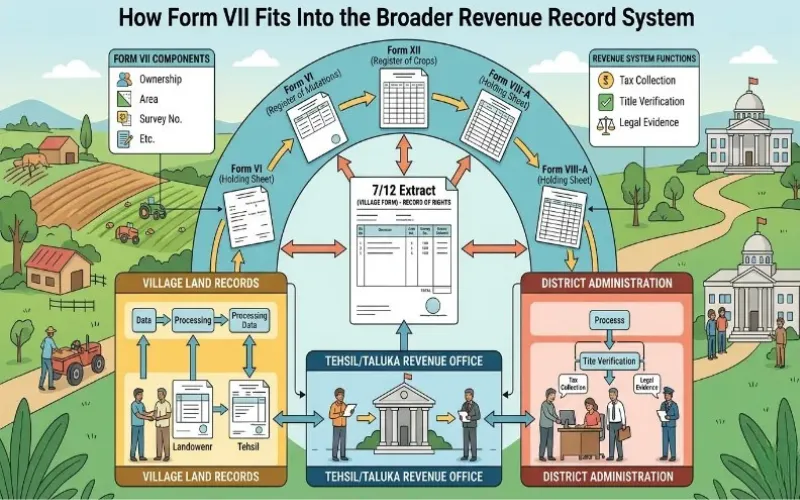
Village Form VII does not stand alone. It is one part of a larger system of village registers maintained by the Patwari, each of which captures a specific aspect of land administration. Seeing where it sits within that system clarifies its purpose and authority.
The Jamabandi in revenue is prepared by consolidating Form 7-A and 7-B data along with cultivation records from the Khasra Girdawari. The Jamabandi is attested by the revenue officer and becomes the legally authenticated ownership snapshot for that revision period. Form VII is the working register that feeds into that snapshot.
The Khasra Girdawari records seasonal crop and cultivation data, while Form VII records the rights. The difference between Jamabandi and Khasra Girdawari is essentially the difference between rights and facts on the ground, and Form VII is where the rights side of that equation originates.
The Role of the Patwari in Maintaining Form VII
The Patwari is the custodian of Village Form VII at the Halqa level. Every mutation approved by the revenue officer is entered by the Patwari into Form 7-A, updating the ownership column with the new owner’s details and the mode of transfer. The Patwari also updates 7-B whenever a tenancy or possession arrangement changes in the village.
The duties of a Patwari in Pakistan include keeping Form VII current at all times, presenting it to superior officers on inspection, and producing certified copies for landowners on request. Failure to update Form VII after a sanctioned mutation is a serious lapse that can create legal complications for the incoming owner.
In practice, delays between mutation approval and Form VII update are one of the most common sources of record inconsistencies. If you have a sanctioned mutation order but the Patwari has not updated the ownership column, your ownership is legally valid but your record is not yet clean. Escalating to the Qanungo is the appropriate step in such cases, as the Qanungo supervises Patwari records and can direct the update.
Reading Your Rights From Form VII
If you obtain a certified copy of your Form VII entry, knowing how to read it gives you a complete picture of your legal standing on a particular plot.
The key column to examine in 7-A is the mode of acquisition. This tells you how the current ownership originated. If it says sale mutation, you are looking at a purchased title. If it says inheritance mutation, the land came through succession. If the entry shows a court decree, it means ownership was established through litigation.
The share column is equally important, particularly for agricultural land that has passed through multiple generations. A share written as 1/3 means the named owner holds only one-third of the survey number, with the remaining two-thirds belonging to other co-owners recorded in the same column. This is essential to understand before any transaction, because a co-owner can only legally transfer their own share, not the entire plot.
Reviewing types of mutations in revenue alongside the Form VII entry helps you trace the ownership history and understand whether each transfer was properly recorded or whether a gap exists in the chain of title.
Form VII and Property Transactions
Any serious due diligence before buying land should include a review of the Form VII entry for the survey number in question. The Fard, which is the ownership certificate issued to individuals on request, is essentially an extract of the Form 7-A data for a specific survey number. What you receive as a Fard document is the certified version of what Form 7-A records for your plot.
Before proceeding with any sale, check whether the 7-B column shows any possessory rights held by a third party. A tenant recorded in Form 7-B as an occupancy tenant has rights that survive a change of ownership in many provinces. Buying land without knowing about existing possessory rights recorded in 7-B is one of the more expensive mistakes a buyer can make.
The register of rights in land revenue consolidates all of this information into a single authenticated document during the Jamabandi revision, but between revisions, Form VII is where the current picture lives.
When Form VII Becomes Evidence in Disputes
Village Form VII carries direct evidentiary value in both revenue proceedings and civil litigation. When a boundary dispute, tenancy claim, or ownership contest reaches the revenue officer or a revenue court, Form VII entries are among the first documents examined.
The reason is simple: the form records not just who owns land but how they came to own it and what rights others hold over it. That combination makes it far more informative than a simple ownership certificate.
If you are involved in a dispute over heirship versus ownership, Form 7-A will show whether the property was ever formally mutated into the heirs’ names or whether the original owner’s entry still stands. If you are dealing with encroachment, Form 7-B will show whether the encroaching party has any recorded possessory right or is occupying without legal basis. Understanding what encroachment of land means and how it interacts with Form 7-B possession entries is important when building a legal case.
Getting a Certified Copy of Form VII
A certified copy of your Form VII entry can be obtained from the Patwari of your Halqa. Present your CNIC, the survey number details, and the name of the revenue village. The Patwari is obligated to provide a certified copy on payment of the prescribed fee under the relevant provincial land revenue rules.
If the Patwari is unavailable or delays without reason, the Qanungo and then the Tehsildar are the appropriate escalation points. The revenue officer’s duties include ensuring citizens receive certified copies of revenue records within a reasonable time.
For inheritance situations specifically, obtaining the Form 7-A entry for all survey numbers belonging to the deceased is the first practical step before filing for inheritance mutation and beginning the process of dividing property among heirs.
Frequently Asked Questions
What is Village Form VII in Pakistan’s land revenue system
Village Form VII is the official ownership and possession register maintained by the Patwari for each revenue estate in Pakistan. It consists of two parts: Form 7-A records legal ownership of each survey number, including the owner’s name, share, and mode of acquisition, and Form 7-B records who is in physical possession of the land, including tenants and mortgagees. Together, these two forms constitute the core ownership record at the village level and serve as the source data for the Jamabandi prepared every four years.
What is the difference between Form 7-A and Form 7-B
Form 7-A records legal ownership. It shows who holds the title to a particular survey number, their ownership share, and how they acquired that right, whether through purchase, inheritance, gift, or court order. Form 7-B records physical possession. It shows who is actually occupying or cultivating the land, which may be a tenant, a mortgagee, or a lessee rather than the legal owner. The distinction matters because possession rights, particularly occupancy tenancy rights, can survive a change in ownership under Pakistan’s land tenancy laws.
Is a Fard the same as a Form VII entry
A Fard is a certified extract of the Form 7-A data for a specific survey number, issued to the landowner as an individual ownership certificate. It contains the same core information as the Form 7-A column for that plot but is formatted and certified for use in transactions and legal proceedings. Form VII itself is the original register maintained by the Patwari, while the Fard is the publicly issued document derived from it. For complete due diligence, both the Fard and the 7-B possession column should be reviewed.
How does Form VII relate to the Jamabandi
Form VII is the working register that the Patwari maintains continuously between Jamabandi revision cycles. Every time a mutation is approved, the Patwari updates Form 7-A to reflect the new ownership. Every four years, the data from Form VII along with cultivation records from the Khasra Girdawari is compiled and attested by the revenue officer to produce the Jamabandi, which is the formally authenticated record of rights for that revision period. The Jamabandi freezes the picture at a point in time, while Form VII stays current between those snapshots.
Can Form VII be used as evidence in a court case
Yes. Village Form VII is an official government register and is admissible as evidence in both revenue courts and civil courts in Pakistan. Revenue officers routinely examine Form VII entries when adjudicating mutation disputes, tenancy claims, and encroachment cases. Civil courts also accept certified copies of Form VII as documentary evidence of ownership and possession. Because the form records the mode of acquisition and any encumbrances, it provides a fuller legal picture than a simple ownership certificate and is considered one of the most authoritative land documents in the revenue record system.