
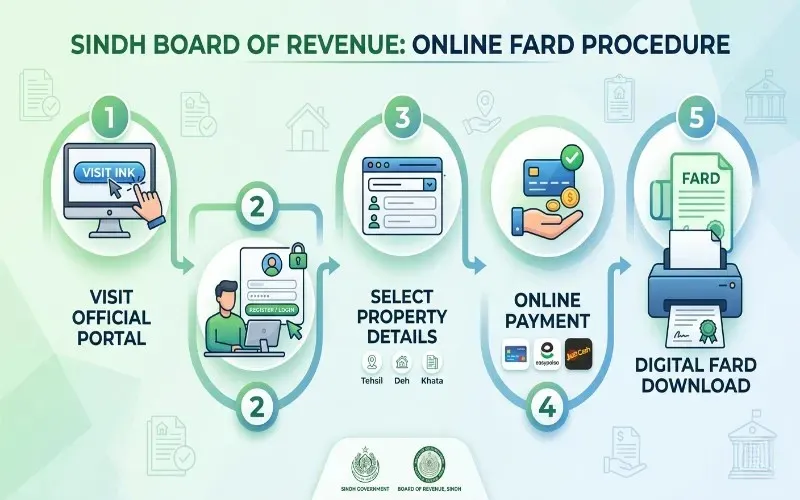

To obtain a fard online from the Sindh Board of Revenue, you need to visit the official Sindh land records portal, enter your plot or land details such as the district, tehsil, and survey number or khasra number, and download or print the digitally issued fard document. This can be done without visiting any revenue office, provided your land record has already been digitised in Sindh’s database.
What Is a Fard and Why You Need It
Before getting into the procedure, it helps to understand what you are actually requesting. A fard is an official extract from the land revenue record that shows who owns a piece of land, what rights exist on it, and how it is currently recorded in government registers. It is the most commonly used document in property transactions, loan applications, inheritance proceedings, and legal disputes.
Understanding what a fard means in revenue terminology helps you use it correctly once you have it. It is not a title deed on its own, but it is the most current snapshot of what the official revenue record says about your land at any given point in time.
The Sindh Board of Revenue and Its Digital Mandate
The Sindh Board of Revenue (SBoR) is the apex land revenue authority in the province. It oversees all land records, revenue collection, and administrative decisions related to land across all districts of Sindh. In recent years, SBoR has moved progressively toward digitising its records and offering online services to reduce the need for citizens to appear in person at revenue offices.
The functions of the Board of Revenue include supervising Patwaris, maintaining jamabandi registers, updating mutations, and issuing certified extracts of land records. The online fard service is an extension of these core responsibilities into the digital space.

Accessing the Sindh Land Records Portal
The primary online portal for land records in Sindh is operated under the Provincial Board of Revenue’s digital services initiative. The portal allows landowners and interested parties to search for records and request fard documents without physical presence.
To access the portal, you need a stable internet connection and the following basic information about the land:
- Province (Sindh)
- District (for example, Karachi, Hyderabad, Sukkur, Larkana, etc.)
- Tehsil or taluka name
- Mauza (village or locality) name
- Survey number, khasra number, or the owner’s name
Having this information ready before you open the portal saves time and prevents errors in the search.
Step-by-Step Online Fard Request Process
The process is straightforward once you know which fields to fill and what each means. Here is how it works from start to finish.
- Step 1 – Open the official SBoR land records portal Navigate to the Sindh Board of Revenue’s official land records website. Avoid using unofficial third-party aggregator sites that claim to offer fard downloads, as these may contain outdated or inaccurate records and are not legally valid documents.
- Step 2 – Select your location details Choose your district, tehsil, and mauza from the dropdown menus. These selections narrow the search to the correct revenue circle where your land is recorded.
- Step 3 – Enter the plot or khasra number Enter the khasra number associated with your land. In urban areas, a survey number or plot number from the original allotment scheme may be used instead. If you do not know the khasra number, you can search by owner name, though this may return multiple results if the name is common.
- Step 4 – View and verify the record The system will display the matching land record on screen. Before downloading, verify that the owner name, plot area, and location details match your actual property. Errors in digitised records do occur, and acting on an incorrect fard creates problems down the line.
Step 5 – Download or print the fard Once the record is confirmed, download the fard as a PDF or print it directly. Some portals issue a digitally stamped version that carries a unique verification code.
Types of Fard Available Online
Not all fard requests are the same. Depending on your purpose, you may need one of several different types of land record extracts from the SBoR database.
The most common type is the fard jamabandi, which is an extract from the jamabandi register showing ownership rights, cultivating rights, and encumbrances on the land. This is what most people mean when they say they need a fard.
Another important type is the fard badar, which is a specific extract showing changes or corrections made to the revenue record. Understanding what fard badar means in revenue records is useful when you are dealing with recently mutated or corrected land entries.
- Fard Jamabandi: ownership and rights snapshot from the current jamabandi
- Fard Badar: extracts relating to corrections or reversals in the revenue record
- Tatima or site plan extract: a sketch or map showing the plot within its surrounding land
- Intkal fard: a record of mutations and ownership changes over time
Verifying the Fard Is Authentic
A digitally issued fard from the SBoR portal carries a verification code or QR code in most updated versions. This allows any recipient to cross-check the document’s authenticity by re-entering the code on the portal.
If you receive a fard from someone else, such as a seller presenting it as proof of ownership, always verify it independently. Fraudulent or outdated fards are a real issue in Sindh’s property market. Knowing how to check land ownership in Pakistan through the official portal directly, rather than relying on a document handed to you, is a practical safeguard.
You can also cross-reference the fard against e-stamp and verification tools if the transaction involves registered documents, to ensure that both the stamp paper trail and the revenue record are consistent with each other.
What the Fard Does Not Tell You
The fard is a powerful document but it has limitations that are important to understand, especially before making a purchase decision.
A fard shows the current state of the revenue record. It does not show pending court orders, injunctions, or disputes that have not yet been formally reflected in the revenue entry. It also does not confirm the physical boundaries of the land or the accuracy of any measurements.
The register of rights goes deeper than the fard and shows encumbrances, mortgages, and historical claims on the land. For a complete picture before any transaction, reviewing both the fard and the register of rights together is the more thorough approach.
When the Record Is Not Available Online
Sindh’s digitisation of land records is still incomplete. Rural areas, interior Sindh districts, and some older urban schemes may not yet have their records available on the portal. In such cases, the traditional route through the Patwari and Mukhtiarkar remains necessary.
If your land record is not available online, the steps are:
- Visit the local revenue office (Patwar Khana) in your area
- Provide the plot details to the Patwari assigned to your mauza
- Request a manually issued certified fard with the official stamp and signature
- Pay the prescribed fee for the manual extract
Manual fards are still legally valid but carry a higher risk of clerical error. Discrepancies between manual records and digitised versions should be flagged and corrected through the mutation process rather than ignored.
Common Errors Found in Online Fard Records
Digitisation has introduced a recurring set of errors worth checking whenever you download an online fard. Name spelling variations are the most frequent problem, particularly where Urdu names were transliterated inconsistently during data entry. Even a minor spelling difference can cause complications during property sales or inheritance proceedings.
Area measurements sometimes differ from the physical plot size when older kanal-marla records were converted to square feet during entry. Understanding the difference between jamabandi and khasra girdawari records helps identify which source the area figure came from and whether a field re-measurement is needed.
Other common issues include mutation entries appearing under the wrong mauza, ownership still listed under a deceased person because inheritance mutation was never completed, and mortgages showing as active after they were cleared. Leaving fraud or manual errors in property records unaddressed compounds over time and becomes significantly harder to fix once the land changes hands.
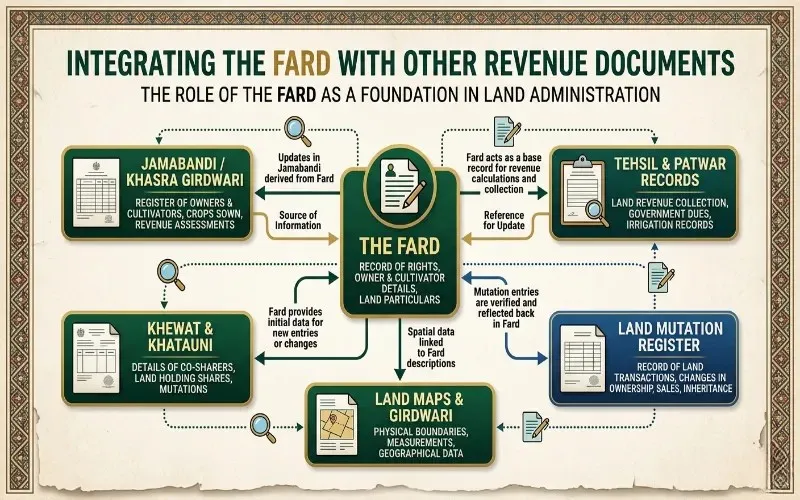
Linking the Fard to Other Revenue Documents
The fard does not stand alone. The difference between jamabandi and intkal matters because a fard shows current ownership rights while the intkal shows how those rights transferred over time. If you need to trace ownership history, the intkal record is needed alongside the fard.
For any transaction, pairing the fard with a confirmed mutation history gives you the most complete and legally defensible picture of the land’s status.
Frequently Asked Questions
Is an online fard from the SBoR portal legally valid
Yes. A digitally issued fard from the official Sindh Board of Revenue portal is legally valid and accepted by courts, banks, and government agencies. It carries the same evidentiary weight as a manually issued fard, provided it is issued through the official channel and carries the digital verification code.
Can I use the online fard for a bank loan or mortgage
Yes, most banks accept an online fard as part of property verification for home loans or commercial financing. Banks typically require a fard that is recent, usually not older than thirty to sixty days, to confirm it reflects the current record. Always obtain a fresh fard at the time of applying.
What if the name on the fard is different from my CNIC
This is a common digitisation issue. If the name spelling does not match your CNIC, apply for a correction at your local revenue office with your CNIC, old fard copies, and an affidavit as supporting documents. The correction is processed administratively through the Patwari and revenue hierarchy.
How often is the online fard record updated
Records update after each mutation is formally entered and approved. Once sanctioned, new ownership details should appear within a reasonable processing period. If your mutation was recently completed but the old owner still shows on the fard, wait a few days and check again before approaching the office.
Can a fard be used as proof of ownership in court
A fard is treated as evidence of the revenue record’s state, not as conclusive proof of title. Courts consider it alongside registered deeds, mutation orders, and inheritance documents. A fard alone is generally insufficient to establish title in a contested case.
What is the fee for obtaining a fard online
The online fard service carries a nominal fee paid electronically during the request. The exact amount varies by extract type and is revised periodically. Manually obtained fards from the revenue office carry a small fixed fee per page as set by the provincial government.