
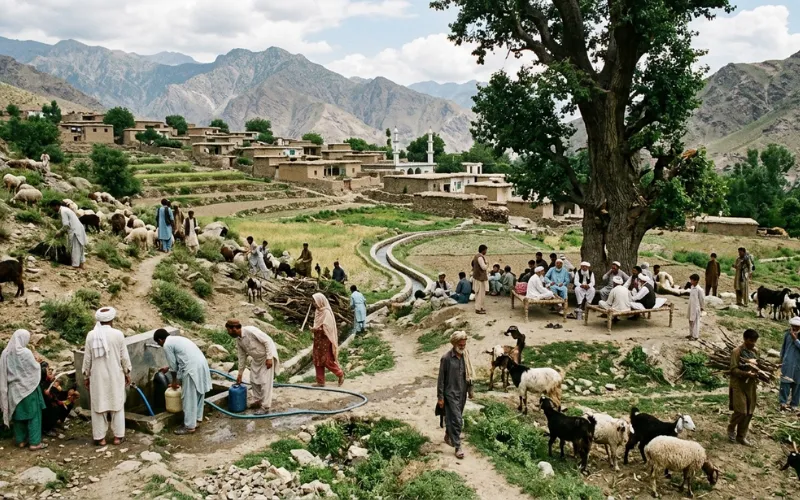

Shamilat, also written as Shamlat, is the common land of a village revenue estate that belongs collectively to all persons recorded as owners in the proprietary body of that village. In KPK, Shamilat land includes grazing grounds, forests, pastures, graveyards, village roads, ponds, and wasteland. Each village landowner has a proportional share in the Shamilat corresponding to their private landholding, but no one co-sharer can claim exclusive possession of any specific part of the Shamilat without a formal partition. In the merged districts of former FATA, much of the Shamilat remains collectively held by tribes, lacks official records, and is the subject of ongoing violent disputes that have claimed lives as recently as the past few years.
Shamilat land is one of the most misunderstood categories in KPK’s land system because it sits between private ownership and government land, belonging fully to neither. It is not ownerless. It is not freely transferable. It cannot be sold by one co-owner or by a group of co-owners without the consent of all. And in KPK’s tribal districts, where formal settlement records were either absent or contested, Shamilat claims have become the focal point of some of the province’s most serious land conflicts.
What Shamilat Land Is and Where It Comes From
The concept of Shamilat Deh, which translates most accurately as community or common land, originated from the land settlement operations conducted under British colonial administration. At the time of settlement, when revenue officers measured and recorded all land in a village estate, certain areas were designated as shared community resources rather than private holdings. These typically included the lands surrounding the settled cultivated areas of the village that were used collectively by all its landowners.
The categories of land recorded as Shamilat in KPK include:
- Grazing grounds (mera) where livestock from the village graze collectively
- Common forests and woodlands used for firewood and timber
- Village roads, pathways, and water channels serving multiple landowners
- Graveyards and other religious sites
- Village ponds and irrigation-related common land
- Wasteland not yet cultivated but held in common for potential future use
As the Gondalgroup analysis confirms, by 1901 the Shamilat system had extended across British India including what is now KPK, distinguishing between Ala Maliks (higher ownership holders) who had the right to bring Shamilat wasteland under cultivation, and Adna Maliks (lower ownership holders) who had more limited Shamilat rights. Malik Qabza holders, who had been transferred rights only to specific land parcels without a share of the Shamilat, were a further distinct category.
The Josh and Mak legal terminology resource confirms that Shamilat in the official record is the common land where shares are calculated based on the amount of land revenue paid, the area of land owned, or the shares indicated in the Shajra Nasab genealogical tree. It is recorded under a collective Khewat in the Jamabandi rather than under individual private Khewats.
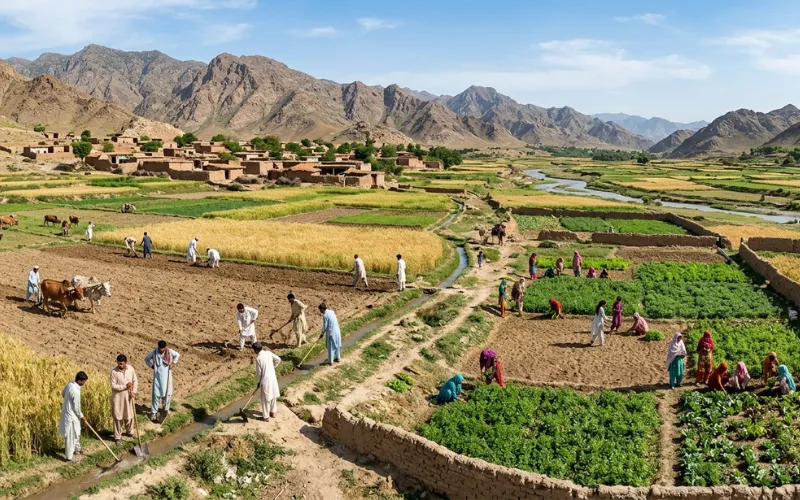
Who Has Rights in Shamilat Land
The Supreme Court of Pakistan and the Peshawar High Court have established through repeated judgments the fundamental legal principles governing who has rights in Shamilat land and what those rights are.
Every person recorded in the proprietary body of the village is entitled to Shamilat land to the extent of their respective proprietary holding in the village. This proportionality principle means that a landowner with a larger private holding has a correspondingly larger share in the Shamilat, and a smaller landowner has a smaller share, but neither can claim more than their proportional entitlement.
Exclusive possession of any specific portion of the Shamilat can only be claimed through a formal partition of the entire Shamilat property, not otherwise. This principle, established in Firdos Khan v. Zain Muhammad (2011 MLD 521), prevents any one co-sharer from simply occupying a piece of Shamilat and treating it as private property. Such occupation without partition is encroachment, regardless of the occupier’s entitlement to a share.
The Municipal Committee Chakwal case (2006 SCMR 688) established that Shamilat Deh land belongs to the occupants of the village, and no external authority, whether a municipal committee, a government body, or a private party, has any right to use it except for the specific purposes for which it was reserved in the record. This principle protects Shamilat from government encroachment as well as private encroachment.
What Cannot Be Done with Shamilat Land
The restrictions on Shamilat transactions are among the most important practical points for anyone dealing with this category of land. Courts have repeatedly clarified what cannot be done without proper partition and consent.
Shamilat property cannot be alienated by agreement to sell, affidavit, or a compromise deed. This means that a co-sharer who sells their Shamilat share through an informal agreement, affidavit, or settlement document has not completed a legally valid transfer. A civil court cannot even issue a declaration of ownership over a portion of unpartitioned Shamilat because the transfer through such instruments cannot be recognized as equivalent to a formal sale deed. The case of Aurangzeb Jahangiri v. Tehsil Municipal Administration Mansehra (2023 CLC 320) reaffirmed this principle most recently.
A share in village common property cannot be transferred without permission of the concerned revenue authority, because possession of a share can only be regulated through partition by metes and bounds. This means that even a willing buyer and a willing seller cannot complete a Shamilat share transfer without going through the formal partition and revenue authority approval process.
The benefit of Section 53-A of the Transfer of Property Act 1882 (part performance) also cannot be extended to a party in respect of unpartitioned Shamilat Deh. This is significant because Section 53-A is often used by buyers who have paid but not yet received formal title. In Shamilat cases, even that protection is unavailable without proper partition.
Types of Shamilat in the Revenue Record
The revenue record in KPK recognizes three distinct types of Shamilat, as noted in Josh and Mak’s legal terminology reference. The first is common Shamilat that belongs collectively to all Khewatdars of the village in proportion to their holdings. The second is Shamilat that is reserved for specific purposes, such as a graveyard, mosque site, or village road, where the use is restricted to that designated purpose regardless of who the co-owners are. The third is Shamilat that has been partially or wholly brought under cultivation by specific co-owners through reclamation, where the cultivating Ala Maliks have established superior claims over that portion while the overall Shamilat structure remains.
The Khasra Girdawari records, which document cultivation and land use status, are particularly relevant for Shamilat because they reflect whether any portion of the Shamilat has been cultivated, by whom, and for how long. This cultivation record can be evidence in disputes about whether a reclamation has created specific rights over a portion of the Shamilat.
The 1975 Notification and Its Impact on KPK Shamilat
A specific development that affected Shamilat status in KPK was a 1975 government notification, referenced in the Chitral Today analysis of unsettled landforms, which declared certain categories of unsettled Shamilat as property of the provincial government of Khyber Pakhtunkhwa. This notification had the practical effect of removing some land from the Shamilat classification and converting it to state property.
The result is that what was historically de facto Shamilat, land used communally by village populations for pasture, seasonal grazing, or other collective purposes, was declared government property without formal settlement. In Chitral and other mountainous districts of KPK, this created a significant conflict between statutory state ownership and the de facto communal use that local populations continued to exercise based on long-standing traditional rights.
This issue is particularly acute in Chitral, where approximately 62 percent of the landmass consists of pasture with sparse vegetation that has historically served as Shamilat for livestock farming communities. The formal state claim over this land as government property following the 1975 notification has not displaced the traditional communal use patterns, creating a situation where legal title and practical reality are in conflict.
Shamilat in the Merged Districts of Former FATA
The most complex and currently most disputed Shamilat situation in KPK is in the Newly Merged Districts, which were formerly FATA. Land in the seven former FATA districts was frequently owned collectively by tribes, and this tribal collective ownership functioned as a form of Shamilat even where it was not formally recorded in a revenue settlement. The problem is that formal land records simply did not exist for much of FATA. The former FATA has an area of approximately 27,220 square kilometres with a population of over five million, but there is no official land record publicly available for most of it.
Radio Free Europe’s Gandhara reporting and the Land Portal analysis of the merged districts document in detail how this absence of formal records has generated violent conflict. Disputes over Shamilat boundaries between Pashtun tribes and clans have caused fatalities in multiple districts. The Sherjan Kallay and Sago Kallay clashes in Kurram were over Shamilat land. The Karkanra dispute in South Waziristan involved Shamilat claims. As the researcher Hassan Turi noted, these Shamilat lands have forests and pastures that are precious resources for cattle farmers, and land close to towns, markets, or roads has dramatically increased in value since the 2018 merger, giving economic urgency to disputes that might previously have been managed through traditional means.
The merger in May 2018 extended KPK’s provincial laws including land laws to the merged districts, and in 2019 the government formally extended the land law framework. However, as the Land Portal analysis confirmed, a proper revenue department had not been established in the merged districts years after the merger. A pilot project successfully carried out in the Alamsher and Dingeela villages of Kurram district produced an online land record, but this remains exceptional rather than the norm. The practical result is that most Shamilat in the merged districts exists in a legal limbo: tribal collective ownership is recognized informally, formal settlement records are absent, and land laws have been extended but lack the institutional infrastructure to implement them.
How Shamilat Disputes Are Resolved
When a dispute arises over Shamilat, whether it is a co-owner claiming exclusive possession, an outsider encroaching on common land, or a government body using Shamilat without authority, the resolution pathways depend on the nature of the dispute.
For disputes between co-sharers over their respective Shamilat shares, the formal mechanism is a partition suit before the revenue court or civil court. If the Shamilat is to be divided, such right belongs to the proprietary body of the village. If the land sought to be partitioned is state land that has been treated as Shamilat, the Provincial Government has the authority to allot it. The partition proceedings require all co-sharers to be formally notified and given the opportunity to appear.
For encroachment by any co-sharer who has taken exclusive possession of a Shamilat portion without partition, the other co-sharers can seek restoration of the Shamilat status through a civil suit. Courts have consistently held that exclusive occupation of Shamilat by one co-sharer is not permissible without a partition order, and have issued injunctions preventing such occupation from continuing.
For encroachment by external parties, including government bodies misusing Shamilat for non-designated purposes, the proprietary body of the village has standing to challenge the use in court. The Municipal Committee Chakwal case established that Shamilat Deh land belongs to the village occupants and municipal committees cannot use it except for the purposes for which it was reserved.
For disputes in the merged districts where no formal records exist, the jirga system of tribal dispute resolution has historically been the primary mechanism. With the extension of formal courts to the merged districts after 2018, the pathway to judicial resolution now exists in theory, but tribal communities remain skeptical about whether formal courts can serve their interests as effectively as jirga resolution. This coexistence of formal legal mechanisms and informal tribal processes is itself a source of uncertainty in Shamilat disputes in these areas.
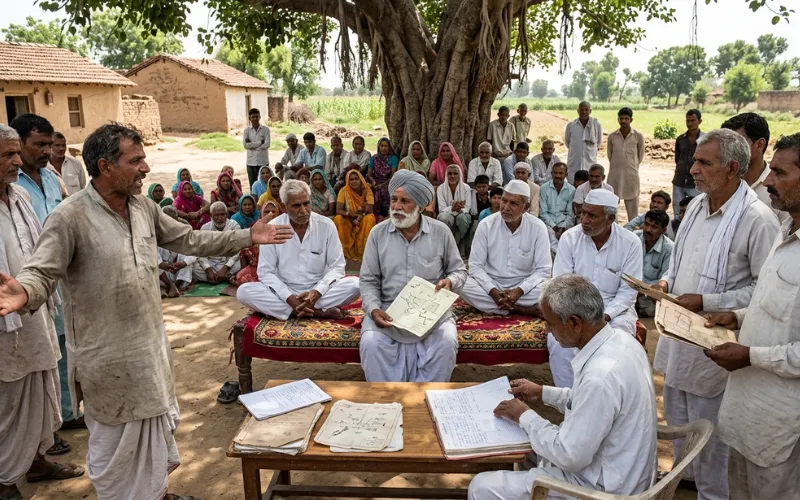
Protecting Your Shamilat Rights
For a landowner in KPK who has a right to a share in the village Shamilat but believes that right is being undermined, there are specific practical steps to take. First, confirm that your name is correctly recorded in the proprietary body of the Register of Rights under the relevant Khewat for the Shamilat. Your Shamilat share cannot be protected or enforced if it is not recorded in the revenue document.
Second, if another co-sharer is occupying a specific portion of the Shamilat exclusively, approach the revenue officer with a complaint. The revenue officer has authority to note the encroachment and refer the matter for formal partition proceedings if appropriate.
Third, if a government body or municipal authority is using Shamilat land for purposes not designated in the record, the matter can be raised before the relevant court. The Supreme Court judgment in Municipal Committee Chakwal established that this kind of misuse is legally challengeable.
Fourth, for landowners in the merged districts, document any traditional use patterns, community acknowledgments of boundaries, and historical practices that establish your community’s or tribe’s claim to specific Shamilat areas. In the absence of formal settlement records, evidence of traditional use and communal recognition is the foundational basis of any legal argument for Shamilat rights.
Understanding the difference between residential and agricultural land in Pakistan is also relevant to Shamilat because Abadi Deh, the residential settlement area, and Shamilat Deh are distinct categories within the same village estate, with different ownership rules. Land that appears to be in or adjacent to the residential area of a village may actually be recorded as Shamilat, which would affect any construction or private use that someone attempts to make of it.
Frequently Asked Questions
What is Shamilat land and who owns it?
Shamilat or Shamilat Deh is the common land of a village revenue estate that belongs collectively to all persons recorded as landowners in that village. Each co-owner has a proportional share corresponding to their private landholding. It is not government land and not private land. It is communally owned by the village’s proprietary body and is typically used for grazing, forests, roads, graveyards, and other shared purposes.
Can a Shamilat co-sharer sell their share to an outsider?
Not freely. A share in Shamilat cannot be transferred without permission of the concerned revenue authority, and transfer through informal instruments such as affidavits or agreement-to-sell documents is not legally valid. Even with revenue authority approval, the transfer must follow a formal process, and exclusive possession of any specific portion cannot be granted without a full partition of the Shamilat by metes and bounds.
Can someone claim exclusive ownership of part of the Shamilat?
No co-sharer can claim exclusive possession of any specific portion of unpartitioned Shamilat regardless of the size of their share. Exclusive possession can only result from a formal partition of the entire Shamilat through the revenue court process, with all co-sharers notified and given the opportunity to participate.
What happens when a government body uses Shamilat land?
Municipal committees, government departments, and other public authorities do not have the right to use Shamilat land except for the specific purposes for which it was designated in the revenue record. The Supreme Court established in Municipal Committee Chakwal v. Ch. Fateh Khan (2006 SCMR 688) that Shamilat belongs to the village occupants and cannot be used by external authorities outside its designated purpose.
Why is Shamilat particularly contested in the merged districts of former FATA?
In the former FATA, much of the Shamilat is tribally owned and lacks formal settlement records. After the 2018 merger with KPK, land values increased significantly, and the absence of official records has created competing claims between tribal groups and between tribes and the government. Violent disputes over Shamilat boundaries have resulted in deaths in several merged districts, including Kurram, South Waziristan, and Mohmand. A formal revenue department and land record system have not yet been fully established in most merged districts, making resolution through formal legal channels difficult.