
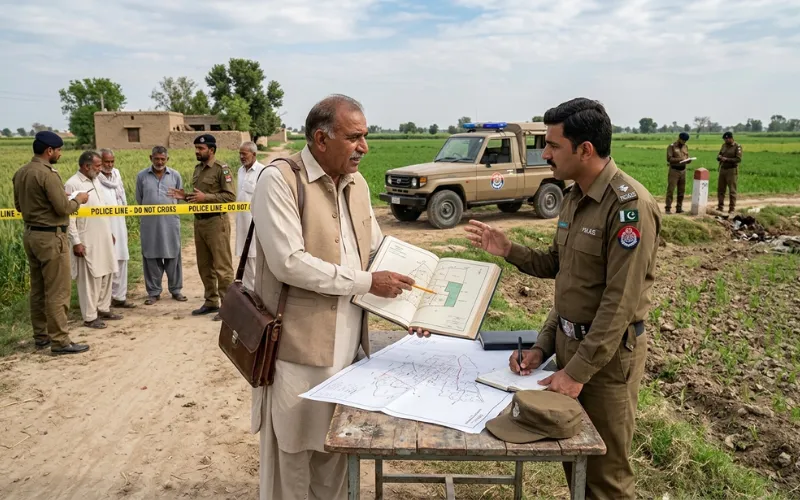

The Patwari plays a crucial supporting role in criminal matters and police investigations in Pakistan, especially in cases related to land, property disputes, and local verification. As the custodian of village land records, the Patwari provides essential documentation and on-ground insights that help law enforcement agencies establish facts.
General Principle: Limited but Mandatory Cooperation
A Patwari is not an investigating officer, but he is legally bound to:
- Assist police authorities when lawfully required
- Provide land-related facts and records
- Help clarify jurisdiction, possession, and boundaries
At the same time, the Patwari must avoid unnecessary involvement that could delay justice or cause harassment. This balance reflects the reality that many criminal cases in Pakistan involve land disputes, boundary conflicts, or possession-related violence, where the Patwari’s knowledge of local landholdings becomes crucial evidence. However, excessive reliance on Patwari testimony can create opportunities for manipulation or delay, particularly if the Patwari has personal connections to parties involved in the criminal matter.

When a Patwari Must Assist Police Investigations
A Patwari is required to assist police when land records, ownership verification, or site details are relevant to a case. Their support is typically requested through proper legal or administrative channels.
1. No Routine Summoning in Ordinary Cases
As a general rule:
- A Patwari should not be summoned during routine police investigations
- Police inquiries must proceed without unnecessary dependence on Patwari attendance
This rule exists to prevent disruption of land-revenue duties. Patwaris are responsible for maintaining Jamabandi records, conducting Khasra Girdawari inspections, and processing mutations,all time-sensitive tasks that affect thousands of landowners. If Patwaris are routinely called away for minor police matters, the entire land revenue system suffers delays.
In practice, many criminal complaints filed at police stations involve property-related allegations, but most of these can be investigated using existing land records without requiring the Patwari’s physical presence. Police should first examine available documents before determining whether Patwari assistance is genuinely necessary.
2. Assistance in Serious Criminal Cases
In serious offences, especially those involving:
- Murder
- Culpable homicide
- Land-related crimes
- Boundary disputes linked to criminal acts
The police officer in charge (with approval of the District Superintendent of Police / ایس پی) may seek assistance from the Patwari only if genuinely necessary.
In such cases, the Patwari may be required to:
- Clarify land location
- Identify ownership or possession
- Explain boundary demarcations
- Assist in preparing factual notes
The requirement for SP-level approval serves as an administrative check, ensuring that Patwari involvement is limited to cases where land-related facts are genuinely material to the investigation. This prevents lower-level police officers from routinely summoning Patwaris for convenience or due to personal relationships, which was a common problem historically.
When serious crimes occur on agricultural land,such as murders arising from irrigation disputes or honor killings related to property inheritance,the Patwari’s testimony about who legally possesses which land parcel, what boundaries existed at the time of the incident, and whether any recent inheritance transfers occurred can be crucial for establishing motive, opportunity, and context.
Limits on Patwari’s Role in Criminal Investigations
A Patwari’s role in criminal investigations is limited to providing accurate land records and factual information when requested by authorities. They do not have investigative powers and cannot influence the outcome of police inquiries or legal proceedings.
No Evidence Fabrication or Delay
The Patwari must:
- Provide information promptly
- Avoid unnecessary delays
- Not influence witness statements
- Not fabricate or alter records
Once factual assistance is provided, the Patwari must not remain involved in the investigation. This separation is critical because Patwaris, as permanent local officials, may face pressure from influential landowners, political figures, or criminal elements to shape testimony in ways that favor particular parties. The rule requiring prompt information provision followed by immediate withdrawal from the investigation reduces opportunities for such pressure to be applied.
Historical cases show that when Patwaris become too deeply involved in criminal proceedings, they risk becoming targets themselves,either for intimidation if they provide truthful evidence against powerful interests, or for accusations of bias if their testimony favors one party over another.
Jurisdiction and Land Identification Support
The Patwari operates within a defined jurisdiction (halqa), ensuring accurate land record management and verification within that area. Their role is crucial in supporting authorities with precise land identification during legal and administrative matters.
Identifying Land Boundaries
If a criminal incident occurs on land:
The Patwari may help identify:
- Exact location
- Khasra number
- Ownership details
- Revenue boundaries
However, final investigative authority remains with the police. The Patwari’s role is limited to providing objective, record-based information. For example, if a murder occurs in a field, the Patwari can confirm which khasra number covers that location and who is recorded as the owner or cultivator, but cannot offer opinions about who had actual control of the field or whether ownership was disputed.
This limitation prevents the Patwari from becoming an unofficial investigator whose personal observations or opinions might carry undue weight simply because of his official position. Police must independently verify possession and control through their own investigation, using the Patwari’s record-based information as one evidentiary source among many.
Preparation of Official Notes and Reports
When assistance is required, the Patwari may:
- Prepare written notes
- Reference official land records
- Submit clarifications through proper channels
He must not submit opinions, only factual data. This distinction between facts and opinions is particularly important in Pakistan’s legal system, where documented evidence carries significant weight. A Patwari’s written note confirming that “according to Jamabandi, Khasra Number 123 is recorded in the name of Person X” is admissible and valuable evidence. A note stating “in my opinion, Person X has been in actual possession of this land” would be improper because it ventures beyond the Patwari’s documentary authority into matters requiring investigation and witness examination.
Protection Against Unlawful Pressure
If a Patwari is:
- Pressured unnecessarily
- Asked to remain present without reason
- Forced to assist beyond legal scope
Such conduct is considered administratively improper and may be reported to senior revenue authorities. This reporting mechanism is essential because Patwaris, as relatively junior officials, may lack the institutional power to resist demands from senior police officers or influential local figures. By establishing clear rules and providing avenues for reporting violations, the revenue administration protects Patwaris from being drawn into improper involvement in criminal matters.
In practice, Patwaris who are repeatedly summoned unnecessarily can file complaints with the Tehsildar or Qanungo, who then have authority to communicate with police supervisors about proper procedures for seeking Patwari assistance.
Section 3.18 – Jurisdictional Authority of the Patwari
The Patwari’s jurisdictional authority is clearly defined to manage land records, oversee revenue collection, and assist in resolving local disputes. This ensures accountability and proper administration within their designated area. Their role is essential for maintaining accurate records that serve as legal evidence in various administrative and judicial matters.
Legal Foundation of Authority
Under Revenue Law No. 45, the Patwari’s authority is limited to:
- His assigned circle
- His designated jurisdiction
He cannot exercise authority outside his circle unless lawfully directed. This jurisdictional limitation is important in criminal cases because it prevents police from “forum shopping”,seeking out Patwaris from other areas who might provide more favorable testimony. If a crime occurs in one Patwari circle, only that circle’s Patwari has official knowledge of the relevant land records and is authorized to provide information.
No Independent Policing Powers
A Patwari:
- Cannot arrest anyone
- Cannot conduct searches
- Cannot interrogate suspects
His role remains administrative and documentary only. This clear limitation prevents situations where Patwaris might attempt to use their knowledge of local affairs to act as informal law enforcement agents. Despite their detailed knowledge of village disputes and family conflicts, Patwaris must not cross the line into policing activities, which require separate legal authority, training, and accountability mechanisms.
Importance of These Rules
These safeguards exist to:
- Prevent abuse of authority
- Protect citizens from harassment
- Maintain separation between revenue and police powers
- Ensure accurate land-related evidence in criminal cases
The separation of revenue administration from police powers reflects a fundamental principle of administrative law: specialized officials should not be given overlapping authorities that could lead to confusion, abuse, or inefficiency. By keeping the Patwari’s role clearly defined and limited, the system protects both the integrity of land records and the fairness of criminal investigations.
When these boundaries are respected, criminal investigations benefit from reliable documentary evidence about land matters without being delayed or corrupted by excessive Patwari involvement. Conversely, when these rules are ignored and Patwaris become too deeply involved in criminal cases, both land administration and criminal justice suffer.
Conclusion
The Patwari plays a supportive but limited role in criminal investigations. While cooperation with police is legally required in serious and land-related cases, strict boundaries exist to prevent misuse. Understanding these limits protects both public rights and administrative integrity within Pakistan’s land revenue system.
The balance struck by these rules,mandatory cooperation when genuinely necessary, but strict limits on scope and duration,ensures that the Patwari can contribute valuable local knowledge and documentary evidence to criminal investigations without being transformed into an investigative officer or subjected to improper pressure. This careful delineation of roles serves justice while protecting the primary function of land revenue administration.
