
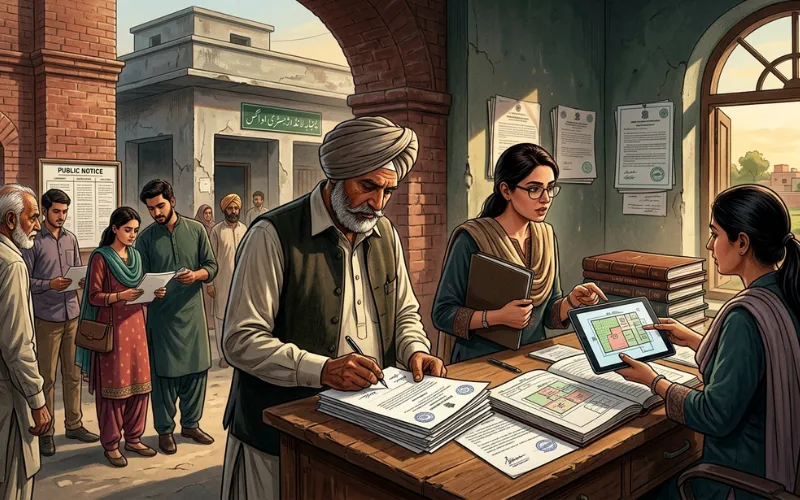

The Punjab Land Revenue (Amendment) Ordinance 2026 digitizes land transfers, restricts patwari authority to inheritance matters only, mandates e-registration for all property transactions, and introduces legal procedures for land demarcation and eviction of illegal occupants across Punjab, Pakistan.
Punjab’s land administration has long been entangled with delays, record manipulation, and unchecked patwari influence. On February 17, 2026, Governor Punjab Sardar Saleem Haider Khan promulgated the Punjab Land Revenue (Amendment) Ordinance, fundamentally reshaping how property transfers, mutations, and disputes are handled across the province. For anyone who owns land, plans to buy property, or has a pending inheritance matter, understanding this ordinance is not optional, it is essential.
What Triggered This Ordinance
The Punjab government did not introduce these changes in a vacuum. Decades of fraudulent land transfers, manipulation of revenue records, and the notorious “patwari culture” created a system where genuine owners were routinely vulnerable. Illegal occupations dragged through courts for years without resolution, and property buyers had little certainty about what they were actually purchasing.
This ordinance is part of a paired legislative push. It was promulgated alongside the Protection of Ownership of Immovable Property (Amendment) Ordinance 2026, and together the two laws are designed to close the gaps that made Punjab’s land system one of the most dispute-prone in the country.
The End of Manual Land Transfers
Perhaps the single most impactful change in this ordinance is the mandatory shift to digital. Every land transfer in Punjab, whether a sale, gift, partition, or any other form, must now go through an e-registration system. This is not optional, and there is no offline alternative. All land transfers have been made fully digital, eliminating the informal back-channel dealings that once allowed manipulation at the revenue office level.
This shift benefits ordinary citizens in a direct and practical way:
- Buyers can verify that a transfer has actually been completed in the system, not just on paper
- Sellers cannot quietly reverse a registered transfer without a formal legal process
- Third parties who may have fraudulent claims can no longer intercept a transaction at the patwari level
- Overseas Pakistanis can monitor property transactions with greater confidence, knowing the process is no longer dependent on physical presence alone
Patwari Powers Are Now Officially Limited
One of the most significant structural shifts in this law is the restriction placed on patwaris. Under the Punjab Land Revenue (Amendment) Ordinance 2026, a patwari is authorized to process only hereditary transfers, meaning wirasti inteqal. All other categories of land transfer, including sale mutations, gift mutations, partition mutations, and court decree mutations, have been removed from the patwari’s jurisdiction.
This matters enormously because the duties of a patwari in the traditional system gave them enormous practical power over whether a transfer happened smoothly or got stuck indefinitely. That leverage was routinely exploited for corruption. By legally restricting the patwari’s role to inheritance-only mutations, the ordinance removes a critical point of abuse.
Electronic Summons and Digital Notices
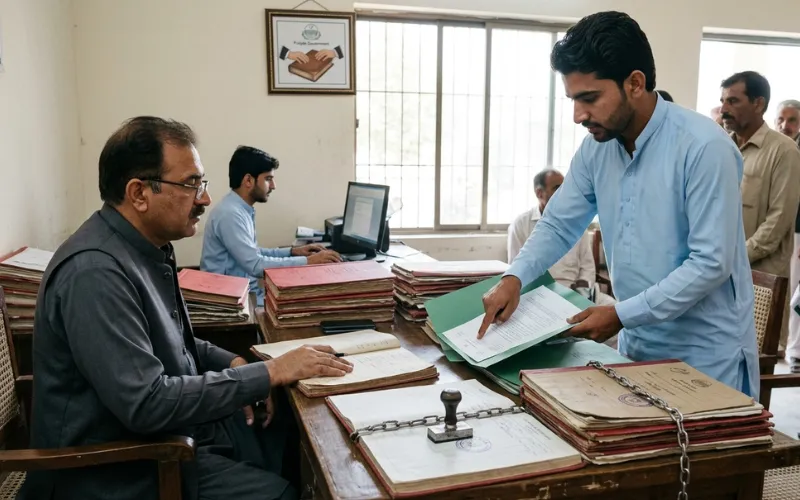
Anyone who has dealt with revenue courts in Pakistan knows how notice issuance was often weaponized. A party could claim they never received a summons, causing indefinite delays. The ordinance addresses this directly by establishing a formal legal procedure for issuing summons, notices, and public announcements through electronic and digital means.
This reform matters for several reasons:
- It removes the excuse of non-receipt in revenue proceedings
- It creates a verifiable trail for every notice sent
- It speeds up the overall timeline of land-related legal proceedings
- It reduces the cost and friction involved in participating in revenue court processes
The impact will be felt most acutely in contested matters where parties previously used procedural delays as a deliberate strategy.
Land Partition Now Requires Physical Possession Transfer
Under the amended law, land partition is now linked directly to transfer of possession. This is a reform that addresses one of the most persistent problems in Punjab’s land disputes: “paper partitions” where a property would be legally divided on record but one party would continue to occupy the entire land without consequence.
The new requirement means that partition must now be accompanied by actual, physical transfer of possession. Mesne profit provisions are also included, ensuring that a party wrongfully occupying land after a legal partition can be held financially accountable for that occupation.
This change is particularly relevant for families going through property division among heirs, where disputes over physical possession have historically been as common as disputes over the paper division itself.
Board of Revenue Gets Exclusive Remand Authority
Another structural reform worth noting is the concentration of remand authority. Under the ordinance, only the Board of Revenue now has the authority to remit cases to lower courts. Previously, this power was distributed more broadly, which allowed for inconsistent decisions and procedural manipulation at lower levels of the revenue hierarchy.
Concentrating this authority at the Board of Revenue level brings greater uniformity and reduces the chances of a case being bounced between courts indefinitely. The functions of the Board of Revenue in the revised framework carry considerably more institutional weight than before.
Legal Framework for Demarcation and Eviction
For years, there was no clear, formalized legal procedure specifically for land demarcation and the eviction of illegal occupants through the revenue system. This created a vacuum where boundary disputes and encroachment cases either escalated into civil litigation or stalled indefinitely at the revenue stage.
The Punjab Land Revenue (Amendment) Ordinance 2026 fills this gap by establishing a defined legal procedure for demarcation of lands and eviction of illegal possessors. This is a critical tool for landowners facing encroachment who previously had limited options short of filing a full civil suit.
What the Companion Ordinance Adds
While the land revenue ordinance handles the administrative and procedural side, the Protection of Ownership of Immovable Property (Amendment) Ordinance 2026 deals with enforcement and criminal consequences. Understanding both is necessary for a complete picture.
The companion ordinance replaces the previous Dispute Resolution Committee with a more empowered Scrutiny Committee. This committee now includes the Deputy Commissioner, District Police Officer, Additional Deputy Commissioner Revenue, Assistant Commissioner, Sub-Divisional Police Officer, Circle Revenue Officer, and the Officer-in-Charge of the relevant police station. The expanded membership gives the committee greater investigative and enforcement reach.
Key enforcement timelines and penalties under the companion ordinance:
- The tribunal must forward a complaint to the Scrutiny Committee within 3 days
- The Scrutiny Committee must submit its report within 30 days
- The tribunal must issue a final decision within 30 days of receiving that report
- Illegal possession now carries imprisonment of 5 to 10 years and a fine of up to Rs10 million, or both
- Filing a false complaint can result in imprisonment of up to 5 years and a fine of Rs500,000
Serving Additional Sessions Judges now sit on the tribunal as members, replacing the previous practice of appointing retired High Court and Sessions Court judges. This shift is intended to make the process faster and institutionally more robust.
What This Means for You Practically
Whether you are a landowner, a buyer, an heir, or someone managing property on behalf of family, the ordinance changes what you should expect and what steps you should take. The types of mutations in Punjab are now legally segregated, with only inheritance mutations remaining in the patwari’s hands. Every other mutation must follow the digital e-registration pathway.
Here is what these reforms mean in practical terms:
- If you are buying property, demand confirmation that the transfer is being processed digitally through the e-registration system
- If you are an heir, understand that a partition on paper alone is no longer sufficient, physical possession transfer is now a legal requirement
- If your land is encroached upon, the new demarcation and eviction procedures give you a formal revenue-based path to resolution
- If you receive a notice in a land matter, electronic receipt is now legally valid, you cannot dismiss it as undelivered
The land mutation process in Punjab is undergoing its most significant transformation in decades. These changes require every property owner to update their understanding of how transactions are completed, how disputes are filed, and what legal tools are now available to protect ownership.
Reforms in the Appeals and Review Process
Beyond the frontline changes, the ordinance also introduces reforms in the appeals and review process. While specific procedural details of the appellate reform are being implemented through rules, the intent is to streamline how decisions made at the lower revenue level are challenged and reviewed, reducing the number of escalation points and the time spent at each stage.
This appeals reform, combined with the exclusive remand authority now vested in the Board of Revenue, creates a more structured and predictable pathway for resolving disputes that cannot be settled at the field level.

Frequently Asked Questions
What is the Punjab Land Revenue Amendment Ordinance 2026?
It is a provincial ordinance promulgated by the Punjab Governor on February 17, 2026, that amends the Punjab Land Revenue system to mandate digital land transfers through e-registration, restrict patwari authority to inheritance-only mutations, establish electronic summons and notice procedures, formalize land demarcation and eviction processes, and reform the appeals system.
What can a patwari do under the new ordinance?
Under the Punjab Land Revenue (Amendment) Ordinance 2026, a patwari is only authorized to process hereditary transfers, that is, wirasti inteqal. All other categories of mutation, including sale, gift, partition, court decree, and exchange mutations, must be processed through the new digital e-registration system without patwari involvement.
Is e-registration mandatory for all property transfers in Punjab?
Yes. The ordinance mandates that all land transfers in Punjab be processed through the e-registration system. There is no provision for manual or offline processing of non-hereditary transfers under the new law.
What happens if someone illegally occupies your land under the new law?
Under the companion Protection of Ownership of Immovable Property (Amendment) Ordinance 2026, illegal possession of property carries imprisonment ranging from 5 to 10 years and a fine of up to Rs10 million, or both. The case is filed before a tribunal of serving judges, and a decision must be issued within 30 days of the Scrutiny Committee’s report.
Does land partition now require physical handover of the property?
Yes. One of the core reforms in the ordinance is that land partition must now be accompanied by an actual transfer of physical possession. A paper-only partition is no longer legally sufficient. Mesne profit provisions also mean that a party wrongfully occupying land after a lawful partition can be held financially liable for that continued occupation.
Who has the authority to remand cases to lower courts under the new law?
The Punjab Land Revenue (Amendment) Ordinance 2026 vests this authority exclusively in the Board of Revenue. No lower revenue authority has the power to remand cases to subordinate courts under the revised legal framework.