
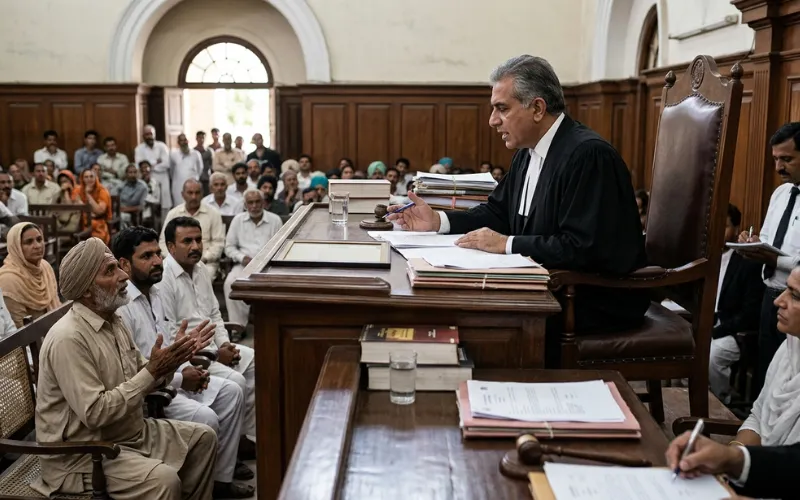

Under the Punjab Protection of Ownership of Immovable Property (Amendment) Ordinance 2026, serving Additional Sessions Judges presiding over Punjab Property Tribunals have the power to issue interim protective orders, determine questions of property title, sentence illegal occupants to 5 to 10 years imprisonment, impose fines of up to Rs10 million, award monetary compensation to rightful owners, try connected offences in a single case, declare property transfers null and void, and punish false complainants. Bail for any accused arrested under this law can only be granted by the Lahore High Court, not by the tribunal itself.
For decades, the most important decisions in Punjab’s land dispute system were made by bureaucrats and administrative officers. The 2026 Amendment Ordinance changed that fundamentally. It transferred decision-making authority from executive committees to serving judges of the sessions court, creating a judicial forum at the district level with powers broad enough to address every dimension of a property dispute in a single proceeding.
Why Serving Judges and Not Retired Ones
The original Punjab Protection of Ownership of Immovable Property Ordinance 2025 assigned tribunal membership to retired judges of the Lahore High Court or retired District and Sessions Judges. The Lahore High Court suspended that law in December 2025, raising concerns about due process and the appropriateness of the framework.
When the 2026 Amendment Ordinance was drafted in response, the Punjab government, in consultation with the Chief Justice of the Lahore High Court, replaced retired judges with serving Additional Sessions Judges. The Advocate General Punjab specifically informed the LHC bench during proceedings that judicial powers had been taken back from the executive and transferred to the tribunals, and that serving Additional District and Sessions Judges, rather than retired ones, would now be appointed. This distinction matters for several reasons that go beyond formality.
A serving judge remains within the active judicial hierarchy. They are subject to the administrative authority of the Chief Justice, accountable to the High Court, and their decisions carry the institutional weight of an active court of sessions. Their appointments are made by the Punjab government in consultation with the Chief Justice of the Lahore High Court, ensuring judicial oversight over who sits on these tribunals from the outset. A retired judge, by contrast, operates outside that ongoing accountability structure.
Exclusive Jurisdiction Over Title and Offences
The Punjab Property Tribunal presided over by a serving Additional Sessions Judge has exclusive jurisdiction over two categories of matters: questions of property title and offences under the ordinance. No other court operates parallel to it on these issues. Civil courts cannot be approached for the same relief if a matter is already before the tribunal. The only forums that sit above or outside this jurisdiction are the Federal Constitutional Court, the Supreme Court of Pakistan, and the Lahore High Court.
This exclusivity is significant in practice. Before this law, a complainant might pursue an eviction through a civil court, a mutation challenge through the revenue hierarchy, and a criminal complaint through an FIR simultaneously, with each track moving at its own unpredictable pace. The tribunal consolidates all of this into a single judicial forum. The judge resolves the question of who legally owns the property and also sentences the person who illegally occupied it, in the same proceeding.

Power to Issue Interim Protective Orders
A serving judge on the Punjab Property Tribunal is not required to wait for the Scrutiny Committee’s report or for the full hearing before taking action to protect a property. The ordinance explicitly empowers the tribunal to issue interim orders at any stage of the proceedings to regulate possession of the disputed property.
These interim orders can include:
- Sealing the disputed property to prevent any physical interference while the case proceeds
- Prohibiting the accused from carrying out construction, demolition, or any modification to the property
- Requiring the accused to post a surety bond as a condition of maintaining the status quo
- Regulating who may access or occupy the property during the pendency of the case
These protective powers previously rested with the Deputy Commissioner under the old executive committee system. The 2026 Amendment transferred them entirely to the tribunal. This means a serving judge, not a bureaucrat, now decides whether your property gets sealed or protected on an emergency basis. Crucially, interim orders issued by the tribunal are not separately appealable to the Lahore High Court. Only the final judgment is appealable, which prevents the accused from using interlocutory appeals as a delay tactic.
Power to Declare Property Transfers Null and Void
Once a complaint is filed before the tribunal, any sale, lease, gift, mortgage, or other form of alienation of the disputed property is automatically null and void under the ordinance. However, the tribunal also has the specific power to permit a transfer if circumstances warrant it. This is an active judicial power, not just a passive legal presumption.
In practice, this means that if a party claims they need to complete a legitimate transaction on the disputed property while the case is pending, they must obtain the tribunal’s explicit permission. Without it, no notary, registrar, or revenue official can process the transfer. The property registry system and the e-registration framework are both bound by this prohibition. A judge’s authorization is the only mechanism through which that prohibition can be lifted during live proceedings.
Power to Try Connected Offences in a Single Case
One of the specific powers added in the 2026 Amendment that was not present in the old framework is the tribunal’s authority to hear connected offences in the same trial. Property occupation through fraud rarely involves just one person committing just one act. It often involves forged documents, conspiracy among multiple people, fabricated mutation entries, and sometimes corruption of revenue officials.
Under the previous system, these connected criminal acts would have required separate proceedings in different forums. The tribunal can now try all of these related offences together. This consolidation serves both efficiency and justice: a single judge understands the full picture of how the illegal occupation was arranged and can sentence all involved parties based on their specific roles, rather than having the scheme fragmented across multiple proceedings where none of the individual courts sees the complete chain of events.
This power also reinforces the ordinance’s expanded definition of accused, which covers individuals, companies, corporations, partnerships, societies, trusts, and religious institutions. A tribunal can prosecute the organization and the individuals within it who arranged the illegal occupation in a single consolidated hearing.
Power to Impose Criminal Sentences
The serving judge on the Punjab Property Tribunal has full criminal sentencing authority within the penalty ranges set by the ordinance. For direct illegal possession through fraud, force, forgery, or misrepresentation, the judge can impose:
- A minimum of 5 years and a maximum of 10 years rigorous imprisonment
- A fine of up to Rs10 million
- Both imprisonment and fine simultaneously
For those who attempt, abet, or conspire in illegal occupation without physically occupying the property, the judge can impose 1 to 3 years imprisonment and a fine of up to Rs1 million. For anyone found to have filed a false, frivolous, or vexatious complaint, the judge has the power to impose imprisonment of up to 5 years and a fine of up to Rs500,000 on the complainant.
These are criminal court sentences, not civil awards. They are enforceable immediately on pronouncement and carry the same legal standing as any sessions court conviction. The land dispute being resolved through this tribunal is treated as a criminal matter from the beginning, not a civil dispute that might eventually acquire criminal dimensions.
Power to Award Monetary Compensation
Beyond criminal penalties, the serving judge has the authority to award monetary compensation to the lawful owner. The ordinance sets a floor for this compensation: the amount cannot be less than the officially notified value of the disputed property at the time of the judgment. There is no ceiling specified, meaning the judge can award more based on the facts of the case.
The tribunal can additionally order recovery of profits earned by the illegal occupant during the period of illegal possession. If a qabza group has been collecting rent from tenants on your land for three years while your case was in the system, the judge can compel them to surrender those rental earnings to you. This profit recovery mechanism transforms the financial consequence of illegal occupation from a flat penalty into something that actively restores the owner’s economic position.
This compensation power gives the tribunal a civil restitution function alongside its criminal sentencing function, making it genuinely dual-jurisdictional in a way that no previous forum in Punjab’s land dispute system had been.
Day-to-Day Proceedings and the Adjournment Cap
The ordinance specifically requires that tribunal proceedings be conducted on a day-to-day basis. Adjournments are not prohibited but are capped at a maximum of 7 days at a time. This procedural constraint is a direct judicial instruction from the legislature, binding on the serving judge.
The practical effect is that once a case is listed for hearing before the tribunal, it cannot be indefinitely deferred through serial adjournment requests, which was one of the primary methods organized land grabbers used to outlast property owners in traditional courts. A 7-day maximum adjournment combined with a 30-day decision deadline from receipt of the Scrutiny Committee’s report creates a hearing schedule that must stay on track.
Understanding how revenue courts traditionally operated in Punjab makes the significance of this constraint clear. Cases that could sit dormant for months between hearings are no longer legally possible under this framework.
Bail Authority Rests Exclusively with the Lahore High Court
One of the most operationally significant powers assigned by the ordinance is actually one the tribunal does not have: the power to grant bail. Any person arrested in connection with an offence under the ordinance cannot be granted bail by the tribunal or any sessions court. Bail can only be granted by the Lahore High Court.
This single provision has substantial deterrent value. In ordinary criminal cases, an accused can approach a sessions court for bail relatively quickly after arrest. Under the POIP framework, the only path to bail is through the High Court, requiring proper High Court proceedings and creating a much higher practical bar for release. An organized land grabber who would normally secure bail within days through local court connections now faces the prospect of remaining in custody unless the LHC is satisfied that bail is warranted.
This design also reinforces the seriousness with which the ordinance treats illegal land occupation. It signals clearly that this is not a category of offense where judicial discretion at the district level is considered sufficient for release decisions.
The Appellate Structure Above the Tribunal
A serving judge’s final decision is not the last word, but the appellate path is narrow and time-bound. Appeals against final tribunal judgments lie only before the Lahore High Court, and must be filed within 30 days of the decision. There is no intermediate appellate forum. Interim orders, as noted, are not separately appealable at all.
The 30-day window is strict. Missing it would ordinarily bar the appeal entirely unless the High Court grants leave for a late filing on exceptional grounds. This timeline prevents the use of the appellate process as a delay mechanism and ensures that successful complainants can access the benefits of a tribunal order without waiting indefinitely for appellate proceedings to conclude.
For property owners who have already registered their land mutation and have their title clearly documented, a favorable tribunal decision followed by a failed appeal before the LHC is the final resolution of their case. The illegal occupant would have exhausted every available legal challenge at that point.
What This Means for Property Owners Going to the Tribunal
The concentration of these powers in a serving Additional Sessions Judge changes what a property owner can realistically expect from the tribunal process. You are going before a judge with the authority to protect your property immediately through interim orders, investigate the occupation through the Scrutiny Committee, try everyone involved in the illegal occupation in a single hearing, sentence them to prison, fine them up to Rs10 million, and order them to pay you compensation at minimum equal to the property’s notified value plus any profits they collected from it.
That breadth of judicial power in a single forum is something that previously required multiple simultaneous proceedings across civil courts, revenue courts, and criminal courts, each moving at a different pace. Making sure your ownership documents and property records are clean, current, and consistent before approaching the tribunal remains the foundation of a strong case regardless of how powerful the forum is.

Frequently Asked Questions
Who are the serving judges in Punjab Property Tribunals and how are they appointed?
Punjab Property Tribunals are presided over by serving Additional Sessions Judges. They are appointed by the Punjab government in consultation with the Chief Justice of the Lahore High Court. Each tribunal operates at the district level, with jurisdiction over its respective district. These judges remain part of the active judicial hierarchy and are accountable to the High Court through the normal judicial administration structure.
What is the difference between the powers of a serving judge and the old retired judge system?
Under the 2025 Ordinance, tribunals were headed by retired Lahore High Court judges or retired District Judges. The 2026 Amendment replaced them with serving Additional Sessions Judges. Beyond the composition change, the powers of the tribunal were significantly expanded. The serving judge can now try connected offences in a single case, issue interim orders that were previously given to the Deputy Commissioner, award property-value compensation to owners, and operate within a strict 30-day decision timeline.
Can a serving judge grant bail to someone arrested under the POIP Ordinance?
No. The ordinance explicitly reserves bail authority for the Lahore High Court only. A person arrested under the ordinance cannot be granted bail by the tribunal, the sessions court, or any subordinate court. They must approach the Lahore High Court directly for bail. This is one of the most significant deterrent provisions in the law.
What kind of compensation can a serving judge award to a property owner?
The tribunal can award monetary compensation to the lawful owner at a minimum equal to the officially notified value of the disputed property. In addition, the judge can order recovery of any profits the illegal occupant earned during the period of illegal possession, such as rent collected from tenants. There is no specified ceiling on the total compensation amount.
Can a serving judge seal a property before the case is decided?
Yes. The tribunal has the authority to issue interim orders at any stage of the proceedings, including sealing the property to prevent physical interference. These interim orders can be issued before the Scrutiny Committee submits its report and before the final hearing. Importantly, interim orders are not separately appealable to the Lahore High Court, which prevents the accused from using interlocutory appeals to delay protective measures.
Can the tribunal handle multiple accused persons and related offences in one case?
Yes. One of the specific powers added in the 2026 Amendment is the tribunal’s authority to hear connected offences in the same trial. If multiple people were involved in arranging an illegal occupation, including the occupant, document forgers, intermediaries, and anyone who abetted the crime, the serving judge can try all of them together in a single case rather than requiring separate proceedings for each person.