
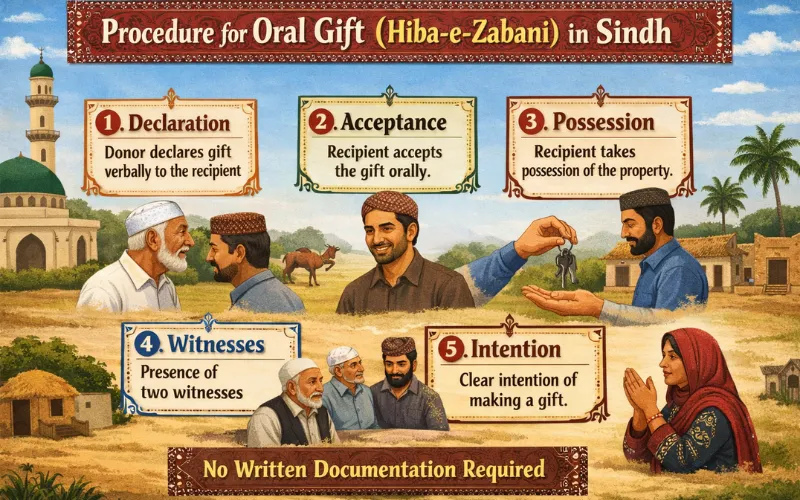

An oral gift of property is legally valid in Pakistan under Islamic law without any written document, provided three conditions are met: the donor declares the gift, the one accepts it, and possession is transferred. In Sindh, once these three elements exist, the gift is complete as a matter of Islamic jurisprudence. However, for the gift to be recognized in the official land record and protected against future disputes, it must be documented through a mutation at the local revenue office.
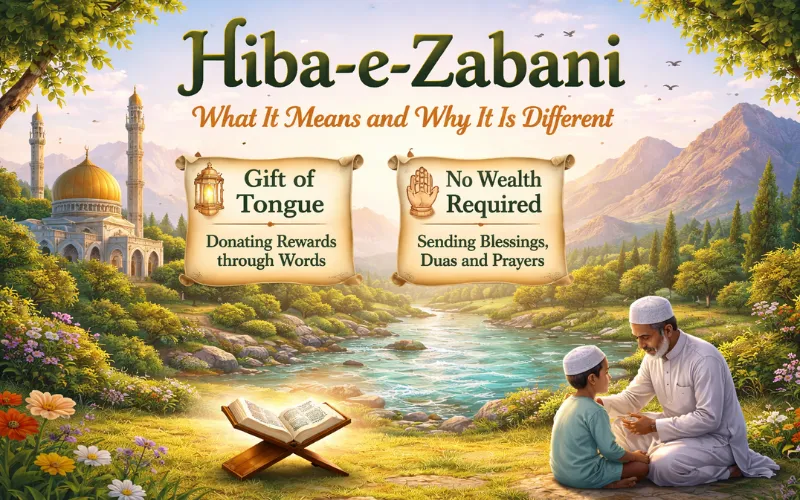
What Hiba-e-Zabani Means and Why It Is Different
Hiba is the Arabic term for gift in Islamic law. Hiba-e-Zabani means an oral gift, one made without any written deed. Pakistani courts, following Islamic personal law, have consistently held that a Hiba is valid without documentation provided the three essential conditions are satisfied. This distinguishes it from a contractual gift under general property law, which typically requires a written instrument.
The practical reality in Sindh, however, is that a legally valid oral gift becomes extremely difficult to prove and enforce without documentary evidence. Once the donor dies or disputes arise, an undocumented gift is contested by other heirs who were not present at the time of the declaration. This is why converting a Hiba-e-Zabani into a recorded mutation is not a legal requirement but an urgent practical necessity for anyone who has received or given an oral gift of land.
The Three Essential Conditions of a Valid Hiba
Before initiating any documentation process, it is important to confirm that the oral gift satisfies the conditions that make it legally valid under Islamic law. A mutation filed for a gift that does not meet these conditions can be challenged and set aside.
The three conditions are distinct and all three must be present for the gift to be complete:
- Declaration (Ijab): The donor must clearly express the intention to gift the property. A vague statement of intent or a conditional promise does not constitute a valid declaration.
- Acceptance (Qabool): The donee must explicitly accept the gift. Acceptance can be verbal or through conduct, but it must be unambiguous.
- Delivery of Possession (Qabza): The donor must deliver actual physical possession of the gifted property to the donee. For agricultural land, this means the donee must begin cultivating it or exercising control over it. For a house, it means the donee must move in or take the keys.
The delivery of possession is the element most frequently disputed in Sindh’s revenue courts. If a donor declares a gift and the donee accepts but the donor continues to live on or use the land as before, courts may find that possession was never truly transferred, which invalidates the gift. Evidence of actual possession transfer is therefore central to any Hiba case.
Why Documentation Matters Even for a Valid Oral Gift
A gift that is valid under Islamic law can still be defeated in practice if it is not formally recorded. When the donor dies, other heirs may claim the gifted property as part of the estate, arguing that no gift was ever made or that the conditions were not fully met. Without a mutation order, a court decree, or any written record, the donee has little beyond witness testimony to rely on.
Fraud and manual errors in property records are among the leading causes of land disputes in Pakistan, and undocumented gifts create exactly the kind of gap in the record that others can exploit. Filing a mutation as soon as an oral gift is made, while the donor is still alive and able to confirm the gift, is the most reliable way to protect the donee’s interest.
How to File a Gift Mutation for Hiba-e-Zabani in Sindh
The mutation process for a Hiba-e-Zabani follows the same procedural route as other gift mutations, with the additional requirement of establishing that the gift was oral rather than documented through a written deed. The gift deed mutation process in Pakistan covers the broader framework, and the steps below reflect how that process applies specifically to oral gifts in Sindh.
- Step 1: Approach the Patwari Halqa Office Visit the Patwari responsible for the Deh where the land is located. Bring the survey number, Deh name, Taluka, and district details along with the CNICs of both the donor and the donor.
- Step 2: Submit the Mutation Application File a mutation application stating that a gift was made verbally, the date the gift was made, the identity of the donor and donee, the relationship between them, and confirmation that all three conditions of Hiba have been satisfied. The application must be signed by the donor and the donee.
- Step 3: Produce Two Witnesses Because the gift was oral, witnesses are essential to establishing that it occurred. Bring at least two adult witnesses who were present when the declaration, acceptance, and possession transfer took place. The Patwari will record their statements as part of the mutation inquiry.
- Step 4: Revenue Officer Inquiry The Patwari forwards the mutation application to the revenue officer, who conducts an inquiry. The revenue officer will call both the donor and donee to appear, question the witnesses, and verify from the field record whether actual possession has been transferred. If the inquiry is satisfied, the revenue officer sanctions the mutation.
- Step 5: Mutation Sanction and Record Update Once sanctioned, the donee’s name is entered into the ownership register in place of the donor’s name. The donee can then request a Fard in their own name from the Patwari to confirm the transfer is reflected in the official record.
Documents to Bring to the Revenue Office
Preparation before visiting the Patwari prevents unnecessary return trips and speeds up the inquiry. The following documents should be ready before filing:
- CNICs of the donor and donee
- CNICs of the two witnesses
- Details of the gifted land: survey number, Hissa number, Deh, Taluka, and district
- Most recent Card or any document confirming the donor’s ownership of the land
- Any corroborating evidence of possession transfer, such as utility bill transfers, cultivation records, or photographs
No written gift deed is legally required for Hiba-e-Zabani, but if any written note, text message, or other record of the gift exists, producing it can significantly strengthen the mutation application.
What Happens When the Oral Gift Is Contested
Not all Hiba-e-Zabani mutations proceed smoothly. Other heirs, particularly siblings or children of the donor who feel their inheritance share is being reduced, may object during the revenue officer’s inquiry or after the mutation is sanctioned.
During the inquiry stage, any objection by an interested party results in the revenue officer recording both sides and conducting a more detailed field inquiry. If the evidence supports the gift, the mutation is sanctioned despite the objection. If the evidence is inconclusive or strongly disputed, the revenue officer may decline to sanction the mutation and direct the parties to the civil court for a declaration.
After sanction, a dissatisfied party can challenge the mutation before the relevant revenue authority within the limitation period, or file a civil suit seeking cancellation of the mutation. Revenue courts in Pakistan hear challenges to mutations and can set them aside if the original conditions of the gift are found to have not been met.
A gift mutation that is challenged by other heirs also intersects with property distribution after death in Islam, because if the donor dies before the mutation is finalized or sanctioned, the gifted property may be treated as part of the estate unless the gift can be independently established as complete during the donor’s lifetime.
Conditions Under Which a Hiba Can Be Revoked
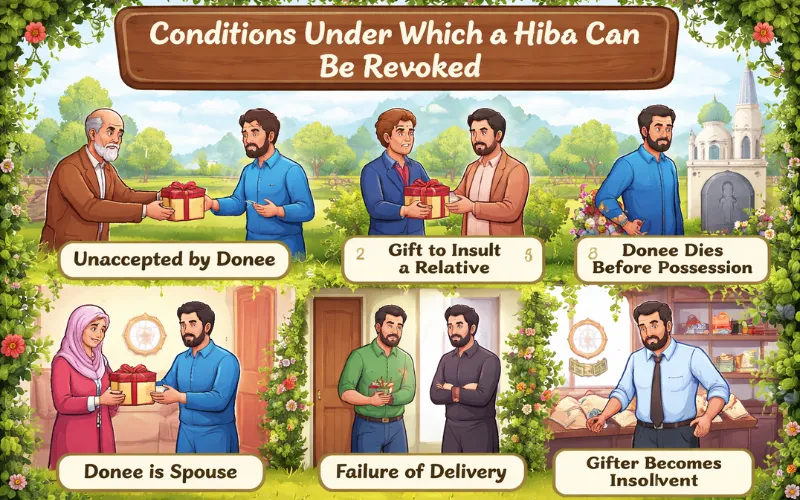
Under most schools of Islamic jurisprudence recognized in Pakistan, a gift once complete and accepted cannot be revoked without the donee’s consent, except in specific circumstances. A gift from a parent to a child can be revoked during the parent’s lifetime under certain conditions. A gift made under undue influence, coercion, or when the donor lacked legal capacity can be challenged.
If a Hiba-e-Zabani mutation has already been processed and the donor later claims to revoke the gift, the donee can resist that revocation if the gift was freely and validly made. The matter becomes a legal dispute for the revenue court or civil court to resolve, not something the Patwari can handle administratively.
Protecting the mutation record immediately after it is sanctioned is therefore important. Obtaining a certified Fard document in the donee’s name as soon as the mutation is processed creates an official record that is much harder to undo through informal pressure or later claims.
Special Consideration for Gifts to Minor Children
A common use of Hiba-e-Zabani in Sindh is a parent gifting agricultural land to a minor child. Islamic law recognizes gifts to minors as valid, but the condition of acceptance and possession transfer must be handled through the minor’s guardian, typically the other parent or a court-appointed guardian.
The guardian accepts the gift on behalf of the minor and takes possession in a representative capacity. The mutation application should clearly state that the donee is a minor, that the guardian is accepting on their behalf, and identify the guardian’s CNIC and relationship to the child.
When dividing land among heirs later, a gift made to a minor during the donor’s lifetime may be counted as an advance on that heir’s share, or may be treated as a separate gift outside the estate, depending on the donor’s stated intention at the time. Stating that intention clearly during the mutation inquiry, and having it recorded, prevents ambiguity after the donor’s death.
Protecting the Gift Against Future Claims
Once the mutation is sanctioned and the Fard is updated, the donee should take several additional steps to secure their position. Paying property tax and any land revenue dues in their own name establishes a further record of ownership. Cultivating or maintaining the land openly and continuously strengthens the possession record against any future challenge.
If the land was also the subject of any previous transaction or encumbrance, reviewing the full record through the register of rights in land revenue confirms that the gifted plot is free of any liabilities that might complicate the donee’s ownership going forward.
Frequently Asked Questions
Is an oral gift of land legally valid in Sindh without a written document
Yes. Under Islamic law as applied in Pakistan, an oral gift of property is legally valid without any written document provided three conditions are satisfied: the donor makes a clear declaration of the gift, the donee accepts it, and the donor transfers actual physical possession of the property to the donee. Pakistani courts have consistently upheld valid oral gifts as legally binding. However, without documentation through a mutation at the revenue office, the gift becomes extremely difficult to prove and enforce if it is disputed after the donor’s death.
What are the three conditions that make a Hiba-e-Zabani valid in Pakistan
A Hiba-e-Zabani is legally valid in Pakistan when three conditions are present together. First, the donor must make a clear declaration of the intention to gift, known as Ijab. Second, the donee must explicitly accept the gift, known as Qabool. Third, the donor must deliver actual physical possession of the gifted property to the donee, known as Qabza. All three conditions must be present. A gift where possession was never actually transferred, even if declaration and acceptance occurred, is incomplete under Islamic law and can be set aside by a court.
How is a Hiba-e-Zabani mutation different from a regular gift mutation in Sindh
A regular gift mutation typically involves a written gift deed (Tamleek Nama or Hiba Nama) that is produced at the revenue office as documentary evidence of the gift. A Hiba-e-Zabani mutation has no written deed because the gift was made orally. The additional requirement is therefore witness testimony. At least two witnesses who were present when the declaration, acceptance, and possession transfer occurred must appear before the revenue officer during the mutation inquiry to confirm the gift took place. The revenue officer gives greater weight to this testimonial evidence in the absence of a written document.
Can other heirs challenge an oral gift mutation after it is sanctioned
Yes. Other heirs who feel their inheritance rights are being affected can challenge a sanctioned gift mutation in revenue court within the applicable limitation period, or file a civil suit for cancellation of the mutation. The challenge typically argues that one or more of the three conditions of a valid Hiba were not met, most commonly that actual possession was never transferred. If the donee can produce the revenue officer’s inquiry record, witness statements, evidence of possession such as cultivation records or utility transfers, and the sanctioned mutation order, their position in the dispute is significantly stronger than an undocumented gift would allow.
What happens if the donor of an oral gift dies before the mutation is processed
If the donor dies before the mutation is sanctioned, the legal position of the donee becomes more difficult but not necessarily lost. The donee must apply to the civil court for a declaration that the gift was validly made during the donor’s lifetime, satisfying all three conditions of Hiba. The court will examine witness testimony, circumstantial evidence of possession transfer, and any corroborating documents. If the court accepts the evidence, it issues a decree confirming the gift, and a court decree mutation can then be processed at the revenue office to transfer the land into the donee’s name.