
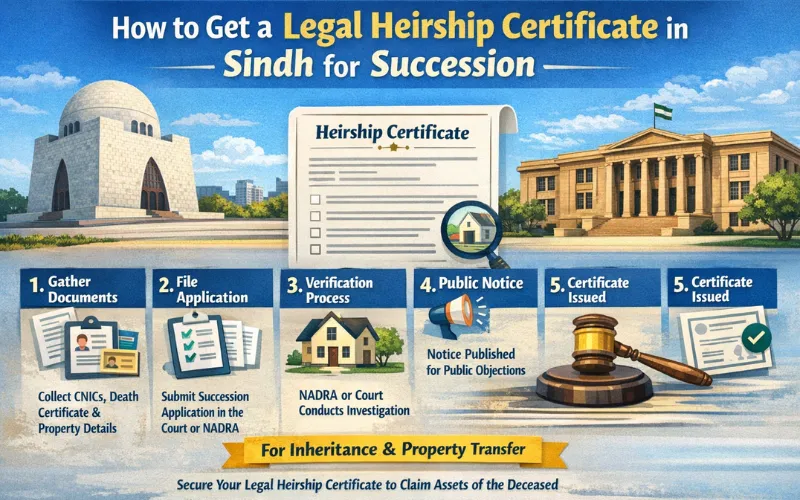

When a person passes away in Pakistan, their legal heirs do not automatically receive a government document confirming their status. That confirmation has to be applied for, and in Sindh the process involves specific courts, specific documents, and a specific sequence of steps that many families get wrong simply because they do not know what is required. A Legal Heirship Certificate, also referred to as a Succession Certificate in certain contexts, is one of the most important documents a family needs to settle an estate, transfer property, access bank accounts, and begin the process of distributing what was left behind.
What a Legal Heirship Certificate Actually Does
A Legal Heirship Certificate is an official document issued by a competent court or authorized government body that formally identifies the legal heirs of a deceased person and their respective shares in the estate. It confirms who has the legal standing to claim the deceased’s assets, including land, bank accounts, pension benefits, provident funds, and other movable and immovable property.
Without this certificate, the revenue department will not process an inheritance mutation transferring land from the deceased’s name into the heirs’ names. Banks will not release funds from the deceased’s accounts. Government departments will not transfer service benefits. In short, the estate remains legally frozen in the deceased’s name until the heirs can prove their status through this document.
It is worth understanding the distinction between a Heirship Certificate and a Succession Certificate in Pakistani law. A Succession Certificate is issued by a civil court under the Succession Act 1925 and specifically authorizes the holder to collect debts and securities owed to the deceased. A Heirship Certificate, also called a Legal Heir Certificate or Family Certificate, identifies who the heirs are but does not by itself grant authority over specific assets like negotiable instruments. For land transfer purposes in Sindh, the Heirship Certificate is typically the document required alongside other inheritance documentation.
Who Can Apply for a Legal Heirship Certificate in Sindh
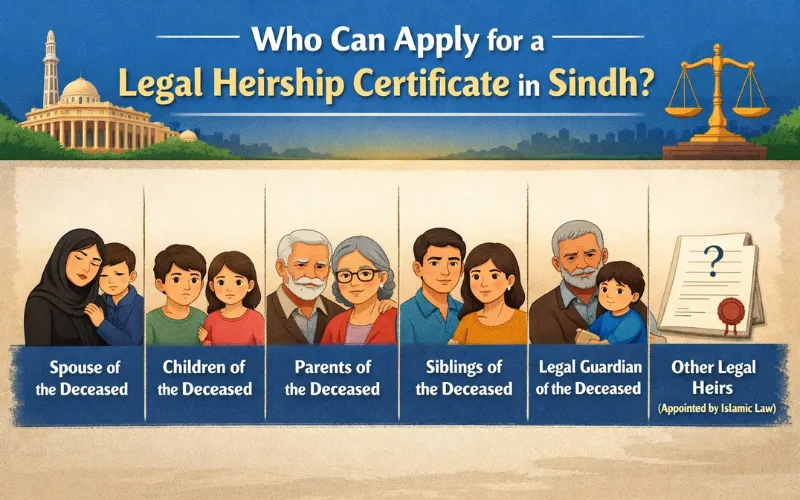
Any adult legal heir of the deceased can apply for this certificate. In most cases, the application is filed by one heir on behalf of all, with all other heirs named in the application and identified by their CNICs.
Pakistani law recognizes a defined set of compulsory heirs whose entitlements are fixed by Islamic inheritance law and cannot be set aside by any agreement among the living. Understanding who the compulsory heirs are under Pakistani law is essential before filing the application, because the certificate must accurately list every legal heir along with their correct fractional shares. Omitting an heir from the application, whether by mistake or deliberately, can invalidate the certificate and expose the applicants to legal liability.
For Shia families in Sindh, the distribution rules differ from Sunni Hanafi inheritance in several important ways. Families following Jafari fiqh should verify their specific entitlements before any certificate is prepared, since the shares assigned to heirs differ between the two legal frameworks under Pakistani family law.
Where to Apply in Sindh
In Sindh, a Legal Heirship Certificate can be obtained through two main routes depending on the nature of the assets involved and the level of formality required.
The first route is through the local Union Council or the relevant Municipal office. For straightforward cases involving a small estate, no disputes among heirs, and no need to claim debts or securities, many government departments in Sindh accept a Family Certificate issued by the Union Council. This is the faster and cheaper route and does not require a lawyer or court proceedings.
The second route is through the Civil Court having jurisdiction over the area where the deceased was domiciled. A court-issued Succession Certificate carries greater legal authority and is required for claiming bank accounts, insurance payouts, savings certificates, and similar financial assets. It is also the document required by some revenue offices when the estate is large or contested.
For land-specific inheritance in Sindh, the revenue department generally accepts a Family Certificate from the Union Council combined with a death certificate and CNIC copies of all heirs for the purpose of initiating an inheritance mutation. However, if any heir disputes the shares or if the mutation is contested, a court-issued certificate becomes necessary.
Documents Required for the Application
Having all documents ready before approaching either the Union Council or the court significantly speeds up the process. Missing a single document often results in the application being returned, adding unnecessary delay at an already difficult time for the family.
The following documents are generally required for both routes:
- Original death certificate of the deceased, issued by the relevant Nadra or Union Council
- Computerized National Identity Cards of all surviving legal heirs
- CNIC or B-Form of any minor heirs
- Marriage certificate of the deceased’s spouse, or Nikah Nama, to establish the spousal relationship
- Any previous Heirship or Family Certificate if one has already been issued in another province or district
- Affidavit from two witnesses confirming the family relationships stated in the application
- Copies of property documents or other asset documents if required by the specific office
For court applications specifically, you will also need a formal petition drafted by a lawyer and filed in the Civil Court of the district where the deceased was permanently resident. The court will require publication of a notice in a local newspaper giving third parties the opportunity to raise any objection before the certificate is issued.
The Union Council Route: Step by Step
The Union Council process is the most commonly used route for straightforward inheritance cases in Sindh, particularly for families seeking to initiate land mutation without court proceedings.
Step 1: Obtain the Death Certificate Before anything else, the death must be registered and a formal death certificate obtained from Nadra or the Union Council where the death occurred. No Heirship Certificate can be issued without this document.
Step 2: Prepare the Application The application lists the deceased’s full name, their CNIC number, date of death, permanent address, and the names, CNICs, and relationship to the deceased of every legal heir. The fractional shares of each heir should also be stated based on the applicable inheritance rules.
Step 3: Attach All Required Documents Compile the death certificate, CNIC copies of all heirs, Nikah Nama, and the affidavit from two witnesses. Some Union Councils also require a No Objection Certificate signed by all heirs confirming they agree on the identified list of heirs and their respective shares.
Step 4: Submit and Pay the Fee Submit the application at the Union Council office in the area where the deceased was domiciled. Pay the applicable fee, which is nominal, and collect the acknowledgment receipt.
Step 5: Collect the Certificate Processing time at the Union Council typically ranges from a few days to a few weeks depending on workload and whether the office requests any additional documents or verification. Once issued, the certificate carries the Union Council Chairman’s signature and official stamp.
The Civil Court Route: When and Why
A court-issued Succession Certificate is required when the estate includes financial instruments such as bank accounts, defence savings certificates, stock certificates, or insurance policies. Banks and financial institutions will not release these assets on the basis of a Union Council certificate alone.
The civil court process involves filing a petition in the court having jurisdiction over the deceased’s last domicile. The court issues notice in a local Urdu newspaper and sets a date for hearing. If no objections are raised within the notice period, the court proceeds to issue the certificate, typically within a few months. If an objection is filed by another claimant, the matter becomes a contested case and may take significantly longer to resolve.
The property distribution after death under Islamic law governs how shares are assigned to each heir in the petition. The court does not recalculate shares independently. It relies on the shares stated in the petition and may require the testimony of a witness familiar with the family relationships to confirm the list of heirs is complete and accurate.
Using the Certificate to Transfer Land in Sindh
Once you have the Heirship Certificate, it becomes the primary document supporting the inheritance mutation at the revenue office. The mutation, known as Intkal in Sindh’s revenue system, transfers the land from the deceased’s name in the record to the names of the heirs in their respective shares.
The process of land mutation in Pakistan requires filing a mutation application at the local Patwari Halqa office. Along with the Heirship Certificate, you will need the death certificate, CNIC copies of all heirs, and the details of the survey number and Deh where the land is located.
The Patwari records the mutation application and forwards it to the revenue officer for inquiry and sanction. After the mutation is sanctioned, the heirs’ names are entered into the ownership register in their respective shares, and each heir can then request a certified Fard in their own name. The difference between Jamabandi and Intkal clarifies how the mutation record and the Jamabandi ownership register interact after this process is complete.
Dividing the Estate After the Certificate Is Issued
A Heirship Certificate confirms who the heirs are and what shares they are entitled to, but it does not physically divide the estate. That step requires a separate process depending on whether the heirs agree to divide voluntarily or require a court order.
Where heirs agree on how to divide the land among themselves, a voluntary partition of land can be executed through a registered partition deed followed by individual mutations for each heir’s specific portion. Where agreement cannot be reached, any heir can file a suit for partition in the civil court or revenue court, and the court will order the land divided in accordance with the shares established in the Heirship Certificate.
For families with minor heirs, the guardian of the minor must represent their interests throughout both the Heirship Certificate process and the subsequent partition. No agreement that reduces a minor’s share below their legal entitlement is enforceable, and the court will scrutinize any such arrangement closely.

What to Do If an Heir Is Left Out or the Certificate Is Wrong
An Heirship Certificate that omits a legal heir, states incorrect shares, or misidentifies family relationships is a legally flawed document and can be challenged in court. If you discover that a certificate was issued without including you as a rightful heir, you can file a petition in the civil court seeking cancellation or correction of the certificate.
Acting quickly matters here. Once an inheritance mutation is processed based on a flawed certificate and land is transferred into other heirs’ names, correcting the record becomes a more complex process involving both the revenue department and the courts. Heirship versus ownership is a distinction that becomes practically important in exactly this situation, where legal heirship exists but the ownership record does not yet reflect it.
Frequently Asked Questions
What is a Legal Heirship Certificate in Sindh and who issues it
A Legal Heirship Certificate in Sindh is an official document that identifies the legal heirs of a deceased person and their respective shares in the estate under Pakistani inheritance law. It is issued either by the local Union Council for straightforward cases involving immovable property and administrative purposes, or by the Civil Court for cases involving financial instruments, disputed shares, or large estates. The certificate is required to initiate land mutation, access bank accounts, claim pension or provident fund benefits, and distribute any other assets of the deceased.
What is the difference between a Heirship Certificate and a Succession Certificate in Pakistan
A Heirship Certificate, also called a Legal Heir Certificate or Family Certificate, identifies who the legal heirs of a deceased person are and what shares they hold. It is typically issued by the Union Council and is used for land mutations and administrative asset transfers. A Succession Certificate is a court-issued document under the Succession Act 1925 that specifically authorizes the holder to collect debts, recover money, and deal with securities and negotiable instruments belonging to the deceased. Banks and financial institutions require the Succession Certificate to release funds, while the revenue department typically accepts the Heirship Certificate for land transfer purposes.
How long does it take to get a Legal Heirship Certificate in Sindh
Through the Union Council route, processing typically takes anywhere from a few days to a few weeks depending on the office’s workload and whether any additional documents are requested. Through the Civil Court route, the process generally takes several months because the court must issue public notice, allow time for objections, hold a hearing, and then issue the certificate. If the case is contested by another claimant, the court process can extend significantly longer. Having all required documents ready at the time of filing is the most effective way to avoid delays in either route.
Can all heirs be listed on one Heirship Certificate or does each heir need a separate one
A single Heirship Certificate lists all legal heirs together along with their respective shares. It is not issued separately to individual heirs. The certificate names every heir as a group, and all of them are bound by its contents. Individual heirs can then use the joint certificate to take further steps such as filing for mutation, opening joint accounts, or initiating partition proceedings. If an heir needs a certified copy of the certificate for their own use, they can obtain one from the issuing authority, but the document itself remains a collective instrument covering the entire group of heirs.
What happens if someone is excluded from the Heirship Certificate by mistake or deliberately
If a legal heir is excluded from the Heirship Certificate, whether by error or by another heir’s deliberate omission, the excluded heir has the right to challenge the certificate in the Civil Court. The court can cancel the incorrect certificate and order a fresh one to be issued with the correct list of heirs and accurate shares. If land has already been mutated based on the flawed certificate, the excluded heir can also seek correction of the mutation record through a revenue court proceeding. Acting promptly is important because delays in challenging an incorrect certificate can complicate the subsequent correction of the land record.