

If you own land in Sindh or are planning to buy property there, knowing how to access your land records online is one of the most practical skills you can have. The Sindh government has digitized its land administration through LARMIS – the Land Administration and Revenue Management Information System – making it possible to verify ownership, check record history, and avoid costly disputes without visiting a government office. This guide walks you through exactly how to use it, step by step.
What Is LARMIS and Why Does It Matter?
LARMIS (Land Administration and Revenue Management Information System) is Sindh’s official digital platform for land record management. Launched under the Board of Revenue Sindh, it is the province’s answer to Punjab’s PLRA and KPK’s land portals. The system stores digitized versions of traditional land documents like the Fard (ownership certificate), Jamabandi (record of rights), and mutation records, all accessible through an online interface.
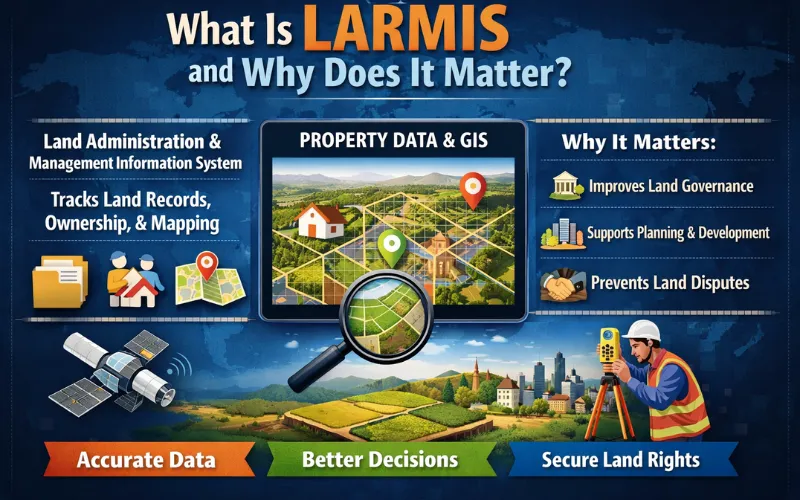
Before LARMIS, landowners in Sindh had to physically visit the local Patwari or revenue office to get any document verified. This created room for fraud and manual errors in property records, delays, and even corruption. The digital system reduces dependency on intermediaries and gives citizens direct access to their own data.
- Verify ownership before purchasing any property
- Download official Fard documents for legal use
- Check if any encumbrances, liabilities, or disputes are recorded
- Confirm mutation status after a property transfer
Search Land Records Sindh Online
The primary function of LARMIS is to let citizens search land records in Sindh online using basic identifiers like district, tehsil, village (deh), and survey number. You do not need a lawyer or an agent – just the basic details of the land.
Before you start searching, it helps to know what the key terms mean in Sindh’s revenue system:
- Survey Number – the unique plot identifier assigned during land settlement surveys. This is Sindh’s equivalent of the Khasra number used in Punjab. Understanding what a Khasra number means in land records helps you navigate both systems confidently.
- Deh – the revenue village within a taluka. Every land parcel in Sindh is located within a specific Deh.
- Taluka – the administrative subdivision equivalent to a Tehsil in Punjab.
- Hissa Number – the sub-division of a survey number when land is split among multiple owners, often through inheritance or partition.
Step-by-Step: How to Search Land Records in Sindh via LARMIS
Accessing LARMIS is straightforward once you have the basic land details in hand.
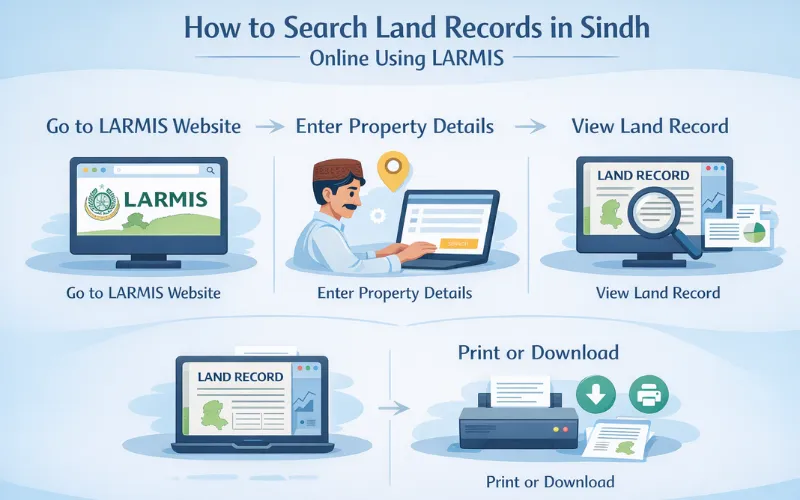
Step 1 – Visit the Official LARMIS Portal Go to the official Board of Revenue Sindh website or LARMIS portal at: sindhbor.gos.pk or the LARMIS-specific URL provided by your district revenue office. Make sure you are using the official government domain to avoid phishing sites.
Step 2 – Select Your District Sindh has 30 districts. Choose the one where your land is located – for example, Karachi, Hyderabad, Sukkur, Larkana, or Mirpurkhas.
Step 3 – Enter Taluka and Deh After selecting the district, you will be prompted to select the Taluka and then the Deh (revenue village). These are hierarchical filters that narrow down your search area.
- If you don’t know your Deh name, check your old property documents or ask the local Patwari’s office
- Some portals allow partial name searches
Step 4 – Enter the Survey Number or Owner Name Input either the Survey Number (and Hissa Number if applicable) or the owner’s name. Survey Number-based searches are more accurate. Name-based searches may return multiple results if the name is common.
Step 5 – View and Download Your Fard Once the record appears on screen, you can view the details and, in most cases, download or print the Fard – the official record of rights in land revenue that confirms ownership and any associated liabilities.
What Information Does LARMIS Show?
Understanding what the system actually displays helps you interpret the results accurately. A standard LARMIS record includes:
Ownership Details – the name(s) of the current legal owner(s) and their share (expressed as a fraction like 1/2 or 1/4 for jointly held property). This is important when dividing land between families through inheritance.
Mutation History – a log of all past transfers, sales, gifts, and inheritance changes. Every time ownership changed, a mutation (intkal) was recorded. Reviewing this history helps you spot gaps or suspicious transfers. If you want to understand the difference between registry and mutation of property, this section makes it very clear in practice.
Land Classification – whether the land is irrigated (Sailabi), rain-fed (Barani), or cultivated. This affects valuation and legal use.
Encumbrances – any mortgage, lien, or court freeze registered against the property.
Why Verifying Land Records Before Buying Matters
One of the most important uses of LARMIS is due diligence before a purchase. Pakistan’s property market has a well-documented problem with fraudulent documents and double-selling – where the same plot is sold to multiple buyers. Running a LARMIS check before signing any agreement can save you from a legal nightmare.
When you check land ownership in Pakistan through an official platform, you get a verifiable, government-backed confirmation of who legally owns the land. This is far more reliable than relying on a seller’s photocopied documents.
Always cross-check the owner’s CNIC with the name on the Fard. If there is any discrepancy, pause the transaction and seek clarification before proceeding. The steps to buy land in Pakistan include this verification as a non-negotiable first step.
Common Issues When Using LARMIS and How to Resolve Them
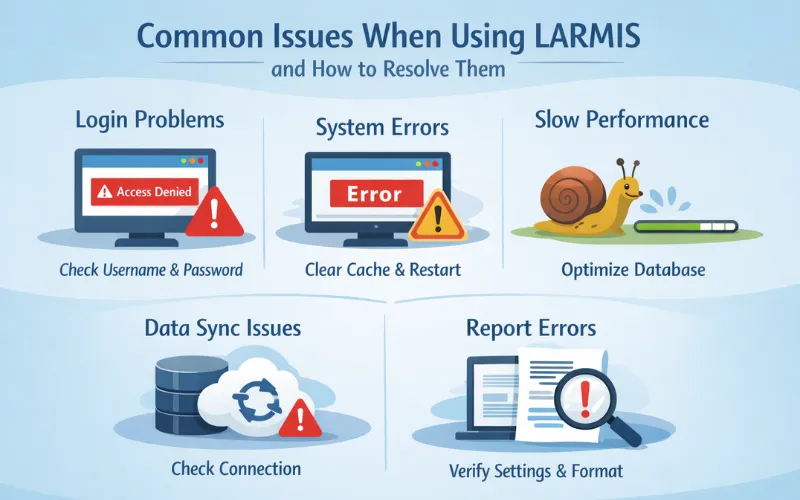
Record Not Found This usually means either the data has not yet been digitized for that particular Deh, or the survey number entered is incorrect. Sindh’s digitization is still ongoing in some rural areas. In this case, visit the local revenue office and request a certified copy of your Fard manually.
Name Mismatch If the land was inherited and the inheritance mutation was never processed, the system may still show the deceased original owner’s name. This does not mean ownership is lost – it means the mutation is pending and should be filed urgently.
Multiple Owners Showing This happens with jointly held land, especially after a partition that was not formally registered. Understanding types of mutations in revenue will clarify what kind of mutation you need to file to clean up the record.
The Role of the Patwari in Sindh’s Land System
Even with digital access, the Patwari remains the backbone of Sindh’s revenue administration. The Patwari maintains physical records, conducts field inspections, and processes mutation requests at the grassroots level. Knowing the duties of a Patwari in Pakistan helps you understand when to approach them and what to expect.
For mutations and corrections, you will still need to visit the local Patwari’s office with original documents. LARMIS lets you verify – but the Patwari is who executes changes.
What Happens After You Verify – Next Legal Steps
Once you have confirmed ownership through LARMIS, there are often follow-up steps depending on your purpose:
If you are buying property, proceed to the property registration process in Pakistan – this involves executing a sale deed, paying stamp duty, and registering the transfer.
If you are inheriting land, the next step is filing for a court decree mutation or an inheritance mutation with the Patwari’s office backed by a succession certificate.
If you are resolving a dispute, understanding the jurisdiction and role of revenue courts in Pakistan is essential – these are the specialized courts that handle land ownership and mutation disputes.
If you are paying property taxes, you can use the verified records to pay property tax online without needing to visit a tax office.
LARMIS vs. Punjab’s PLRA – A Quick Comparison
| Feature | LARMIS (Sindh) | PLRA (Punjab) |
| Land unit | Survey Number / Hissa | Khasra Number / Khewat |
| Access | Web portal | Web + app |
| Fard download | Available in most districts | Available province-wide |
| Mutation status | Partially available | Fully integrated |
| Language | Urdu / English | Urdu / English |
Both systems are improving rapidly, but Punjab’s PLRA is currently more mature and widely accessible. Sindh’s LARMIS is expanding its coverage, with Karachi and larger districts being most well-served.
Frequently Asked Questions (FAQs)
Q1: What is LARMIS and who manages it in Sindh?
LARMIS stands for Land Administration and Revenue Management Information System. It is managed by the Board of Revenue, Government of Sindh. The system provides citizens online access to digitized land records including ownership details, mutation history, and Fard documents across districts in Sindh. It was developed to reduce reliance on manual record-keeping and improve transparency in the provincial land administration system.
Q2: Can I search land records in Sindh online without a lawyer or agent?
Yes. LARMIS is a citizen-facing portal that allows anyone with basic land details – district, taluka, Deh, and survey number – to search ownership records directly. No intermediary is legally required to access basic land record information. However, for legal transactions like property purchase or inheritance mutation, professional guidance is advisable.
Q3: What documents can I download from LARMIS?
The most important document available on LARMIS is the Fard, which is the official land ownership certificate. It contains the owner’s name, survey number, area, classification, and any recorded liabilities. This document is used in property transactions, court proceedings, and mutation applications.
Q4: What should I do if my land record is not available on LARMIS?
If a record is not found online, it may be because that particular Deh has not yet been fully digitized. In this case, visit your local Tehsildar or Patwari’s office with your original documents. You can request a certified manual Fard and ask about the timeline for digitization. Sindh’s rural areas are still in the process of being fully integrated into LARMIS.
Q5: Is a LARMIS Fard enough proof of ownership for a property sale?
A LARMIS Fard is strong evidence of ownership but is not the final legal document for completing a sale. A valid property sale also requires a registered sale deed (Bay Nama), payment of stamp duty, and completion of the mutation (intkal) process. The Fard confirms who the current legal owner is – the sale deed and mutation together transfer that ownership to a new buyer.