


To check land records in KPK using your CNIC, you have three routes depending on what you need. For an online search by property location, use the KPK Land Records (KPLR) portal at kplr.gkp.pk, which lets you search by district, Tehsil, Mauza, and owner CNIC for digitised districts. For a certified physical copy of the Fard, visit the nearest Service Delivery Centre (SDC) with your CNIC. For access via NADRA’s franchise network, use the e-Sahulat service available at NADRA franchise outlets across the province, which as of March 2026 operates under a formal SOP issued by the KPK Board of Revenue under a Memorandum of Understanding with NADRA Technologies Limited. The KPLR portal is free, accessible 24 hours a day, and covers all districts that have been digitised under Phase I and Phase II of KPK’s Land Record Computerisation Project.
Understanding which route gives you what is important. The KPLR portal provides a searchable, viewable record that you can use for verification purposes from anywhere in the world. The SDC issues the official certified Fard on the spot, which is the document required for property transactions, loan applications, and court proceedings. The e-Sahulat franchise also issues a digitised Fard extract that is legally backed by the LRMIS under the March 2026 SOP, providing a third-party facilitation channel for people who live far from an SDC.
Which Districts Are Digitised in KPK
Before using the online portal, it helps to know whether your property’s district has been digitised. The KPK Board of Revenue completed Phase I of its Land Record Computerisation Project across seven divisional headquarter districts: Peshawar, Mardan, Abbottabad, Buner, Kohat, Bannu, and Dera Ismail Khan. Phase II extended digitisation to thirteen more districts: Swat, Shangla, Mansehra, Batagram, Nowshera, Charsadda, Hangu, Karak, Haripur, Swabi, Lakki Marwat, and Tank.
The Directorate of Land Records has confirmed that all SDCs have been integrated for effective monitoring and that GIS-based cadastral mapping and real-time dashboards are being scaled. For districts not yet fully digitised, the online portal may not return results, and the Patwari’s manual register at the Tehsil remains the source of record. In those cases, visiting the Tehsildar office with your CNIC is the correct route.
For the merged districts that were previously part of FATA, the GIS settlement project is ongoing in phases, and land records are being brought into the LRMIS progressively. Check with the relevant District Office for current digitisation coverage in merged districts.
Checking KPK Land Records on the KPLR Portal
The official KPK land records portal is at kplr.gkp.pk. This is operated by the Revenue and Estate Department KPK, Project Management Unit, Revenue Academy, Railway Line, Phase III Chowk Hayatabad, Peshawar. The portal’s contact is info@kplr.gkp.pk and 091-9219242.
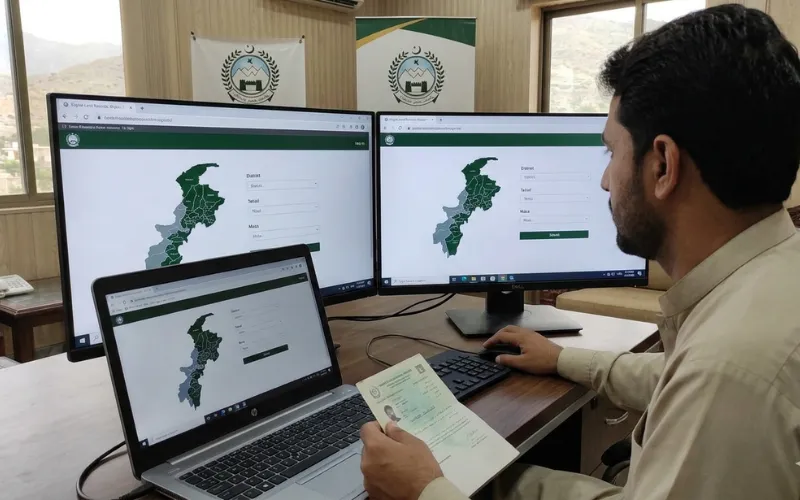
To search for a land record on the portal, open kplr.gkp.pk in any browser. The homepage displays three primary functions: Find Land Records, Book Appointment, and Search and Feedback. Click Find Land Records. You will be presented with a search interface where you select the district from the dropdown, then the Tehsil, then the Mauza (revenue estate or village). Once the Mauza is selected, you can enter the owner’s CNIC number or other identifiers such as the Khewat number or Khasra number.
When you search by CNIC, the system queries the Land Record Management Information System (LRMIS) database for that Mauza and returns all land parcels registered under that CNIC. The results display the owner’s name, the Khewat and Khasra numbers, the land area, the land type, and the share of ownership. This gives you a complete view of what the LRMIS currently shows for that CNIC in that Mauza.
The portal search is free. You do not need an account to view records. No OTP or registration is required for the search function. The search results are for viewing and verification purposes online. If you need a printed certified Fard, that requires either an SDC visit or the e-Sahulat service.
What to Do If You Don’t Know the Mauza Name
The KPLR portal search requires you to know the district, Tehsil, and Mauza of the property. If you only have the CNIC and do not know the Mauza, there are two options. First, check any existing property document such as an old Fard, the previous sale deed, or an inheritance mutation copy, all of which will state the Mauza name. Second, contact the local Tehsildar or Patwari for the area where the property is located and ask them to confirm the Mauza name for the Khasra or plot you are interested in.
For buyers verifying a seller’s ownership before purchase, the seller should be able to provide the Mauza name from their existing Fard. If a seller cannot tell you the Mauza their property is in, treat this as a red flag that warrants further investigation before any payment.
Getting a Certified Fard from the SDC
The SDC visit is the most commonly used method for obtaining a certified, official Fard in KPK. SDCs are located at Tehsil headquarter level across all digitised districts. The KPLR portal lists all active SDC locations under the SDC Centers section.
To get a Fard at the SDC, book your appointment online through kplr.gkp.pk/Appointment/BookNow. This saves time compared to walking in without a booking, as SDCs can be busy in high-transaction districts. If you cannot book online, you can visit during working hours and obtain a token on arrival.
At the SDC, present your CNIC. The SDC official accesses the LRMIS database and issues the Fard on a single click, as confirmed by the KPK Board of Revenue’s description of the SDC system. The process is biometrically tracked: every action of the SDC official is recorded in the software, providing a check and balance against manipulation. The Fard issued at the SDC is the certified extract that can be used for legal, financial, and transactional purposes.
Fard types available at the SDC include the Fard Malkiat (ownership Fard confirming who owns the property), the Fard Inteqal (mutation Fard showing recent transfer history), and the Fard Badar (record correction Fard). For a buyer verifying a seller’s ownership, the Fard Malkiat is what you need. For checking the full mutation history of a property, request the Fard Inteqal.
Getting a Fard via NADRA e-Sahulat
As of March 11, 2026, the KPK Board of Revenue has issued a formal Standard Operating Procedure for the issuance of Digitised Fard through NADRA e-Sahulat franchises across the province. This was notified under the Memorandum of Understanding between the Revenue and Estate Department KPK and NADRA Technologies Limited, governed by the West Pakistan Land Revenue Act 1967 and the Land Revenue Rules 2021, specifically Sections 39, 41-A, 42-A, 52, and 55.
The Digitised Fard issued through e-Sahulat is a digitally generated extract of the latest periodic land record from the LRMIS. It is intended as a public facilitation mechanism and carries the legal backing of the governing provisions. To use this service, visit any NADRA e-Sahulat franchise in KPK, present your CNIC, and request a Fard for the property. The franchise operator accesses the LRMIS through the e-Sahulat system and issues the Fard extract. To find your nearest e-Sahulat franchise, visit the NADRA e-Sahulat locator at e-sahulat.nadra.gov.pk or call NADRA’s helpline.
The e-Sahulat Fard is particularly useful for people who live in areas where the nearest SDC is distant, or who need a Fard quickly outside of SDC operating hours and locations. The fee for the Fard through e-Sahulat is set by the KPK government’s prescribed schedule.
What the Online Record Shows vs What It Cannot Tell You
The KPLR portal and the Fard it reflects show the current state of the digitised revenue record: who owns the land, what parcels are registered under their CNIC, the area, the Khasra and Khewat numbers, and any mutations entered in the system. This is exactly what you need to verify a seller’s ownership claim before a property transaction.
However, there are things the online record does not automatically tell you. It does not show pending court cases or litigation unless a court order has been converted into a mutation. It does not show informal encumbrances such as family disputes that have not been formalised in the revenue record. It does not show properties in districts or Mauzas that have not yet been digitised, where the record exists only in the Patwari’s manual Jamabandi. And it does not show properties in private housing societies that maintain their own member registers rather than revenue records.
For a complete picture before a major transaction, checking land ownership online is the starting point, not the ending point. Pair the KPLR portal search with a physical certified Fard from the SDC, a verification that the CNIC on the record matches the seller’s actual CNIC, and a check of the mutation history to confirm there are no pending entries that would change ownership.
Checking From Abroad: Overseas Pakistanis
The KPLR portal is accessible from any country with internet access. No Pakistan-based mobile number or SIM card is required to view records on the portal. Overseas Pakistanis can search by their CNIC number, Khewat number, or Khasra number from anywhere in the world and view the current state of the LRMIS record for their property.
For property owners monitoring their KPK land from abroad, the KPLR portal is the most direct tool for detecting unauthorised changes to the record. If a fraudulent mutation has been entered, it will appear in the LRMIS and be visible when you search your CNIC or Khewat number. Regular checks from abroad, ideally every few months, are one of the most practical safeguards against the fraudulent mutation problem that affects overseas property owners.
If a discrepancy is found, the overseas Pakistani can immediately file a complaint through the KP Citizens Portal at complaint.kp.gov.pk or call 8889, or email the KPLR PMU at info@kplr.gkp.pk with the details. The KPK Special Court for Overseas Pakistanis, approved in January 2026, provides the formal legal remedy for cases where a fraudulent mutation has already been attested.

The LRMIS Database and What Instant Update Means
One of the most significant differences between KPK’s SDC-based system and the old Patwari manual system is the update cycle. Under the manual system, the Jamabandi was prepared once every four years, meaning that a transaction entered in year one might not appear in the main record until the next Jamabandi revision. Under the SDC system, every mutation and transaction is updated in the LRMIS instantly at the time of attestation. The digital record therefore reflects the current ownership position rather than the position as of the last Jamabandi preparation.
This means that if you check the KPLR portal today and the record shows no pending mutations, you can be confident that no mutation has been attested in the SDC system since the last settlement. It does not rule out a mutation application that has been submitted but not yet attested, which exists in a queue state in the LRMIS. To check for pending unattested mutations, an SDC officer can view the application queue for a specific Mauza, which is an additional verification step available in person at the SDC.
Frequently Asked Questions
What is the KPLR portal address for KPK land records?
The official KPK land records portal is kplr.gkp.pk. It is operated by the Revenue and Estate Department KPK under the Board of Revenue. You can search for land records, book SDC appointments, and access the Search and Feedback function from this portal. Contact the PMU at info@kplr.gkp.pk or 091-9219242 if you face access issues.
Can I search KPK land records by CNIC without knowing the Khasra number?
Yes. The KPLR portal allows you to search by selecting the district, Tehsil, and Mauza and then entering the CNIC number. The system will return all land parcels registered under that CNIC in the selected Mauza. You do not need to know the Khasra or Khewat number in advance to search by CNIC, though you do need to know the Mauza the land is located in.
Is the online KPK land record the same as the official Fard?
The online portal shows you the data in the LRMIS, which is the same database that the SDC uses to issue the official certified Fard. The portal view is for verification purposes. The official certified Fard is the printed document issued by the SDC or the Digitised Fard issued through NADRA e-Sahulat, which carries the necessary institutional endorsement for legal, financial, and transactional use.
What if my district is not showing results on the KPLR portal?
If your district is not returning results, it may not yet be fully digitised in the LRMIS. Phase I covered seven districts and Phase II covered thirteen more. For remaining districts, particularly some merged district areas, the Patwari’s manual record at the Tehsil is still the authoritative record. Visit the relevant Tehsildar office in person with your CNIC for a manual Fard in such cases.
How do I get a certified Fard in KPK without visiting an SDC?
Use the NADRA e-Sahulat service. As of March 2026, the KPK Board of Revenue has issued a formal SOP under the MoU with NADRA Technologies Limited for issuance of Digitised Fard through e-Sahulat franchise outlets across the province. Visit any NADRA e-Sahulat franchise, present your CNIC, and request the Fard for the relevant property. The Fard is issued as a digitally generated extract from the LRMIS and carries legal backing under the West Pakistan Land Revenue Act 1967 and the Land Revenue Rules 2021.