
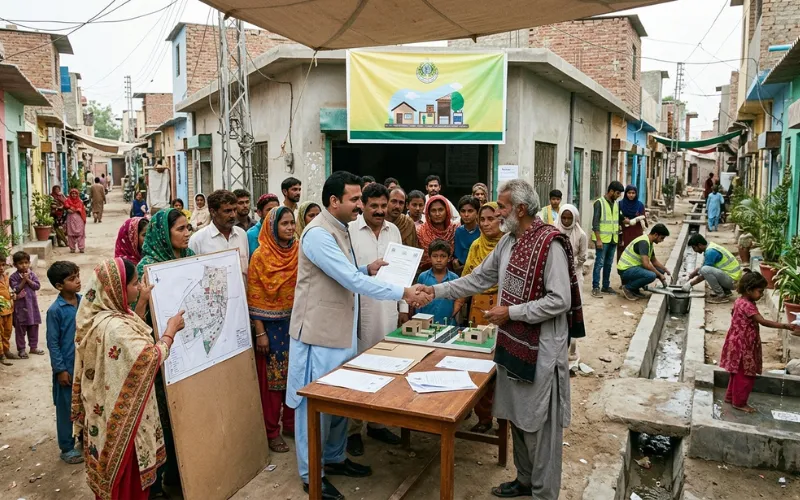

Katchi Abadi regularisation in Sindh is a legal process through which residents of informal or unauthorised settlements apply to the government to get official ownership rights, legal documents, and recognised land status for their homes. If you live in a Katchi Abadi or are helping someone navigate this process, understanding the steps, the authorities involved, and the legal framework is the most practical thing you can do.
What Is a Katchi Abadi and Why Does Regularisation Matter
Millions of urban residents in Sindh have built their homes on land they do not legally own. A Katchi Abadi is any informal settlement, usually built on state land, agricultural land, or private land without formal legal documentation or planning permission. The term itself comes from Urdu, roughly meaning “temporary or unregistered settlement.”
Regularisation matters because without it, residents of these areas live under the constant threat of demolition, cannot get utility connections in their name, and have no legal protection over the land they have occupied sometimes for decades. Once regularised, a resident gains legal title, the right to sell or inherit the property, and access to civic services.
- No legal title means no ability to mortgage the property for loans
- Utility agencies often refuse permanent connections without official ownership proof
- Heirs cannot inherit or transfer an unregistered plot without a legal document
- Residents have no legal standing to challenge encroachment or eviction actions
The Legal Framework Behind Katchi Abadi in Sindh
Sindh has its own dedicated legislation for addressing informal settlements. The Sindh Katchi Abadis Act 1987 is the primary law governing the regularisation process in the province. It was introduced to acknowledge the ground reality that a significant portion of Karachi and other urban centres of Sindh had populations living in informal areas that the government could not simply relocate.
Under this law, the Sindh Katchi Abadis Authority (SKAA) was created as the nodal body to identify, survey, and process regularisation applications. The SKAA works under the Local Government Department and handles cases from Karachi to interior Sindh urban towns.
Who Qualifies for Regularisation Under SKAA
Not every settlement automatically qualifies. There are conditions that the land and its residents must meet before regularisation can be considered.
- The settlement must have been in existence before a certain cut-off date (typically recognised before January 1, 1985 in many Katchi Abadi schemes)
- The land must not fall in a prohibited zone, such as a sea defence area, airport boundary, or railway right-of-way
- The applicant must be an actual resident, not a speculative buyer or absentee plot holder
- The plot must not be under active litigation or claimed by another private party under registered property documents
If the land is government-owned and the settlement qualifies, SKAA initiates the regularisation survey and measurement process.
Step-by-Step Process to Apply for Regularisation
The regularisation process may seem complicated, but breaking it into stages makes it manageable. Here is how it typically works in Sindh.
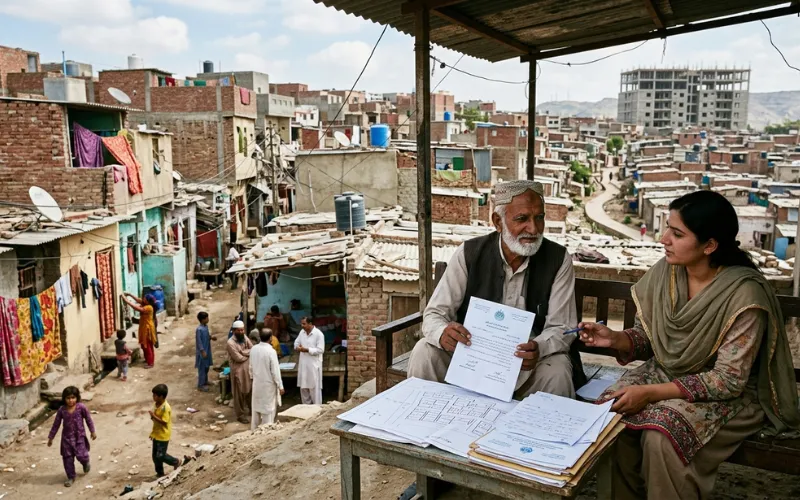
- Step 1 – File an Application with SKAA Visit the nearest SKAA office and submit an application with your personal details, plot number (if any), locality name, and your proof of residence. This includes utility bills, voter registration cards, or any school or hospital record showing your address.
- Step 2 – Survey and Verification SKAA officials will visit the settlement to physically verify the boundaries, measure plots, and compare existing layout against government records. This is the most critical stage.
- The survey team checks whether the land belongs to the provincial government, a local body, or a private entity
- Any discrepancy between claimed and actual measurements can delay the process
- Disputes with neighbours must be resolved before this stage progresses
- Step 3 – Notification and Gazette Publication Once the settlement is cleared for regularisation, SKAA issues a formal notification and it is published in the Sindh Government Gazette. This legally declares the area as a regularised Katchi Abadi.
Documents Required at the Time of Application
Having your paperwork in order speeds up the entire process significantly. Incomplete documentation is one of the most common reasons for delays in Katchi Abadi regularisation cases.
The documents you should gather include:
- Copy of your CNIC (Computerised National Identity Card)
- Proof of residence such as electricity or gas bills in your name
- Any prior agreement or sale letter from the original occupant, even if informal
- Photographs of the structure showing its current state
- Affidavit confirming you are the occupant and have not sold the plot to anyone else
Understanding who can legally own land in Pakistan is important here, especially for women applicants or joint family households, as ownership rights can become contested during the documentation stage.
The Role of Revenue Department and Mutation
Once SKAA completes regularisation, the matter moves to the Revenue Department for official record entry. This is where the land gets a formal entry in government records, and the resident is recognised as the legal owner.
The revenue process involves creating a mutation entry, which formally transfers or recognises ownership in the government’s land register. Many residents are unfamiliar with this step, but it is essential. Without the mutation entry, the SKAA certificate alone does not give you full legal ownership standing.
You can learn more about how the land mutation process works in Pakistan to understand what happens after SKAA approval and how to follow up with the local revenue office.
Common Challenges and How to Handle Them
Regularisation sounds straightforward on paper, but residents frequently encounter practical obstacles. Knowing what these are in advance helps you address them proactively.
One of the most common issues is conflicting government ownership claims. In some cases, a piece of land may have been allocated to multiple agencies at different times. For instance, a plot might have SKAA claiming it as eligible for regularisation while another authority claims it as reserved land. These cases often end up in revenue courts, and legal representation becomes necessary.
Another issue is third-party encroachment on the edges of your plot. Neighbours sometimes take advantage of survey delays to expand their footprint. Document the current boundaries with photographs and witnesses before the survey team arrives.
- Keep copies of every document you submit to SKAA
- Follow up in person every few weeks rather than relying on phone calls
- Do not pay unofficial “speed money” to clerks, as this creates legal complications later
- If your case involves inheritance, resolve the inheritance and mutation aspect separately before combining it with regularisation
What Happens After Regularisation Is Complete
Regularisation does not end with an SKAA certificate. There are several things you should do immediately after getting official recognition to secure your rights fully.
Once the regularisation is done and the mutation is entered in revenue records, you should get a fard (property record extract) from the local revenue office. This document is your day-to-day proof of ownership for transactions, utility transfers, and legal matters.
You should also update property registration records at the Sub-Registrar’s office in your area. While mutation covers revenue records, a registered deed provides stronger legal protection in civil courts. Getting both done is the gold standard for protecting your regularised Katchi Abadi plot.
Financial Implications and Leasehold vs Freehold
Most regularised Katchi Abadi plots in Sindh are granted on a 99-year leasehold basis rather than outright freehold ownership. This means you legally own the right to occupy and use the land for 99 years, but the underlying ownership remains with the government.
This is still a massive improvement over no documentation at all. A leasehold document allows you to sell, rent, mortgage, or transfer the property to heirs just like freehold property in most practical situations. The lease fee charged by SKAA is generally nominal and is calculated based on plot size and location.
Understanding the difference between leasehold documentation and actual registry and mutation helps you make the right legal moves after receiving your lease deed.

Frequently Asked Questions
What is the cut-off date for Katchi Abadi regularisation in Sindh
The Sindh Katchi Abadis Act 1987 typically uses January 1, 1985 as the general cut-off date for settlement recognition. However, different schemes and notifications have extended this in specific localities. Always confirm the applicable cut-off with your nearest SKAA office, as it can vary based on when a specific survey was officially launched.
Can I sell my plot once it is regularised
Yes, a regularised plot with a lease deed or mutation entry can be sold, gifted, or transferred to heirs. The transaction must follow the standard property transfer process, including getting a sale deed executed and the mutation updated in revenue records.
What happens if my Katchi Abadi is on privately owned land
If the land belongs to a private party and not the government, SKAA does not have direct jurisdiction to regularise it. In such cases, either a negotiated purchase or a court settlement is required. The government can sometimes acquire the land through compulsory acquisition in public interest, after which regularisation may proceed.
Is there a fee involved in the regularisation process
Yes, SKAA charges a regularisation fee based on the size of the plot and its location within the city. Urban areas like Karachi command higher fees compared to smaller towns. The fee schedule is published by SKAA and can be confirmed at their offices. Leasehold fees are generally affordable and are designed to be accessible for low-income residents.
Can women apply for regularisation in their own name
Absolutely. Women can and should apply as the primary applicant if they are the actual occupant or owner of record. There is no legal restriction on women holding Katchi Abadi leases in Sindh. In fact, many SKAA schemes actively encourage female ownership as a policy priority for housing security.
What if I face land disputes with a neighbour during the regularisation process
Disputes with neighbours should be resolved before the SKAA survey is completed. If a dispute arises, you can approach the local union council for mediation, or file a complaint with SKAA directly. Unresolved disputes are flagged in the survey report and can pause the regularisation of your plot until the matter is settled.