
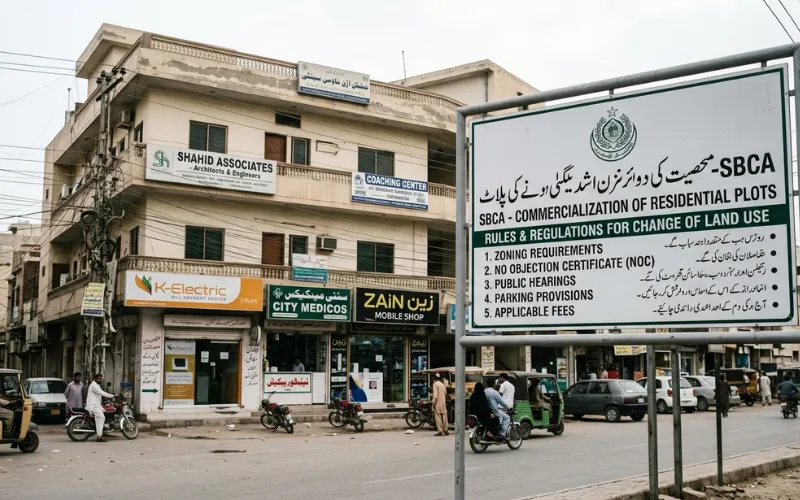

Commercialization of a residential plot in Karachi means getting official permission from the Sindh Building Control Authority (SBCA) or the relevant local authority to use a property zoned as residential for commercial or mixed-use purposes. Without this permission, operating a business, clinic, school, or office on a residential plot is technically illegal and exposes the owner to penalties, demolition notices, and legal action.
What Commercialization Actually Means in Karachi’s Context
Karachi is one of the most commercially active cities in Pakistan, and the line between residential and commercial use has blurred significantly over the decades. Many plots originally zoned as residential now operate as offices, salons, restaurants, warehouses, and medical facilities. This has not happened with proper approvals in most cases, and the city’s regulatory bodies have been tightening enforcement.
Commercialization is not just about what activity you run on a plot. It is a formal change in the land-use category of your property, which affects your tax liability, the type of construction you can do, and the legal standing of your business premises. Understanding the difference between residential and commercial property in Pakistan’s regulatory framework is the starting point for anyone considering this process.
Which Authority Governs Commercialization in Karachi
The SBCA (Sindh Building Control Authority) is the primary regulatory body for building and land-use approvals in Sindh, including Karachi. However, commercialization approvals do not always sit exclusively with SBCA. Depending on the location of your plot, the following bodies may also be involved.
- SBCA for plots in areas under its direct jurisdiction
- Karachi Development Authority (KDA) for certain older schemes
- Lyari Development Authority (LDA) for plots in the Lyari area
- Cantonment Boards for plots within cantonment limits
- Defence Housing Authority (DHA) for plots within DHA Karachi
Each body has its own rules, fee structure, and permitted uses, so confirming which authority controls your area is the very first step before spending time or money on an application.
What Types of Uses Can Be Commercialised
Not every type of commercial activity qualifies for commercialization approval under SBCA rules, and the permitted uses vary by the zoning classification of the area. Broadly speaking, commercialization in residential zones is allowed for the following categories.
Professional offices such as doctor clinics, law offices, consultancy firms, and chartered accountancy practices are typically permitted as they generate low traffic and minimal nuisance. These are sometimes referred to as “home-based businesses” in the context of single-unit approvals.
More intensive uses like shops, restaurants, retail outlets, and service centres require a full change-of-use application and the plot must be on a road of sufficient width. SBCA typically requires the plot to front a road that is at least 40 feet wide for commercial approval, and some categories require an even wider road.
Road Width Requirements and Their Importance
One of the most commonly overlooked criteria for commercialization is road width. SBCA rules in Karachi tie the type of commercial use directly to the width of the road on which the plot is situated.
- Plots on roads below 40 feet wide generally cannot be commercially approved for retail or service uses
- Roads between 40 and 60 feet may qualify for limited commercial use such as professional offices or clinics
- Roads above 60 feet qualify for most commercial categories including retail and food service
- Corner plots sometimes receive additional consideration regardless of individual road widths
This requirement exists to ensure that commercial activity does not create traffic congestion, parking problems, or safety hazards in primarily residential streets. Before applying, physically measuring the road in front of your plot and cross-checking it with SBCA’s road width records is essential, as map approvals for construction and use-change are closely tied to this measurement.
The Step-by-Step Commercialization Application Process
Knowing the process in advance prevents avoidable delays. The SBCA commercialization application follows a defined sequence, even if it sometimes moves slowly in practice.
- Step 1 – Verify zoning and road width Before preparing any documents, visit SBCA’s office or check the Master Plan of Karachi to confirm whether your area’s zoning allows commercialization and whether your road qualifies. This is a preliminary screening you can do without filing anything.
- Step 2 – Prepare ownership documents You need clear proof that you own the plot. This includes your original title documents, property registration records, and any mutation documents showing you as the current owner.
- Step 3 – Commission a site plan Hire a licensed architect to prepare a site plan showing the existing structure, road frontage, plot dimensions, and proposed commercial use. This plan must be prepared by an SBCA-registered professional.
- Step 4 – Submit the commercialization application Submit your application with the site plan, ownership documents, and the prescribed application form to SBCA’s relevant district office. A processing fee is payable at this stage.
- Step 5 – Inspection and NOC SBCA will depute an inspection team to verify the site, road width, and compliance with the proposed use. If everything is in order, an NOC (No Objection Certificate) for commercialization is issued.
Documents Required for the Application
Having your documents complete before submission prevents the most common cause of delay, which is back-and-forth requests for missing paperwork.
- Original title deed or lease document
- Allotment letter from the original authority (KDA, DHA, government scheme, etc.)
- CNIC of the owner
- Site plan prepared by a licensed architect
- Survey report showing plot boundaries and road width
- No-objection from the local body if required by your area’s authority
If the plot is jointly owned, all co-owners must sign the application or provide a power of attorney authorising one person to proceed. Any ambiguity in ownership at this stage can pause the process. It is also worth knowing how to proceed with steps to buy and confirm land ownership before you arrive at this stage with unclear title.
Commercialization Fees and Ongoing Charges
SBCA charges a one-time commercialization fee based on the size of the plot, the type of commercial use, and the location. These fees are periodically revised and should be confirmed directly from SBCA’s fee schedule at the time of application.
Beyond the one-time fee, commercialized plots attract higher property tax rates than residential ones. Once your plot is commercially approved, the relevant local body will reassess its tax category. Understanding how property tax works and how to pay it online helps you stay compliant and avoid penalties after the approval is granted.
Stamp duty on any subsequent sale or transfer of a commercially approved plot will also be higher than on an equivalent residential plot, since commercial properties carry a different valuation rate. The stamp duty implications of a changed land-use category are a real financial consideration when deciding whether commercialization is worth it for your situation.
Floor Area and Construction Limits After Commercialization
Commercialization approval does not give you unlimited freedom to build. SBCA’s building regulations still apply, and the permitted covered area, height, and setbacks for a commercial structure are different from those for a residential one.
For instance, commercial structures in Karachi must observe specific ground-coverage ratios and height limits depending on the plot size and road width. Understanding covered area versus total area rules is important because violating these limits, even after obtaining commercialization approval, results in illegal construction that can attract a separate set of penalties.
Any changes to an existing structure as part of the commercialization process must also go through building plan approval before construction begins. Running a commercial operation out of an unapproved structure, even if the land use has been officially changed, is still a regulatory violation.
Risks of Operating Without Commercialization Approval
Many plot owners in Karachi operate commercial businesses on residential plots for years without formal approval, but this carries real risks that increase over time. SBCA and local bodies periodically conduct drives to identify and penalise unauthorised commercial use.
The consequences include sealed premises, demolition of non-compliant construction, SBCA fines, and complications at the time of sale. Buyers conducting due diligence will discover the unauthorised status, and any errors or violations already noted in property records make the situation harder to resolve later.
If a third party files a complaint, the matter can reach revenue courts or civil courts, adding legal costs on top of the regulatory penalties.
Special Situations That Complicate Commercialization
Not all plots follow the standard path, and some situations add meaningful complexity before an approval can even be considered.
If your plot is subject to an ownership dispute or court injunction, SBCA will not process the application until the matter is resolved. Unresolved land disputes must be cleared first. Similarly, some areas of Karachi fall within coastal buffer zones or heritage conservation zones where commercial use requires additional approvals from separate authorities.
If any part of your plot boundary extends onto a public footpath or road reserve, this counts as an encroachment issue and SBCA will flag it during inspection, requiring rectification before approval proceeds.
Frequently Asked Questions
Can every residential plot in Karachi be commercialised
No. Commercialization is only possible if the plot meets SBCA’s road-width criteria and is not in a zone where commercial activity is prohibited. Plots near educational institutions, heritage zones, or low-density residential areas face additional restrictions. Always verify zoning status before applying.
How long does the SBCA commercialization process take
The process can range from a few weeks to several months depending on the area, document completeness, and whether inspection reveals any issues. Applications with complete paperwork and no site violations move significantly faster.
Is a separate building plan approval needed after commercialization
Yes. Commercialization approval only changes the permitted land use. Any physical construction or structural modification still requires a separate building plan approval from SBCA before work begins.
Does commercialization affect the mutation and registry of the property
Yes. Once a plot is officially commercialised, its categorisation in property records changes to reflect the new land use. Revenue records and SBCA records should be aligned to avoid discrepancies in future transactions.
Can the government cancel a commercialization approval
Yes. SBCA can revoke an approval if the use violates its terms, if the approval was obtained through misrepresentation, or if the plot falls within an area subsequently declared as government-reserved land. Keeping your approval documents archived protects you against any wrongful revocation.