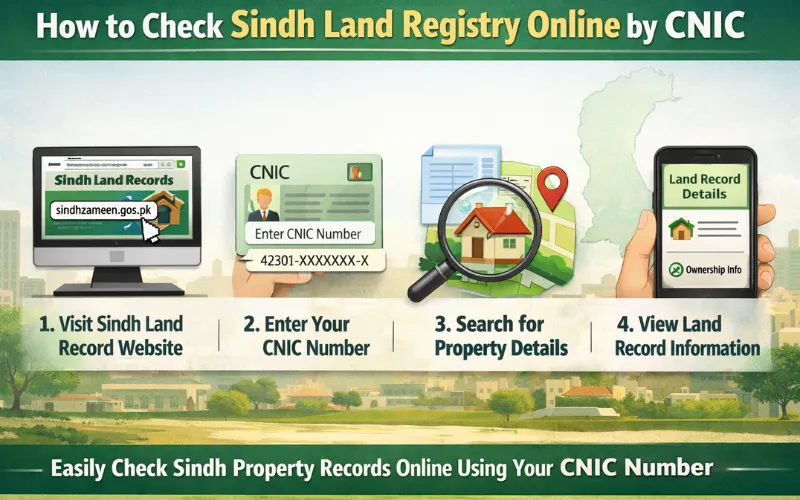
If you own land in Sindh, are planning to buy property, or need to settle an inheritance, one question matters above everything else: is this land actually registered to the right person? Checking the Sindh land registry online by CNIC is now possible through LARMIS — the official Land Administration and Revenue Management Information System — and this step-by-step guide shows you exactly how to do it, what to look for, and what to do when something goes wrong.
What Is Sindh Land Registry?
The Sindh Land Registry is the official government system that records property ownership, land transfers, mutations, and encumbrances across all districts of Sindh. It is maintained by the Board of Revenue Sindh under the authority of the Government of Sindh and operates through LARMIS — the digital platform that has replaced physical registers for most urban and semi-urban areas in the province.
Every parcel of land in Sindh is identified by a survey number and a Hissa number, assigned within a specific Deh and Taluka. The Sindh Land Record Information System links these identifiers to ownership data, meaning any verified citizen can query the digital land registry using their CNIC and retrieve official property records tied to that identity number.
Unlike Punjab’s PLRA, which has a fully mature citizen-facing app, Sindh’s LARMIS is in an advanced but still expanding phase of digitization. CNIC-based searches are available in most urban and semi-urban districts, while some interior Sindh Dehs are still being integrated into the system.
Why Online Land Verification by CNIC Matters
Property fraud in Pakistan often exploits one vulnerability: buyers and heirs do not verify ownership before a transaction. A seller presents photocopied documents, the buyer trusts them, and the legal trouble begins only after the money has changed hands.
Searching land records using a CNIC cuts through that risk. It connects a verifiable national identity number — issued and maintained by NADRA — directly to the land ownership record, making it much harder to present fake or outdated documents. This is especially critical when fraud and manual errors in property records remain among the most common causes of land disputes in Pakistan.
The benefits of online property verification in Sindh include:
Confirming that a seller is the actual registered owner before any money changes hands
Verifying your own inherited land is recorded in your name after mutation
Identifying all land holdings of a deceased person before filing for inheritance
Checking whether any family member has registered property without disclosure
Confirming that no mortgage, court freeze, or lien is attached to a property before purchase
Requirements for Online Land Verification in Sindh
Before running a CNIC property search on the Sindh land registry portal, gather the following information. Some fields are mandatory; others help narrow results faster when a CNIC is linked to multiple properties.
13-digit CNIC number of the owner (without dashes) — this is the primary search key
District name — required in some versions of the portal to filter results by region
Taluka name — narrows results when a person owns land in multiple talukas
Survey number or Hissa number — optional but useful for cross-referencing a specific plot
Deh name — optional, helps confirm results when the owner holds land in multiple Dehs
If you are verifying a seller’s ownership as part of a purchase, ask them for the survey number and Hissa number in advance so you can cross-check what the CNIC search returns against what they have told you.
How to Search Sindh Property Records by CNIC: Step-by-Step Guide
The Sindh online registry portal is accessible to any citizen with a CNIC. The process is straightforward once you have the right URL and a few basic details ready. Here is how to complete a property details by CNIC search from start to finish.
How to check Sindh land registry online using CNIC
Step 1: Open the Official Sindh Land Registry Portal
Go to the Board of Revenue Sindh’s official LARMIS portal at sindhbor.gos.pk. Only use the official government URL. Third-party sites may display outdated, incomplete, or entirely fabricated data, and they carry no legal weight.
Step 2: Select “Owner Search” or “CNIC Search”
On the search interface, look for multiple search options. Select the Owner Search or CNIC Search tab rather than the survey number search. This retrieves all land records linked to a specific national identity number across the province.
Step 3: Enter the 13-Digit CNIC Number
Type the CNIC number without dashes. The system will query the Sindh property database and return a list of all survey numbers and Hissa numbers registered under that identity. If the CNIC belongs to a deceased person, their records will still appear here until a mutation is filed.
Step 4: Select District and Taluka If Prompted
Some versions of the LARMIS portal require you to select a district or Taluka before running the search. If you are not certain which district the land falls under, select the most likely one based on the property address you have. You can run multiple searches for different districts if needed.
Step 5: Review and Verify the Results
The results display each survey number linked to the CNIC, along with the Deh name, Taluka, district, land area, and ownership share. Click on any entry to open the full Fard document — the official ownership certificate for that plot — and review it carefully before drawing any conclusions.
How to Verify Ownership Authenticity: Reading the Fard
Once you access a record through the online Fard verification tool, the Fard is the document that carries legal weight. It is the official land ownership document in Sindh’s revenue system and the primary record used in courts, mutation offices, and property transactions.
The Fard shows the owner’s name and their share in the property, expressed as a fraction for jointly held land. It also displays the survey number, Hissa number, Deh, and Taluka — giving you the precise cadastral location of the plot. One of the most important sections is the encumbrances column, which records any mortgage, court freeze, or lien registered against the property.
Difference Between Fard and Registry
A common source of confusion for buyers is the difference between the Fard and the registry (sale deed). The Fard is the current revenue record maintained by the Board of Revenue Sindh — it shows who owns the land in the government’s database right now. The registry (or sale deed / Bay Nama) is the legal document that records a transfer of ownership. Both matter, but the Fard is the ground truth: if a sale deed exists but the mutation was never filed, the Fard will still show the previous owner. Always verify the Fard directly, not just the paper documents a seller provides.
Here is what each Fard status means in practice:
A clean Fard shows no encumbrances and a single owner with full share — the property is straightforward to transfer
A Fard with multiple owners means the land is jointly held — all co-owners must consent to any sale
A Fard with an encumbrance entry means the land is tied to a loan or court order — no transfer should proceed until it is resolved
A Fard where the owner’s name does not match the seller’s CNIC is a serious red flag requiring immediate clarification before any payment is made
Common Problems During Verification and How to Fix Them
Even a correctly run online registry check can return unexpected or missing results. Understanding why this happens helps you respond appropriately rather than assuming the worst — or, equally dangerous, assuming everything is fine.
No Results Returned for the CNIC
The most common reason is that the land’s mutation has not yet been processed. If someone inherited land but never filed for an inheritance mutation, the record will still show the original owner’s CNIC, not the heir’s. The land legally belongs to the heir, but the digital record has not been updated.
A second reason is that the Deh has not yet been fully digitized. Interior Sindh districts — particularly rural Talukas in Khairpur, Jacobabad, and Tharparkar — may have physical records that have not yet been uploaded to LARMIS. For these areas, a visit to the local Patwari office remains the only option for land ownership status verification.
CNIC Entered Incorrectly During Digitization
Data entry errors during digitization are more common than expected, particularly where records were transcribed from handwritten registers. If you are certain a property should appear under a given CNIC but it does not, try searching by survey number instead. If that confirms the land record exists but with a wrong CNIC, file a written correction application at the district revenue office with supporting documents.
Results Show Inconsistent Information
If the land record search returns data that conflicts with documents the seller has provided — for example, different ownership shares or a different Hissa number — do not proceed with the transaction. Visit the Tehsildar or district revenue officer directly to reconcile the discrepancy. Revenue courts in Pakistan issue orders that are not always updated in real time on digital platforms, so a physical office check is sometimes necessary for full clarity.
Benefits of Digital Land Records in Sindh
The shift to digital land records under LARMIS has changed what is possible for ordinary citizens when it comes to property record checks. Before digitization, verifying land ownership required a trip to the Patwari office and complete dependence on a government official’s willingness to retrieve physical registers. Now, much of the same information is available online, 24 hours a day, at no cost.
Free access: The LARMIS portal is publicly accessible and does not charge a fee for basic CNIC-based searches or Fard viewing
Instant results: CNIC searches return results in seconds for digitized districts, eliminating delays that previously required physical visits
Reduced fraud risk: Connecting land records to NADRA-verified CNICs makes it significantly harder to forge or misrepresent ownership documents
Remote access: Overseas Pakistanis and non-resident landowners can now conduct initial property verification in Pakistan from abroad before engaging a local representative
Estate transparency: Searching a deceased person’s CNIC surfaces all their registered holdings in Sindh, making estate settlement more complete and less dependent on family disclosures
Verifying Inherited Land: A Special Case
Inheritance situations are where CNIC property search becomes especially powerful. When a property owner passes away, their land does not automatically transfer in the digital record. The heirs must file for inheritance mutation, and until that is done, the deceased person’s CNIC remains linked to the property.
This creates a practical opportunity: searching a deceased parent’s or relative’s CNIC through LARMIS can surface all registered land holdings across Sindh that you may not have known existed. This is a useful step during estate settlement, allowing families to account for the full estate before dividing property among heirs.
Once you have identified all holdings, the next step is to understand who the compulsory heirs are under Pakistani law before proceeding with distribution and formal mutation filing. Once mutation is complete, the land record will reflect each heir’s CNIC and ownership share.
Checking Before You Buy: A Non-Negotiable Step
If you are about to purchase land in Sindh, running a CNIC search on the seller is one of the most important steps in your due diligence process. The steps to buy land in Pakistan consistently place ownership verification at the top of the list, and for good reason.
A CNIC check confirms that the person selling the land is actually the person recorded as the owner in the official government database. If the two do not match, stop the transaction immediately. The seller either does not own the land, or the land mutation process was never completed after a previous transfer — a legal complication that must be resolved before any new sale can proceed.
It is equally important to check whether the land record shows co-owners. In Sindh’s agricultural districts, land is frequently held in fractional shares among siblings or extended family. Purchasing from one co-owner without the others’ consent can expose you to land disputes that are both expensive and time-consuming to resolve. The functions of the Board of Revenue include protecting against exactly this kind of unauthorized partial transfer — but only if you have first verified the Fard.
How to Verify Property Ownership Legally: After the Search
Running a CNIC search and reviewing the Fard is the beginning of the ownership verification process, not the end. Depending on what the land ownership status results show, there are different paths forward.
If the records are clean and the seller’s CNIC matches the registered owner, the next step is to move toward a formal sale deed (Bay Nama) and registration. This involves preparing the deed, paying applicable stamp duty, and completing the land mutation process so the new owner’s CNIC becomes attached to the property transfer record.
If the record shows a mutation is pending or the name does not yet reflect the correct owner, that issue must be resolved first. A sale requires a sale mutation, a gift requires a gift deed mutation, and inheritance requires an inheritance mutation. Each has its own documentation requirements and timeline under the Revenue Department Sindh.
When to Approach the Revenue Office Directly
Not every registry verification can be completed online. There are situations where a physical visit to the revenue office is necessary and skipping it carries real risk.
When online land record check is not enough – revenue office visit guide
If the CNIC search returns records that appear inconsistent with the documents you have been given, visit the Tehsildar or district revenue officer directly. If a property has been involved in a court case, the online record may not reflect the full picture of restraint orders or decrees. Revenue courts issue orders that must be physically verified at the local office level, as they are not always updated in real time on digital platforms.
Bring your CNIC, the survey number details, and any documents the seller has provided. Ask for a certified copy of the Fard and request written confirmation of whether any pending mutation or court order is attached to the record. This physical verification is particularly important for high-value properties and any land that has changed hands more than once in the last decade.
Disclaimer: This article is for informational purposes only and does not constitute legal advice. Land record systems are updated periodically, and some data — particularly in rural Sindh districts — may not yet be fully digitized. Always verify critical ownership information through official government channels and consult a qualified property lawyer for transactions involving significant value or legal complexity.
Frequently Asked Questions About Sindh Land Registry
How can I check Sindh land registry online using CNIC?
Visit the official LARMIS portal at sindhbor.gos.pk, select the “Owner Search” or “CNIC Search” option, and enter the 13-digit CNIC number without dashes. The system will return all land holdings registered under that CNIC across digitized districts in Sindh.
Is online property verification in Sindh free?
Yes. The LARMIS portal is publicly accessible and does not charge a fee for CNIC-based searches or viewing the Fard record. You may pay a fee if you request a printed certified copy from the revenue office, but digital access is free.
Can I verify property ownership with CNIC number alone?
Yes, in most digitized districts. The CNIC number is the primary search key and is sufficient to retrieve all land records linked to a person. Having the district name available speeds up the search on some versions of the portal that require it as a filter field.
What details are required for a Sindh land record search?
The minimum requirement is the 13-digit CNIC number. Some portal versions also require the district or Taluka selection. Having the survey number and Hissa number available helps you cross-reference results with the documents a seller has provided.
How do I download land ownership records online?
After retrieving the Fard through the LARMIS portal, most browsers allow you to save or print the page as a PDF. For a certified, legally admissible copy, you will need to visit the district revenue office and request an official printed Fard, which carries a revenue stamp.
What is the official Sindh land registry portal?
The official portal is operated by the Board of Revenue Sindh at sindhbor.gos.pk. Always use this URL directly rather than accessing it through third-party links, as unofficial sites may display outdated or incorrect data.
Can overseas Pakistanis verify Sindh property online?
Yes. The LARMIS portal is accessible from outside Pakistan. Overseas Pakistanis can run a CNIC search on their own or a relative’s identity number to check land ownership status remotely. For transactions, mutation filing, and certified document requests, you will still need a local representative or attorney to handle the in-person steps at the revenue office.
What should I do if my land does not appear in the online record?
There are three common reasons: the mutation has not been filed yet (the record still shows the previous owner), the Deh has not been digitized yet, or there was a data entry error during digitization. Try searching by survey number to confirm whether the record exists at all. If it does but with the wrong CNIC, file a written correction application at the district revenue office with supporting identity documents.
Is CNIC enough for property verification, or do I need more?
A CNIC search is the starting point, not the complete picture. After retrieving the Fard, check the encumbrances column, confirm there are no co-owners whose consent would be required, and physically verify
Yes. The LARMIS portal maintained by the Board of Revenue Sindh allows citizens to search land ownership records by entering a 13-digit CNIC number. The search returns all survey numbers and plots registered under that CNIC across the selected district or taluka. This is one of the most direct ways to verify whether a person owns land in Sindh without needing to know the survey number in advance.
What if the land I inherited is not showing under my CNIC in Sindh?
If inherited land does not appear under your CNIC, it most likely means the inheritance mutation has not been filed or processed yet. In Pakistan’s land revenue system, ownership does not automatically transfer in the official record when a person dies. The heirs must apply for inheritance mutation at the local Patwari office with a succession certificate or court order. Until the mutation is completed, the deceased’s CNIC remains attached to the record.
Is the LARMIS online record legally valid for property transactions?
The LARMIS record provides official government data that is legally recognized as part of Sindh’s land revenue system. However, for a property transaction to be legally complete, a certified physical Fard obtained from the revenue office carries the greatest evidentiary weight. The online record is the starting point for due diligence, but a registered sale deed and completed mutation are required to legally transfer ownership.
What does it mean if a Sindh land record shows multiple owners on one CNIC search?
Multiple ownership entries on a CNIC search mean the person holds shares in more than one survey number, or holds a fractional share in jointly owned land. This is very common in Sindh’s agricultural districts where land is divided among siblings over generations. In a sale scenario, all co-owners must consent to the transaction. No single co-owner can legally sell the entire plot without the written agreement of the others.
What should I do if someone else’s name appears on land that belongs to me in Sindh?
If the official LARMIS record shows a different owner for land you believe is yours, do not attempt to resolve it informally. File a written application with the district revenue officer along with all documents establishing your claim, including any previous Fard, sale deed, mutation record, or court order in your favour. The revenue officer has the authority to order an inquiry and direct the Patwari to investigate. If the dispute involves a competing ownership claim, the matter may be referred to a revenue court for adjudication.