
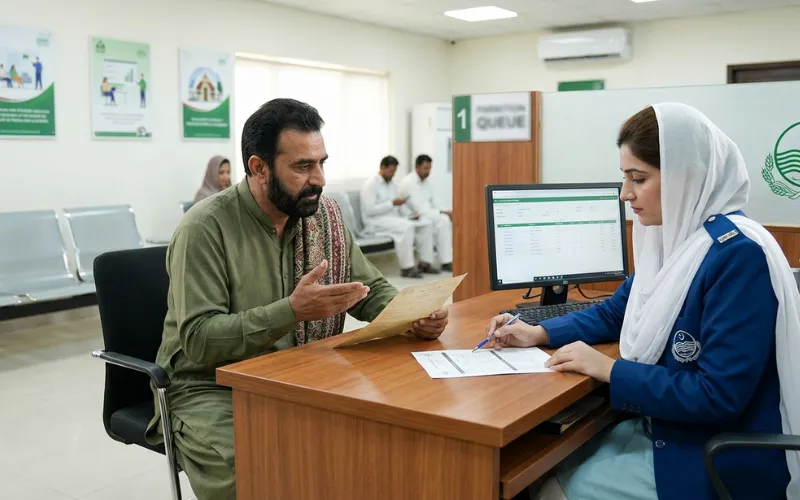

To get a land record error corrected through an Arazi Moawin center in Punjab, visit your nearest authorized Arazi Moawin location with your original CNIC and property reference documents, register your CNIC at reception, complete biometric verification, obtain a service token, and present your case to the service center official who will examine the record, determine the type of error, and initiate the Fard Badar process to correct it. The correction is then forwarded through the PLRA hierarchy for verification and final approval by the Assistant Director of Land Records.
Punjab’s land records have been fully digitized across all 36 districts, but digitization does not eliminate errors. Name misspellings, incorrect area measurements, wrong ownership entries from data migration, discrepancies left over from the manual Patwari era, and clerical mistakes in mutation processing all still occur and need formal correction. The Arazi Moawin network was created specifically to bring these correction services closer to citizens, reducing the distance and time involved in reaching the official Arazi Record Centres.
What Arazi Moawin Centers Are and How They Differ from ARCs
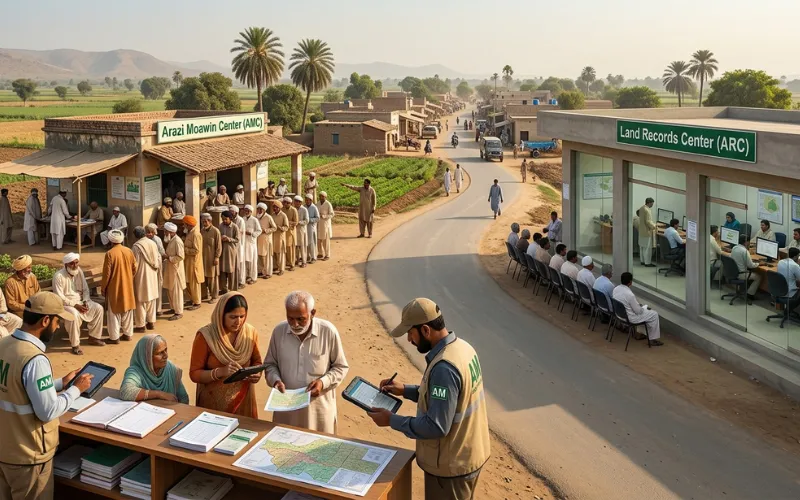
The Arazi Moawin initiative is a Public-Private Partnership model launched by the Punjab Land Records Authority. Under it, qualified individuals or businesses are authorized to operate as certified PLRA franchise partners, offering official land record services to the public from their own premises. These franchise partners are known as Arazi Moawins, and the centers they operate are spread across all tehsils of Punjab.
The key difference between an Arazi Moawin center and an official Arazi Record Centre is ownership and structure. Arazi Record Centers are government offices staffed by PLRA employees. Arazi Moawin centers are privately operated but PLRA-authorized, equipped with specific PLRA-mandated technology, and connected to the same PLRA central database. A citizen using either type of center is accessing the same official land record system. The Arazi Moawin model was introduced to extend reach into areas where ARCs are not conveniently accessible and to create a more distributed service network across Punjab’s tehsils.
Every Arazi Moawin is authorized to provide Fard issuance and mutation processing services. Record correction through the Fard Badar process is also accessible through these centers for eligible correction types. Services such as e-registration and e-stamp processing are planned for addition to the Arazi Moawin platform in future phases.
Understanding the Fard Badar Before You Visit
Before approaching an Arazi Moawin or ARC for a correction, it is important to understand what the Fard Badar process actually is, because the type of error in your record determines what kind of correction is possible and how quickly it can be resolved.
Fard Badar is the legal mechanism for correcting or amending land revenue records to ensure they accurately reflect the facts of ownership and property details. It is distinct from Inteqal, which records ownership changes due to sale, transfer, or inheritance. Fard Badar addresses errors in what the record says, not changes in who owns the property. It applies in the following situations:
- Spelling errors in the owner’s name, father’s name, or address
- Incorrect land area or classification recorded in the system
- Discrepancies between the computerized record and the original scanned manual record
- Errors introduced during data entry when records were digitized
- Mistakes made during mutation processing that need to be corrected by the approving officer
- Inaccuracies arising from inheritance claims or disputes that affect how a record reads
What Fard Badar cannot do is change who legally owns the property. If the correction you are seeking involves affecting another person’s ownership rights, the law is clear: correction can only be made through a judicial order of the District Collector. If the error has been in the record for a long time and involves long-standing entries, a civil court order is required before any correction can be implemented at the ARC or Arazi Moawin level.
How to Find Your Nearest Authorized Arazi Moawin Center
Not every person operating under the name “Arazi Moawin” or offering land record services is officially authorized by PLRA. Using an unauthorized center puts you at risk of fraudulent processing and potential damage to your land record. Always verify authorization before proceeding.
The official way to locate an authorized Arazi Moawin center in your tehsil is through the PLRA portal at punjab-zameen.gov.pk. Under the Find Arazi Moawin section, use the dropdown menus to select your district and tehsil. The system displays all authorized Arazi Moawin centers in that area, including their address, contact number, and working hours. You can also verify a franchise’s authorization by calling the PLRA helpline at 042-111-22-22-77 or checking through the PLRA mobile application.
If you have any doubt about a center’s authenticity, contact PLRA directly rather than proceeding. Service charges at authorized centers are pre-determined by PLRA and displayed at each franchise location. Any center charging rates that significantly differ from the PLRA-published fee schedule should be reported through the PLRA online complaint portal.
The Step-by-Step Correction Process at an Arazi Moawin Center
The procedure for record correction follows a structured sequence that applies both at official ARCs and at authorized Arazi Moawin centers connected to the PLRA system.
Step One: Visit in Person with Your Documents
Record correction cannot be initiated online. You must appear in person at the center with your original CNIC. Additional documents that strengthen your correction application include the most recent Fard showing the error, any previous Fard or mutation document that shows the correct information, the original registry or sale deed if the error relates to ownership or area details, and any field survey records or Khasra Girdawari entries that support the correction you are seeking.
If the correction involves an inheritance matter, bring the death certificate of the previous owner, the family registration certificate, and CNIC copies of relevant heirs. Having all supporting documents organized before you arrive avoids being turned away for insufficient evidence.
Step Two: Register Your CNIC and Complete Biometric Verification
On arrival at the center, register your CNIC at the reception desk. The center will capture your photograph and take your biometric thumb impression, which is verified against the NADRA database to confirm your identity. A service token is issued after verification. This token places you in the queue and creates a timestamped record of your visit and service request.
Step Three: Present Your Case to the Service Center Official
When your token is called, a service center official examines the land record in the PLRA database alongside the documents you have brought. The official’s first task is to determine the nature of the error. This classification determines the correction pathway.
There are two primary categories the official will assess:
If the computerized record is inconsistent with the original scanned manual record in the PLRA system, the error is classified as a data entry correction. This is the simpler category. The SCO prepares a basic data entry Fard Badar, which is verified by the Service Center Incharge and then approved by the ADLR. No field verification is typically required for this type.
If the error exists in the manual record itself, meaning the original paper record from the Patwari era contained a mistake that was then faithfully digitized, the correction requires the field staff to prepare the Fard Badar after verification against ground records. This takes longer because field verification involves the local revenue staff physically examining the property details.
Step Four: Fard Badar Registration and Forwarding
Based on the error classification, the official prepares and registers the Fard Badar complaint in the PLRA system and forwards it to the responsible service center. The Service Center Incharge reviews the revised documentation by comparing it with the existing land record and supporting evidence. If satisfied that the correction is supported by the evidence presented, the case is sent to the Assistant Director of Land Records.
Step Five: ADLR Inquiry and Approval
The Assistant Director of Land Records conducts a formal inquiry into the correction request. This inquiry examines the documentary evidence, the nature of the discrepancy, and whether approving the correction would affect any other owner’s rights. If the ADLR’s findings support the correction and no third-party rights are affected, the Fard Badar is verified and the official record is updated.
Once updated, the corrected entry becomes the new official record in the PLRA database. A fresh Fard reflecting the corrected information is then available for download through the Punjab Zameen portal or from the Arazi Moawin center itself.
When the Correction Cannot Be Done at an Arazi Moawin Center
There are specific situations where the Fard Badar process at an Arazi Moawin or ARC is legally insufficient and a higher authority must be involved.
If the correction would affect another owner’s rights, it can only be made through a judicial order of the District Collector. This commonly arises when two parties have conflicting claims about ownership shares, boundaries, or area and correcting one person’s record would necessarily diminish what is recorded for another.
If the entry that needs correction has been in the record for a long time and involves long-standing or historical entries, a civil court order is required before the correction can be implemented. Long-standing errors are treated with greater caution because they may have formed the basis of subsequent transactions, mutations, or legal proceedings.
If a mutation that was previously approved needs to be corrected afterward, it can only be corrected through a review by the concerned officer who originally approved that mutation. This cannot be initiated at an Arazi Moawin center but must be directed to the appropriate PLRA officer.
Understanding these limits before visiting prevents wasted trips and allows you to prepare the right application, either for the Fard Badar route at the Arazi Moawin center or for a District Collector or court order where that is required.
What Records Can Be Corrected and What Cannot
Arazi Moawin centers operating under PLRA authorization handle minor to moderate clerical corrections where no third-party ownership rights are affected. The types of corrections they can process include:
- Name spelling errors that do not change the underlying identity of the owner
- Errors in area recorded such as an incorrect number of kanals, marlas, or sarsais
- Land classification errors such as a field recorded as cultivated when it should be uncultivated
- Khasra number discrepancies where the reference number in the system does not match the correct field number
- Data entry mistakes from the original digitization where the scanned record shows a different value than what was typed into the system
They cannot process corrections that involve changing ownership from one named person to another, resolving disputes between co-owners about their shares in a Khewat, or implementing court orders. Those require specific documentation and must be handled through the ARC or the relevant judicial or administrative authority.
The Role of Field Staff in Complex Corrections
For corrections that are not purely data entry issues, the field revenue staff plays an investigative role. A Patwari or Girdawar may be asked to verify ground conditions, physically inspect the property boundaries, or check the Khasra Girdawari records against what is in the PLRA database. This field verification feeds into the ADLR’s decision-making on whether to approve the Fard Badar.
Understanding what a Patwari does in the land records system helps clarify why this field verification step exists. Even in the digital era, the ground truth about a piece of land, its physical boundaries, its actual cultivation status, and its water channels, still requires a field official to confirm. The PLRA system stores what was recorded. Field staff confirms whether what was recorded matches what exists on the ground.
Protecting Yourself During the Correction Process
A few practical safeguards matter during any record correction application. Always obtain a written acknowledgment or receipt for any documents you submit. Keep copies of every document you bring, because originals should not be handed over permanently to any center official. Track the status of your application using the PLRA helpline or portal. If the correction is not processed within a reasonable time, file a formal complaint through the PLRA’s complaint management system by calling 042-111-22-22-77 or using the online complaint portal.
Be aware that corrections affecting the Jamabandi record have implications for future transactions. Once the Fard Badar is approved and the record is updated, the corrected Fard becomes the authoritative document for any subsequent mutation, sale, or legal proceeding. Confirming that the updated record accurately reflects your intended correction before using it in a transaction is essential.
Frequently Asked Questions
What is an Arazi Moawin center and is it the same as an Arazi Record Centre?
An Arazi Moawin center is a privately operated but PLRA-authorized franchise that offers official land record services including Fard issuance, mutation processing, and record correction assistance. It accesses the same PLRA database as an official Arazi Record Centre but is not a government office. It is part of PLRA’s public-private partnership model to extend land services across all tehsils in Punjab.
What is the Fard Badar and when is it used?
Fard Badar is the official legal mechanism for correcting errors in land revenue records. It is used when the record contains clerical mistakes such as name misspellings, incorrect area entries, wrong land classification, or data entry discrepancies from digitization. It is different from Inteqal, which records ownership changes. Fard Badar corrects what the record says without changing who legally owns the property.
Can all types of record errors be corrected at an Arazi Moawin center?
No. Arazi Moawin centers can handle minor to moderate clerical corrections where no other owner’s rights are affected. If the correction would affect another party’s ownership rights, it requires a District Collector’s judicial order. If long-standing historical entries need correction, a civil court order is required. Corrections to previously approved mutations must go through the officer who approved the original mutation.
How long does the Fard Badar correction process take?
The timeline depends on the type of error. Simple data entry corrections where the computerized record clearly differs from the scanned manual record can be processed relatively quickly as the SCO prepares the Fard Badar, the Service Center Incharge verifies it, and the ADLR approves it. More complex corrections requiring field verification by revenue staff take longer because field inquiry, ADLR review, and inquiry findings all add stages to the process.
Do I need to bring anything specific to an Arazi Moawin center for a correction?
You must bring your original CNIC without exception. Supporting documents that strengthen your correction application include the most recent Fard showing the error, a previous Fard or mutation document showing the correct information, the original registry or sale deed, and any field survey or Khasra Girdawari records that corroborate your correction request. For inheritance-related corrections, bring the death certificate, family registration certificate, and CNIC copies of relevant heirs.
How do I verify that an Arazi Moawin center is officially authorized by PLRA?
Use the Find Arazi Moawin tool on the official PLRA portal at punjab-zameen.gov.pk, select your district and tehsil, and check whether the center appears on the authorized list with its address and contact details. You can also call the PLRA helpline at 042-111-22-22-77 or verify through the PLRA mobile application. Never use a center whose authorization you cannot confirm through these official channels.