
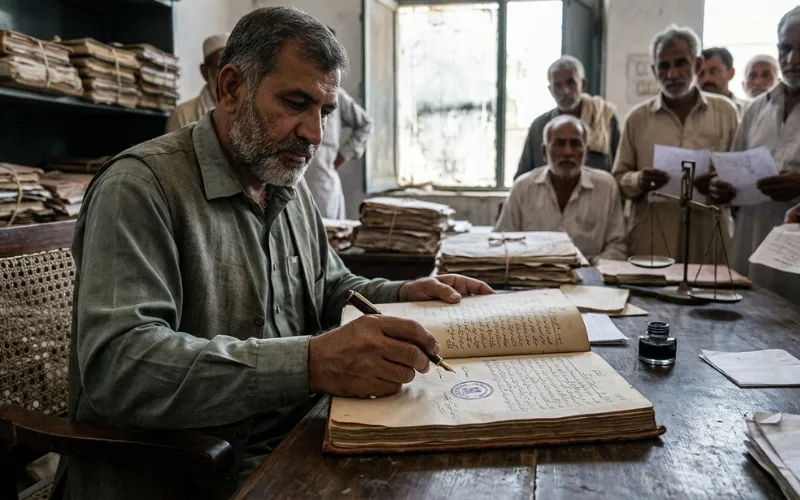

The Punjab Land Revenue (Amendment) Ordinance 2026 restricted Patwari authority to wirasti inteqal, inheritance-based mutations only, because transaction-based mutations such as sales, gifts, exchanges, and partitions were the primary mechanism through which Patwaris manipulated records, extorted payments, enabled fraudulent transfers, and facilitated land grabbing. Since transaction mutations require a buyer, a seller, and a financial exchange, they created leverage for the Patwari that did not exist in the same form with inheritance, where the death of the owner and the identity of the heirs are verifiable facts rather than negotiable positions.
The restriction was not introduced because Patwaris are entirely untrustworthy or because inheritance mutations are corruption-free. It was introduced because the specific structure of transaction-based mutations gave Patwaris a form of gatekeeping power that could not be removed without either abolishing the role entirely or systematically redirecting all transaction mutations through a digital chain that bypasses the Patwari’s discretion. The 2026 ordinance chose the second path.
The Patwari as the Single Point of Failure in Property Transactions
For over a century, the Patwari system in Punjab operated as the sole custodian of land records at the village and circle level. Every mutation entry, every Fard issuance, every record update passed through the Patwari’s hands and was entered into registers maintained by the Patwari in the Patwar Khana. This concentration of record-keeping authority in one person, at the field level, without institutional oversight, created a structural condition where the Patwari was simultaneously the source of truth and the gatekeeper of access to that truth.
Courts in Pakistan, including the Lahore High Court, have repeatedly observed that Patwari records must be verified against registry deeds and Revenue Department approvals, and that no property transfer should be deemed final without formal registry and attestation by a Revenue Officer. The Supreme Court went further, holding that a mutation recorded by the Patwari alone does not confer ownership, and that court proceedings must cross-examine Patwari records to avoid fraudulent transactions. These rulings acknowledged a fundamental reality: the Patwari’s record was treated as authoritative in practice but was not legally conclusive, creating a gap that corruption filled.
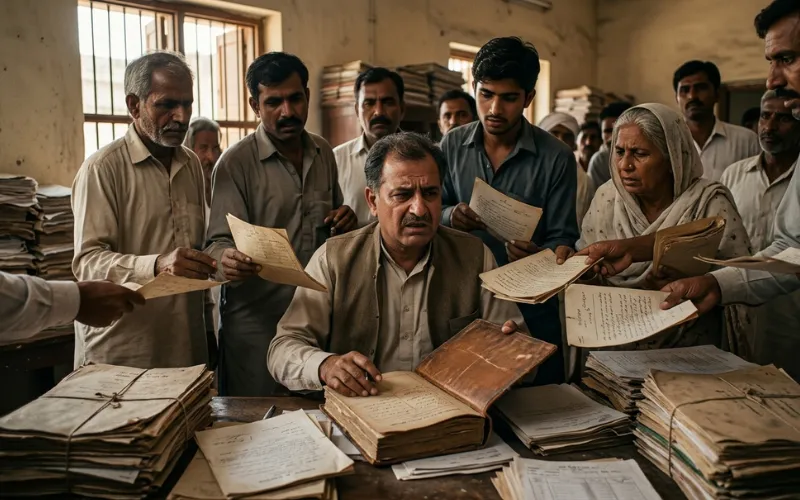
The Business Recorder documented this dynamic with precision: everyone from citizens to investors was compelled to pay homage to what commentators called a “one-man superpower” whose pen could alter, tamper with, or delay any record at will. The World Bank estimated that obtaining a Fard in Pakistan through the Patwar system took six weeks on average, a timeline that had nothing to do with technical complexity and everything to do with the structured need to obtain the Patwari’s informal cooperation.
How Transaction Mutations Created Specific Leverage
An inheritance mutation is triggered by death. The deceased owner cannot contest it. The heirs are identified by the Shajra Nasab genealogical record and the family registration certificate. The documents are either consistent with the official record or they are not. While fraud can occur in inheritance mutations, the Patwari’s leverage is inherently limited because there is no buyer-seller negotiation happening, no money changing hands between private parties in a way the Patwari can extract from, and no urgency created by a commercial deadline.
A sale mutation, by contrast, involves a buyer who has typically already paid money or committed to payment, a seller who needs the mutation completed to fulfill their legal obligations, and a time-sensitive commercial transaction. In this environment, the Patwari’s ability to delay, raise objections, or simply be unavailable created direct financial leverage over both parties. A Patwari who told a buyer that the mutation would take three weeks could extract a payment that made it take three days. A Patwari who “noticed a discrepancy” in a record could make that discrepancy disappear for a consideration.
The same dynamic applied to gift mutations, exchange mutations, and partition mutations. Each involved parties with competing interests, financial stakes, and time pressure. Each therefore created a Patwari leverage point that did not exist in the same degree in inheritance proceedings.
The Pattern of Fraud That Made Reform Unavoidable
The documented cases of Patwari-facilitated fraud in Punjab were not isolated incidents. They represented a systemic pattern that affected ordinary families, overseas Pakistanis, and agricultural communities across the province. The cases that reached Anti-Corruption courts illustrated what was routine at scale.
In one documented case from Rawalpindi, an Anti-Corruption Court sentenced a Patwari to 31 years imprisonment and a Rs1.7 million fine after evidence established that he had manipulated mutation records, forged signatures of a Naib Tehsildar who never sanctioned the mutations, and failed to enter the transactions in the Roznamcha Waqiati as required by law, all to facilitate the fraudulent transfer of property belonging to a British Pakistani family worth approximately three billion rupees. In another case in Sargodha, a Patwari and Naib Tehsildar received 20-year sentences after they sold a piece of agricultural land that did not belong to them by tampering with land record entries.
These were the cases that were investigated, prosecuted, and sentenced. They represented the fraction of fraud that was formally documented. The vast majority of Patwari-facilitated manipulation, including minor record alterations, delayed mutations used as payment extraction, unofficial facilitation of non-legal transfers, and assistance to qabza groups in entering mutations before legitimate owners could respond, never reached prosecution.
The structural reason these frauds were possible was that the Patwari had both the authority to enter mutations and the practical ability to make those entries early, late, incorrect, or absent. When the Patwari was the only person who could enter a mutation, controlling the Patwari controlled the record.
Why Inheritance Was Left With the Patwari
The 2026 ordinance’s decision to retain inheritance mutations within the Patwari’s scope, while removing transaction mutations, reflects a practical recognition about what inheritance verification actually requires.
When a property owner dies and their heirs apply for wirasti inteqal at the Arazi Record Centre, the mutation case is entered in the PLRA system and forwarded to the field revenue staff for Shajra Nasab verification. The Patwari physically knows the families in the assigned circle, knows which person died, knows the family structure, and can verify whether the applicants are genuinely the heirs by cross-referencing the genealogical table maintained for that estate. This is ground-level knowledge that cannot be fully replicated by a remote digital system or a biometric verification process at a Sub-Registrar office.
The Patwari’s field knowledge serves a legitimate function here. Inheritance disputes, fraudulent heir claims, and disputes about the distribution of shares among legal heirs occur and need field-level verification. The Patwari’s report to the ADLR in an inheritance mutation case provides the local contextual knowledge that informs the attestation decision. This investigative and advisory function in inheritance proceedings is what the ordinance preserved.
Critically, the Patwari does not attest inheritance mutations. The attestation authority rests with the ADLR or LRO. The Patwari contributes field verification, but the decision belongs to a higher official in the PLRA hierarchy. This structure limits the Patwari’s leverage even in the category of mutations they retain involvement in.
The Digital System That Makes Restriction Enforceable
The restriction on Patwari authority would have been a policy statement without enforcement teeth if the alternative system were not in place to handle the redirected transaction mutations. The reason the 2026 ordinance could credibly remove transaction mutations from Patwari jurisdiction is that the PLRA’s digital e-registration infrastructure was developed enough to receive them.
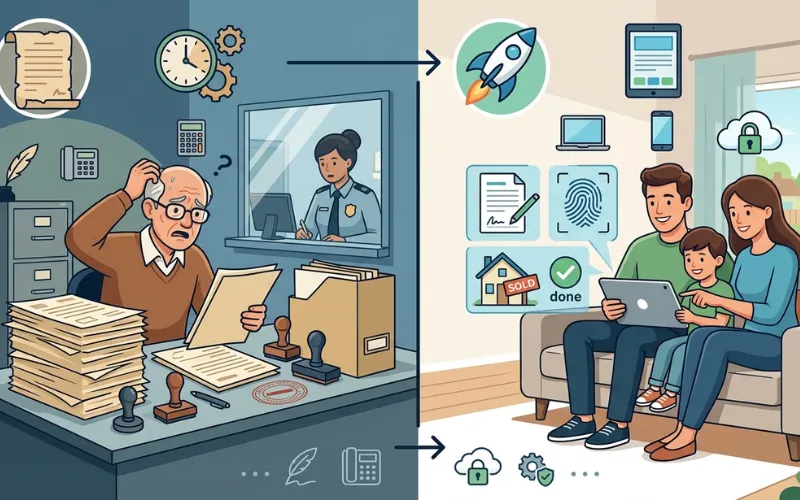
Sale mutations now follow from registered deeds at the Sub-Registrar’s office through the e-registration system. When a sale deed is registered, the data is automatically transmitted to the linked Arazi Record Centre for mutation processing and ADLR attestation. The Patwari is not in this chain. Gift mutations require registered gift deeds. Exchange mutations require registered exchange deeds. Partition mutations now require formal partition proceedings with physical possession transfer. Court decree mutations follow from court orders submitted directly to the ARC.
In each case, the mutation is initiated by a document that exists in a system independent of the Patwari. The Patwari cannot delay the transmission of a registered deed from the Sub-Registrar. The Patwari cannot insert a discrepancy into a biometrically verified deed. The Patwari cannot extract a payment by making themselves unavailable when the digital system processes the mutation without their involvement.
This is the structural logic of the reform: by creating a parallel digital pathway for transaction mutations that does not require Patwari input, the government made the Patwari’s leverage over those transactions moot, and could then formalize the restriction by law.
What Changed for Citizens Dealing with Property Sales
For anyone buying property in Punjab, the change means that completing your sale mutation no longer requires approaching, tracking down, or paying a Patwari. The mutation follows automatically from the registered deed through the digital system. You track its status through the PLRA portal or Punjab Zameen app. If the mutation is delayed, you inquire with the ADLR through the PLRA’s complaint system, not by trying to locate and pay the local Patwari.
For anyone dealing with land in rural areas, the Patwari remains present and active for the Khasra Girdawari harvest inspections, the Roznamcha daily diary, demarcation support, and inheritance mutation verification. These functions have not been transferred away and the Patwari’s local knowledge remains valuable for them. But the Patwari’s authority to enter or withhold transaction mutation entries has been removed.
For overseas Pakistanis whose property was historically the most vulnerable to Patwari-facilitated fraud precisely because of absentee ownership, the change is particularly significant. The digitization of the mutation chain means that a sale mutation for their property now requires biometric verification of the parties at the Sub-Registrar office and follows a traceable digital pathway. A Patwari can no longer enter a fraudulent mutation against an absent owner’s property without a registered deed, a biometric verification record, and a Sub-Registrar’s formal attestation. These are barriers the old system had no equivalent for.
Why Inheritance Was Not Also Removed
A reasonable question is why, if transaction mutation authority was successfully redirected away from the Patwari, inheritance mutation authority was not also transferred entirely to the ARC digital system. The answer is a combination of practical limitation and legislative judgment.
Inheritance verification in rural Punjab often involves properties that have not been formally registered in recent generations, family trees that are known locally but not fully reflected in the digital Shajra Nasab, and disputes between heirs that require ground-level investigation of who actually lived on and cultivated a piece of land. Remote digital processing cannot resolve these questions. The Patwari’s physical presence, local knowledge, and ability to gather witness testimony in the field remain genuinely necessary for inheritance mutation verification in a way that they are not for sale mutations, where the foundation is a formally registered document.
This distinction is not absolute. As Punjab’s digital land records become more complete and the PLRA’s coverage of rural inheritance histories improves, the rationale for field-level Patwari involvement in inheritance mutations may weaken. The 2026 reform can be understood as the first phase of a reduction in Patwari authority, not the final form of it.
Frequently Asked Questions
Why were sale mutations specifically removed from Patwari authority?
Sale mutations involved parties with financial stakes, time pressure, and commercial urgency, which gave Patwaris leverage to demand informal payments in exchange for processing the mutation promptly or correctly. By routing all sale mutations through the e-registration system, biometric verification at the Sub-Registrar, and automatic digital transmission to the ARC, the government removed the Patwari from the chain entirely and eliminated that leverage point.
Does the Patwari have any leverage left over inheritance mutations?
Considerably less than over transaction mutations. In inheritance proceedings, the Patwari submits a field verification report to the ADLR, who is responsible for the attestation decision. The Patwari does not have final authority. Their role is investigative and advisory. While informal pressure can still occur, the Patwari cannot unilaterally approve or block an inheritance mutation without the ADLR’s concurrence, which limits the leverage significantly compared to the old transaction mutation system.
Why did courts repeatedly note that Patwari records alone did not confer ownership?
Because the Lahore High Court, the Supreme Court, and other courts recognized that Patwari records were vulnerable to manipulation and not independently conclusive of title. This judicial position reflected the documented reality that Patwaris could alter records, delay entries, or enter mutations without proper supporting documentation. Courts required that Patwari records be verified against registry deeds, Revenue Officer attestations, and other independent evidence before relying on them as proof of ownership.
Were there actual criminal convictions of Patwaris for land fraud in Punjab?
Yes. Documented court cases include a Rawalpindi Anti-Corruption Court sentencing a Patwari to 31 years imprisonment for forging ownership papers and facilitating fraudulent land transfer worth approximately three billion rupees against a British Pakistani family. In a separate Sargodha case, a Patwari and Naib Tehsildar received 20-year sentences for selling agricultural land that did not belong to them by tampering with revenue records. These are court-decided cases, not allegations.
Will inheritance mutations also eventually be removed from Patwari authority?
The 2026 ordinance makes no provision for removing inheritance mutations from Patwari involvement. The practical argument for retaining field-level Patwari verification in inheritance cases, particularly for rural properties with incomplete digital records and complex family succession histories, remains valid. However, as Punjab’s digital land records become more comprehensive, the case for retaining field-level Patwari verification in inheritance mutations may be reassessed in future legislative cycles.