
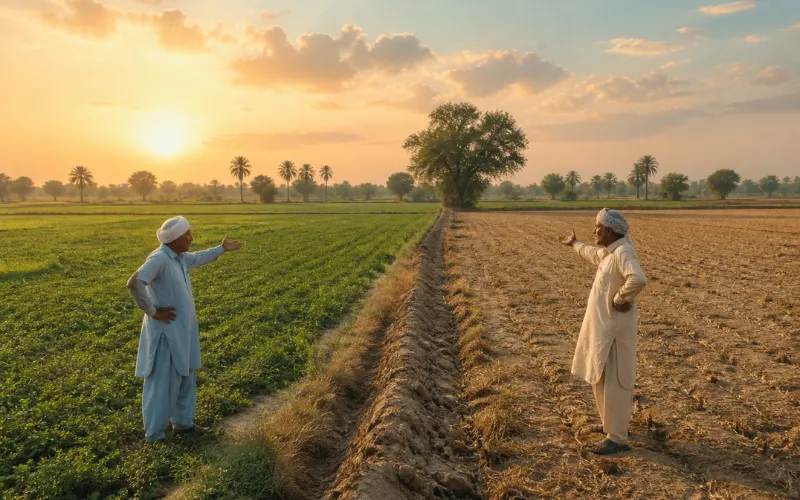

When co-owners of agricultural land in Sindh cannot agree on how to divide it, the law provides a formal mechanism to force that division without requiring unanimous consent. Takseem, which means partition, is the legal process through which jointly held agricultural land is physically divided among co-owners and each heir or co-owner receives a separately demarcated plot in their individual name. Disputes arise when parties disagree on how the division should be done, which portion each person receives, or whether the land should be divided at all.
Why Agricultural Land Partition Disputes Are Common in Sindh
Jointly owned agricultural land in Sindh typically accumulates across generations. When a landowner dies without a formal partition having taken place, all heirs inherit undivided fractional shares in every piece of land in the estate. The next generation inherits from those heirs, and within two or three generations a single survey number may have a dozen or more co-owners, each holding a fraction of a fraction, none of whom have a physically defined portion they can independently use or sell.
This accumulated co-ownership creates practical conflict. One co-owner may want to sell their share. Another may object. One may be cultivating more than their proportional share. Another may be excluding a sibling from the land entirely. Water access, canal turns, and crop decisions all become points of friction when multiple people hold rights over the same undivided plot.
The process of dividing property among heirs through voluntary agreement is always preferable, but when that agreement cannot be reached, the formal Takseem dispute mechanism exists precisely to resolve the deadlock.
Two Types of Partition in Sindh Revenue Law
Before understanding how disputes are handled, it helps to know that Sindh recognizes two distinct types of partition, each with a different procedure and level of formality.
Voluntary Partition (Raza Mandi Takseem) is where all co-owners agree on how the land should be divided, sign a partition deed or mutual agreement, and file a joint application at the revenue office for the partition mutation to be processed. This is the faster and cheaper route and does not require a court order. The partition mutation process covers how this is formalized in the land record once the parties have agreed.
Compulsory Partition is where one or more co-owners cannot reach agreement and one of them files an application before the revenue authority or the civil court seeking a forced division of the land. This is the dispute route and is the focus of this article. It can be initiated by any co-owner regardless of the size of their share, and it cannot be blocked by other co-owners simply refusing to cooperate.
Who Has the Right to Demand Partition
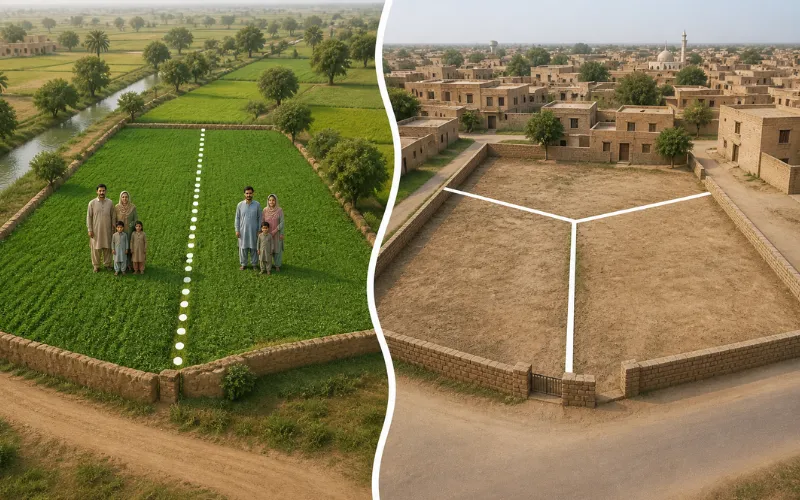
Any co-owner of agricultural land in Sindh, no matter how small their share, has the legal right to demand a partition. The right to partition is a fundamental property right under Pakistani law, and courts and revenue authorities have consistently held that a co-owner cannot be compelled to remain in a joint ownership arrangement against their will.
This means that even a co-owner holding a 1/16 share in a survey number can file for partition and force the entire plot to be physically divided. The other co-owners cannot defeat this right simply by refusing to participate in negotiations. Their participation in the actual partition process is required, but their consent to the partition itself is not.
Understanding who can own land in Pakistan and what rights attach to that ownership clarifies that co-ownership does not diminish the individual partition right of any co-owner, regardless of how their share was acquired.
Filing a Partition Application at the Revenue Office
The first and most direct route for compelling a partition in Sindh is through the revenue authority rather than the civil court. The revenue officer at the Tehsildar level has jurisdiction to order partition of agricultural land among co-owners under the Sindh Land Revenue Act and related rules.
To initiate this process, the co-owner seeking partition files a written application with the Tehsildar of the Taluka where the land is located. The application must state the survey number and Deh, the names and shares of all co-owners as reflected in the current land record, the applicant’s own share and basis of ownership, and a request that the land be physically demarcated and partitioned among the co-owners in proportion to their recorded shares.
The Tehsildar issues notice to all co-owners, giving them an opportunity to appear and state their position. A field inquiry is then conducted, typically involving the Patwari and often a formal demarcation survey, to assess how the land can be physically divided into portions proportional to the recorded shares.
Collecting the following documents before filing will make the process smoother:
- Certified Fard showing all co-owners and their current recorded shares
- Death certificate and inheritance mutation records if the co-ownership arose through inheritance
- CNIC copies of all known co-owners
- Any previous voluntary partition agreements that were attempted but not completed
- Details of any existing cultivation arrangements on the land
The Demarcation Process and What Can Go Wrong
Once the Tehsildar orders a partition inquiry, the Patwari conducts a field demarcation using the Shajra map to identify the physical boundaries of the survey number and then calculates how it can be divided into portions corresponding to each co-owner’s share.
Agricultural land partition is not always arithmetically simple. A long rectangular field divides differently from an irregularly shaped plot. Access to a canal or road may not run along the natural midpoint of the land. A well, an irrigation outlet, or a structure may fall on one side and give disproportionate value to one portion over another.
These physical irregularities are where most partition disputes become genuinely contentious. Common objections raised during demarcation include the following:
- One party arguing that the proposed division gives them the less productive or less irrigated portion
- Disagreement over where existing crop boundaries and cultivation lines fall relative to the proposed partition line
- Disputes about which portion gets access to the canal turn or water outlet
- Claims that an existing structure or tube well built by one co-owner falls within the portion being allocated to another
- One party alleging that the demarcation survey itself was conducted incorrectly or with bias
The role of boundary marks in land revenue is central to the demarcation process. Once the partition is ordered and demarcation is completed, new boundary marks are placed at the corners of each new plot, physically separating the previously joint land into distinct individual holdings.
When the Revenue Authority Cannot Resolve the Dispute
If the parties cannot agree on the proposed demarcation even after the Tehsildar’s inquiry, or if one party refuses to accept the partition order, the matter is referred to or filed before a civil court. Civil partition suits in Sindh are filed in the Civil Court of the district where the land is located.
A civil court partition suit gives the court authority to appoint a local commissioner to inspect the land and recommend how it should be divided, examine evidence about the value and quality of different portions, take into account structures, irrigation access, and other physical features when determining fair allocation, and issue a final decree ordering the partition in specific terms that the revenue department must implement.
Revenue courts in Pakistan also have jurisdiction over certain partition disputes, particularly those that arise directly from the mutation and land record system. Your lawyer will advise whether the civil court or the revenue court is the more appropriate forum based on the specific facts and the province’s current jurisdictional rules.
Partition by Allotment When Physical Division Is Not Possible
Not every agricultural plot can be physically divided into proportional pieces that are each independently viable. A very small survey number with many co-owners may reach a point where each individual share is too small to cultivate meaningfully or to justify separate boundary marks.
In such cases, the court or revenue authority has the option of ordering partition by allotment rather than physical division. This means the entire plot is awarded to one co-owner, or to a subset of co-owners, who then compensate the other co-owners financially for the value of their shares. This is treated as a last resort because it forces co-owners to accept money instead of land, which some may resist, but it is a legally recognized outcome where physical division would produce unworkably small plots.
The valuation of shares for this purpose is based on the assessed or market value of the land, which can itself become a disputed question requiring a separate valuation exercise. Understanding the difference between residential and agricultural land in Pakistan is important here because agricultural land is valued differently from urban land, and the applicable valuation method affects the compensation that non-allotted co-owners receive.
Dealing With a Co-Owner Who Is Absent or Untraceable
A frequent complication in Sindh agricultural land partition disputes is that one or more co-owners are either abroad, have not been in contact with the family for years, or cannot be located. This does not block the partition proceeding. The court or revenue authority can be informed of the situation and asked to proceed despite the absence of a located co-owner.
For co-owners who are abroad, the court typically requires that notice be served through the appropriate legal channels, including publication in a newspaper if personal service is not possible. For co-owners whose whereabouts are completely unknown, the court may appoint a representative to protect their interests during the partition proceedings.
For families with overseas members who want to participate in or consent to a partition without being physically present, a properly executed power of attorney allows a trusted representative in Pakistan to appear before the revenue office or court and sign documents on their behalf.
After the Partition Order: Updating the Land Record
A partition order from the revenue authority or a civil court decree ordering partition must be followed by formal updates to the land record before each co-owner has an independently recognized holding they can manage, sell, or mortgage.
The partition decree or order is taken to the Patwari office and a partition mutation is filed. Once sanctioned, the original survey number is closed and new survey numbers or Hissa numbers are created for each individual portion. Each co-owner can then request a fresh Fard document in their own name for their specific allocated plot.
Failing to file the partition mutation after the order is one of the most common oversights in partition proceedings. The order creates the legal right to the separate plot, but it is the mutation that creates the official land record entry that banks, buyers, and government authorities will rely on in future dealings.
After the mutation is sanctioned, each newly created plot should also be assessed for any land revenue liability and the revenue demand should be updated under each new owner’s name separately so that the fiscal record reflects the post-partition position accurately.
Practical Steps to Protect Your Position During a Dispute
While a partition dispute is pending, your position can strengthen or weaken depending on what actions you take on the ground. Several practical steps significantly improve your standing in both revenue and court proceedings.
Continue to cultivate or use your proportional share of the land actively and visibly. Possession and cultivation are relevant factors in how a partition is physically allocated, and abandoning your portion during a dispute can be interpreted as acquiescence to the other party’s use.
Pay your share of any land revenue or water charges due on the joint holding in your name where possible. Payment records create a documented financial history of your active engagement with the land that contradicts any claim that you abandoned or surrendered your interest.
Do not enter into any side agreements or informal understandings with other co-owners about the partition unless those agreements are formalized and signed. Informal arrangements frequently collapse and create additional confusion when the formal proceedings resume.

Frequently Asked Questions
Can one co-owner force a partition of agricultural land in Sindh without the others’ agreement
Yes. Any co-owner of agricultural land in Sindh, regardless of the size of their share, has the legal right to demand a partition. The right to partition is a fundamental property right under Pakistani law and cannot be denied simply because other co-owners refuse to cooperate. A co-owner seeking partition can file an application with the Tehsildar or a civil partition suit in the district court, and the authority will proceed with ordering and conducting the partition even without the consent of the other co-owners.
What happens when agricultural land cannot be physically divided equally in Sindh
When physical division of agricultural land is not possible because the plot is too small, too irregularly shaped, or the individual shares would be unworkably small, the revenue authority or court can order partition by allotment. This means the entire plot is awarded to one co-owner or a group of co-owners who then compensate the remaining co-owners financially based on the assessed value of their shares. This outcome is treated as a last resort because it compels non-allotted co-owners to accept money in place of their physical land entitlement.
How long does a partition dispute take to resolve in Sindh
The time to resolve a partition dispute in Sindh varies significantly based on the route taken. A revenue authority partition proceeding at the Tehsildar level, where the parties cooperate with the demarcation process, can be resolved within a few months. If the parties dispute the demarcation result and the matter is referred to the civil court, the timeline extends considerably. A contested civil partition suit in Sindh can take anywhere from one to several years depending on the court’s docket, the complexity of the land and the number of co-owners, and whether any party files appeals or interim applications during the proceedings.
What documents are needed to file a partition application in Sindh
To file a partition application at the Tehsildar’s office in Sindh, you need a certified Fard showing all co-owners and their recorded shares, details of the survey number and Deh, CNIC copies of the applicant and all known co-owners, and inheritance mutation records if the co-ownership arose through succession. Any documents showing the applicant’s cultivation history or possession of the land also strengthen the application. For a civil partition suit, your lawyer will prepare the court petition based on these documents along with any additional evidence about the land’s physical layout and value.
What is the difference between voluntary partition and compulsory partition in Sindh
Voluntary partition, called Raza Mandi Takseem, is where all co-owners agree on how the land should be divided and file a joint application at the revenue office for a partition mutation to formalize the division. It is faster, cheaper, and requires no court involvement. Compulsory partition is where agreement cannot be reached and one co-owner files an application with the revenue authority or the civil court seeking a forced division of the land. The authority then orders the partition and oversees the demarcation process regardless of whether all co-owners consent. Both types result in the same outcome: separately identified and officially recorded individual plots for each co-owner.