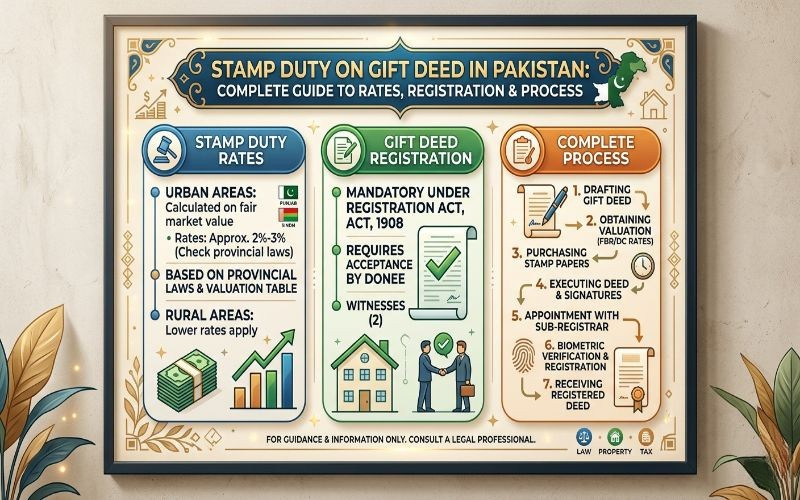

Transferring property as a gift to a family member or loved one is a generous gesture, but it comes with legal obligations that many people overlook. One of the most important requirements when executing a gift deed in Pakistan is paying stamp duty,a government tax that validates your property transfer and makes it legally enforceable. Understanding how stamp duty works on gift deeds can save you from future legal complications, unexpected costs, and potential disputes over property ownership.
Whether you’re planning to gift a house to your children, transfer agricultural land to a relative, or formally register any immovable property as a gift, knowing the correct stamp duty rates and registration procedure is essential. This comprehensive guide walks you through everything you need to know about stamp duty on gift deeds in Pakistan, including provincial variations, calculation methods, required documents, and the complete registration process.
What is Stamp Duty on Gift Deeds?
Stamp duty is a legal tax imposed by the government on various documents and transactions, including property transfers through gift deeds. When you gift immovable property,such as land, houses, or commercial buildings,to another person, the law requires you to execute a formal gift deed on stamp paper of appropriate value. This stamp duty serves as proof that the transaction has been officially recognized by the state and that the required taxes have been paid.
Think of stamp duty as the government’s way of maintaining a public record of property ownership changes while generating revenue for provincial administration. Without proper stamp duty payment, your gift deed remains legally weak and can be challenged in court. The duty amount is calculated based on the property’s market value or the District Commissioner (DC) rate, whichever is higher in most cases.
Key points about stamp duty on gift deeds:
- It’s a mandatory provincial tax, not optional
- Rates vary significantly across Pakistan’s provinces
- The donor (person giving the gift) typically bears this cost
- Payment must be made before or during deed registration
- Unpaid or underpaid stamp duty can invalidate your deed
Why Stamp Duty is Legally Required
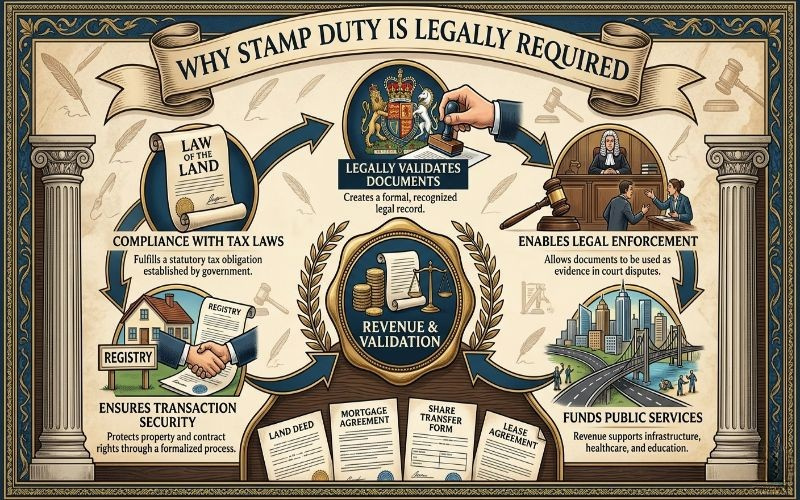
The requirement for stamp duty isn’t arbitrary,it serves several important legal and administrative purposes in Pakistan’s property system. The Stamp Act of 1899, along with provincial amendments, established this framework to create transparency in property transactions and protect both parties involved in the transfer. When you pay stamp duty and register your gift deed, you’re creating an official government record that can be verified by anyone checking property ownership in Pakistan.
From a practical standpoint, stamp duty payment protects the recipient of the gift. If someone later claims they have rights to the property or if the donor’s heirs contest the gift after the donor’s death, a properly stamped and registered deed serves as strong legal evidence. Courts in Pakistan give significant weight to registered documents with appropriate stamp duty, making them difficult to challenge successfully.
Stamp Duty Rates Across Pakistan’s Provinces
One of the most confusing aspects of stamp duty on gift deeds is that rates aren’t uniform across Pakistan. Each province has its own excise and taxation department that sets stamp duty rates based on local regulations and revenue requirements. Here’s what you need to know about stamp duty rates in different provinces:
Punjab:
In Punjab, stamp duty on gift deeds for immovable property is generally charged at 3% of the property’s value. However, this rate can vary based on whether the property is urban or rural, and whether it’s being gifted to a close family member or a non-relative. Some districts offer reduced rates for gifts between parents and children or between spouses. The value is typically determined by the DC rate set for that specific area, which is the minimum valuation the government accepts for property transactions.
Sindh:
Sindh’s stamp duty structure is somewhat different, with rates for gift deeds typically ranging from 3% to 5% of the property value depending on the location and type of property. Karachi and other urban centers often have higher rates compared to rural areas. Additionally, Sindh imposes a Capital Value Tax (CVT) on property transfers, which sometimes overlaps with or replaces traditional stamp duty in certain circumstances. It’s worth noting that Sindh periodically updates its valuation tables, so checking current DC rates with the local excise office is essential.
Khyber Pakhtunkhwa (KPK):
KPK generally charges 3% stamp duty on gift deeds for immovable property, though this can vary in certain districts. The province has been working to digitize its land records and stamp duty collection system, making it somewhat easier to verify correct rates and complete registration. Like other provinces, KPK uses DC rates as the minimum valuation basis for calculating stamp duty.
Balochistan:
Balochistan typically has the most variable rates, with stamp duty on gift deeds ranging from 2% to 5% depending on the district and property type. Due to the province’s vast geography and diverse administrative setup, it’s particularly important to verify rates with your local sub-registrar office before proceeding with a gift deed.
Federal Capital (Islamabad):
The Capital Development Authority (CDA) and Federal Board of Revenue (FBR) jointly govern stamp duty in Islamabad. Gift deeds generally attract 2% to 3% stamp duty, but the calculation can be more complex for properties in developed sectors versus rural zones of Islamabad.
Keep in mind that these rates can change when provincial governments update their finance acts, usually during annual budget announcements. Always verify current rates with official sources before calculating your stamp duty obligation.
How to Calculate Stamp Duty on Your Gift Deed
Calculating stamp duty might seem straightforward,just multiply the property value by the applicable percentage,but there are several nuances that can affect your final amount. The government doesn’t simply accept whatever value you declare for your property; instead, they use the DC rate as a benchmark to prevent undervaluation and tax evasion.
Let’s walk through a practical example. Suppose you’re gifting a 10-marla residential plot in Lahore’s Johar Town to your daughter. The current market value might be around PKR 2.5 crore, but the DC rate for that area is PKR 2 crore. In Punjab, the stamp duty calculation will be based on the higher of these two values,in this case, PKR 2.5 crore since it exceeds the DC rate.
Here’s the calculation:
- Property market value: PKR 2,50,00,000
- Applicable stamp duty rate in Punjab: 3%
- Stamp duty amount: PKR 2,50,00,000 × 3% = PKR 7,50,000
Beyond stamp duty, you’ll also need to budget for registration fees (usually 1% of property value), lawyer fees for drafting the deed, and miscellaneous charges at the sub-registrar office. In total, expect to spend approximately 4-5% of the property’s value on the complete gift deed registration process.
One important consideration: if you intentionally undervalue the property to reduce stamp duty, you risk having the authorities reassess the value, impose penalties, and potentially delay or reject your registration. It’s always better to use realistic valuations based on current DC rates or recent sale comparables in the area.
Complete Registration Process for Gift Deeds
Understanding the registration process helps you prepare properly and avoid unnecessary delays. The procedure for registering a gift deed with appropriate stamp duty involves several clear steps, though the exact requirements can vary slightly between provinces.
First, you’ll need to have the gift deed drafted by a lawyer or legal professional. This document should clearly state the details of the property being gifted, the donor’s and recipient’s complete information, and explicitly mention that the transfer is a gift without any consideration (payment). The deed must be precise about property boundaries, survey numbers, and any existing encumbrances like mortgages.
Step-by-step registration process:
- Draft the gift deed with complete property details and both parties’ information
- Calculate stamp duty based on provincial rates and DC valuation
- Purchase non-judicial stamp paper of the required value from authorized vendors
- Print or write the gift deed on the stamp paper (some provinces now allow e-stamping)
- Gather required documents (discussed in the next section)
- Visit the sub-registrar office in the jurisdiction where the property is located
- Present the deed and documents with both donor and recipient present
- Pay registration fees (typically 1% of property value)
- Biometric verification of both parties (increasingly common)
- Receive the registered deed with official stamps and signatures
The entire process typically takes 2-4 weeks from start to finish, though delays can occur if documents are incomplete or if there are questions about property ownership. In some urban centers, the registration can be completed in a few days if all paperwork is in order.
One practical tip: visit the sub-registrar office beforehand to confirm their specific requirements and any recent procedural changes. Some offices now require appointments, while others operate on a first-come, first-served basis. Knowing these details in advance saves time and frustration.
Required Documents for Gift Deed Registration
Having all necessary documents prepared before visiting the sub-registrar office significantly speeds up the registration process. Missing even a single document can result in your application being rejected or delayed, so thorough preparation is worth the effort.
Essential documents you’ll need:
- Original gift deed printed on stamp paper of appropriate value
- Valid CNIC copies of both donor and recipient (and originals for verification)
- Previous ownership documents (original sale deed, allotment letter, or inheritance documents)
- Fard-e-Malkiyat (recent ownership certificate from revenue department)
- Property tax receipts showing taxes are current
- No Objection Certificate (NOC) from relevant housing authority if in a regulated society
- Mutation certificate or copy from patwari showing current ownership
- Map or site plan of the property with survey numbers
- Two witnesses with valid CNICs (originals and copies)
- Passport-size photographs of donor and recipient
In some cases, additional documents may be required, particularly if the property has a complex ownership history or if there are multiple legal heirs involved. For agricultural land, you’ll need different revenue documents than for urban property.
It’s also worth noting that if the donor is married, some provinces require the spouse’s consent for gifting property, particularly if it was acquired during the marriage. This consent should be properly documented to avoid future disputes. Similarly, if the recipient is a minor, the gift deed must clearly state that a legal guardian will hold the property in trust until the minor reaches adulthood.
Gift Deeds vs. Sale Deeds: Stamp Duty Differences
Many people wonder whether it’s more beneficial to structure a property transfer as a gift deed or a sale deed, especially when transferring property between family members. The stamp duty implications differ significantly between these two types of transfers.
Sale deeds typically attract higher stamp duty rates than gift deeds,usually around 5% in most provinces compared to 3% for gifts. However, there’s an important trade-off to consider. When property changes hands through a sale, the buyer can claim the purchase as a capital investment, and if they later sell the property, they can calculate capital gains tax based on the original purchase price. With gift deeds, the recipient doesn’t have a purchase price to use as a tax basis, which can result in higher capital gains tax if they eventually sell the property.
Key differences to understand:
- Sale deeds require stamp duty of 4-5% of property value in most provinces
- Gift deeds require stamp duty of 2-3% of property value
- Sale deeds create a clear tax basis for future capital gains calculations
- Gift deeds may result in higher capital gains tax liability for the recipient
- Sale deeds involve actual payment consideration; gifts are without consideration
From a pure stamp duty perspective, gift deeds are more economical. However, you should consider the complete tax picture, especially if the recipient might sell the property in the future. Consulting with both a lawyer and a tax advisor helps you choose the most beneficial structure for your specific situation.
Common Mistakes to Avoid When Registering Gift Deeds
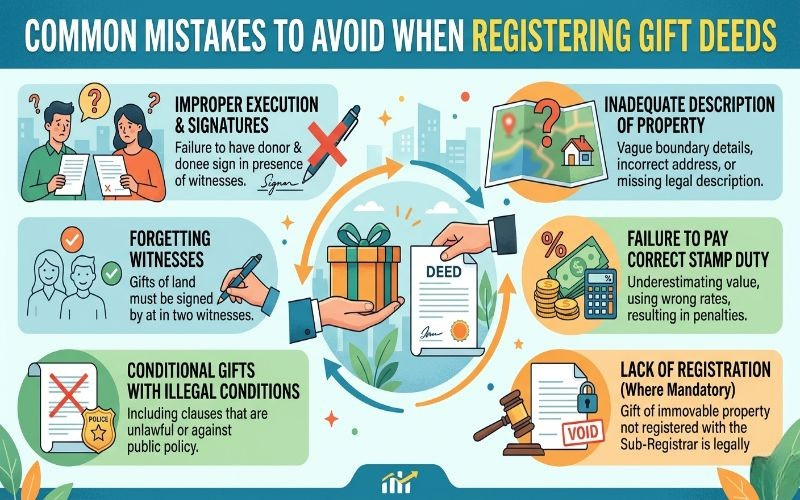
Even with good intentions, many people make costly mistakes during the gift deed process that lead to legal complications, financial penalties, or invalid registrations. Learning from these common errors can save you significant hassle.
One of the most frequent mistakes is undervaluing the property to reduce stamp duty. While this might seem like a clever way to save money, it’s actually quite risky. Sub-registrars are trained to recognize unrealistic valuations, and they have access to DC rates and recent comparable sales. If they determine you’ve deliberately undervalued the property, they can reject your application, impose penalties, and require you to start over with correct valuations. The small amount you might save on stamp duty isn’t worth the legal headaches and potential fines.
Another common error is failing to clear outstanding property taxes before attempting registration. Many sub-registrar offices won’t process a gift deed if the property has unpaid municipal taxes or utility bills. Getting a tax clearance certificate before starting the registration process prevents last-minute delays.
Additional mistakes to avoid:
- Using stamp paper from unauthorized vendors (always buy from licensed stamp vendors)
- Not having both parties physically present at registration (some offices are strict about this)
- Drafting the deed without professional legal help, leading to ambiguous language
- Forgetting to update the mutation records after registration
- Not keeping certified copies of all registered documents for future reference
- Assuming the same rules apply across all provinces
- Failing to inform relevant housing societies or development authorities about the transfer
Perhaps the most overlooked mistake is not updating the revenue records after successful registration. Registering the deed at the sub-registrar office is only half the job,you must also apply for mutation of the property records in the revenue department (patwari system). Until mutation is complete, the revenue records still show the donor as the owner, which can create complications for property tax, utility connections, and future transactions.
Tax Implications Beyond Stamp Duty
While stamp duty is the most visible cost of executing a gift deed, it’s not the only tax consideration you should keep in mind. Understanding the complete tax picture helps you make informed decisions and avoid surprises down the road.
Capital Value Tax (CVT) applies in some provinces, particularly in Sindh, where it’s collected alongside or sometimes instead of traditional stamp duty. CVT is calculated as a percentage of the property’s value and serves a similar purpose to stamp duty. In recent years, there’s been some confusion about whether both CVT and stamp duty apply to gift deeds in Sindh, so checking with the local excise office is important.
For the donor, there’s generally no federal income tax implication for gifting property within Pakistan, as gifts are not considered taxable income for the recipient under current tax laws. However, if the property generates rental income, the recipient will need to declare that income and pay applicable taxes once they take ownership.
The more significant tax consideration often comes later. If the recipient eventually sells the property they received as a gift, they’ll face capital gains tax. The challenge is that they don’t have a purchase price to use as their cost basis,the property was gifted, not bought. This means the entire sale price (minus any improvements they made) could potentially be subject to capital gains tax, which can be substantial.
Important tax considerations:
- Capital Value Tax (CVT) may apply in addition to stamp duty in some provinces
- Gift recipients don’t pay income tax on the gift itself
- Future capital gains tax calculations can be complicated for gifted property
- Property tax obligations transfer to the recipient immediately
- Wealth tax may apply if the recipient’s total assets exceed certain thresholds
Working with a tax consultant before executing a gift deed is particularly wise if you’re dealing with high-value property or if there’s any possibility the recipient might sell the property in the near future. Sometimes, structuring the transfer differently can provide better overall tax efficiency for both parties.
Frequently Asked Questions About Stamp Duty on Gift Deeds
Who pays the stamp duty,the donor or the recipient?
Traditionally, the donor (person giving the gift) bears the cost of stamp duty and registration fees, as they’re initiating the transfer. However, there’s no legal restriction preventing the parties from agreeing that the recipient will pay these costs. What matters legally is that the stamp duty is paid, not who pays it.
Can I gift property to a non-family member?
Yes, you can gift property to anyone,family member, friend, or even a stranger. However, some provinces offer reduced stamp duty rates for gifts between close relatives (parents-children, spouses), so gifts to non-relatives may attract higher rates. Always verify the applicable rate for your specific situation.
What happens if I don’t pay stamp duty or pay too little?
Unpaid or underpaid stamp duty renders your deed legally weak and potentially invalid. Courts may refuse to admit such documents as evidence in disputes. Additionally, authorities can impose penalties equal to several times the unpaid amount, and you’ll still need to pay the original duty to validate the deed.
Is stamp duty on gift deeds the same across all property types?
No, rates can vary based on whether you’re gifting residential property, commercial property, or agricultural land. Agricultural land sometimes attracts lower stamp duty rates in certain provinces. The location (urban vs. rural) can also affect rates.