
Property and wealth are a trust from Allah, and Islam treats their distribution after death as a matter of divine justice, not personal preference. Many family disputes arise not because Islamic law is unclear, but because people do not fully understand how property distribution after death in Islam actually works,especially in different family situations involving men, women, marriage, children, or adoption.
This guide explains Islamic inheritance rules clearly, calmly, and practically, covering all major scenarios: male and female deceased, multiple wives, no children, unmarried women, and adopted children,strictly according to Islamic (Shariah) principles.
Foundations of Property Distribution After Death in Islam
Before discussing specific cases, it is important to understand the foundation of Islamic inheritance. In Islam, inheritance laws are divinely ordained, primarily derived from the Qur’an (Surah An-Nisa), Sunnah, and scholarly consensus.
Islamic inheritance follows a strict order:
- Funeral expenses are paid first
- Debts of the deceased are cleared
- Wasiyyah (Islamic will) is executed (up to one-third, non-heirs only)
- Remaining property is distributed among legal heirs
Only after these steps does actual distribution begin. This structured approach ensures fairness, responsibility, and protection of rights.
Who Can Inherit in Islam?
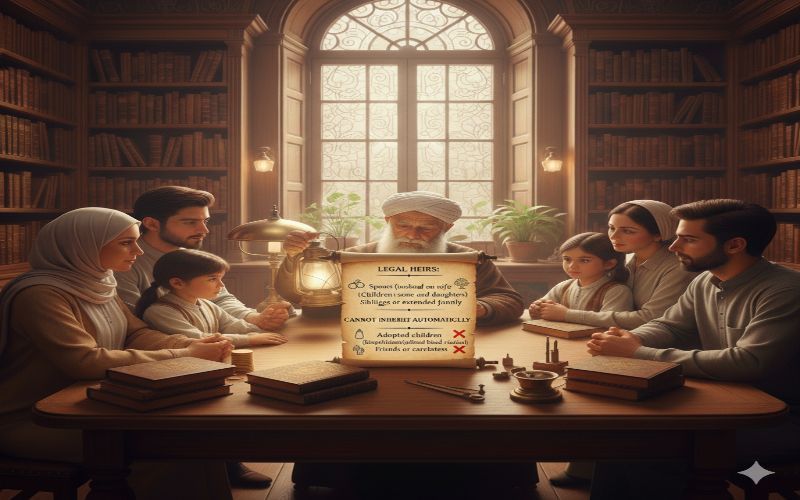
Islam clearly defines who qualifies as a legal heir (warith). Heirs are connected through blood relations or valid marriage, not emotional attachment or personal preference.
Legal heirs generally include:
- Spouse (husband or wife)
- Children (sons and daughters)
- Parents
- In some cases, siblings or extended family
Those who cannot inherit automatically include:
- Adopted children
- Stepchildren (without blood relation)
- Friends or caretakers
This distinction preserves lineage (nasab), which is a core principle in Islam.
Property Distribution When the Deceased Is a Man
When a man passes away, the distribution depends on whether he was married, had children, or had living parents. Islam addresses each scenario clearly.
If a Man Has One Wife and Children
This is one of the most common situations. The wife receives a fixed share, while children inherit the remainder.
Distribution follows this structure:
- Wife receives 1/8 of the total property
- Remaining 7/8 is divided among children
- Sons receive double the share of daughters
This difference is not discrimination but a reflection of financial responsibility, as men are obligated to financially support family members in Islam.
If a Man Has Multiple Wives
Islam allows polygyny with strict justice, and inheritance reflects collective fairness.
In this case:
- All wives together receive 1/8 of the estate
- This 1/8 is divided equally among all wives
- The remainder goes to children according to Islamic rules
Each wife does not receive 1/8 individually,this is a common misconception that often causes conflict.
If a Man Is Married but Has No Children
When a man dies without children:
- Wife receives 1/4 of the property
- Remaining 3/4 goes to parents (if alive) or other heirs
Parents’ presence significantly affects distribution, showing Islam’s emphasis on parental rights.
If a Man Is Not Married
If the deceased man has no wife:
- Parents become primary heirs
- If parents are deceased, siblings or extended relatives may inherit
The estate never becomes ownerless; Islam ensures every lawful heir receives their due.
If a Man Has No Children but Has Adopted a Child
This is a sensitive but important scenario. In Islam:
- Adopted children do not inherit automatically
- Lineage cannot be changed through adoption
However, Islam allows compassion through:
- Wasiyyah (will) of up to 1/3 of property for the adopted child
- Gifts during lifetime (hiba)
This balances care with preservation of lineage.
Property Distribution When the Deceased Is a Woman
Islam grants women independent ownership rights, and their property is distributed separately from their husband’s wealth.
If a Woman Is Married and Has Children
When a married woman with children passes away:
- Husband receives 1/4 of her property
- Remaining 3/4 goes to children
- Sons receive double the share of daughters
This applies regardless of how the property was acquired,inheritance, earnings, or gifts.
If a Woman Is Married but Has No Children
In this scenario:
- Husband receives 1/2 of her estate
- Remaining 1/2 goes to parents or other heirs
This ensures spousal security while preserving family balance.
If a Woman Is Unmarried
An unmarried woman’s property does not go to the state or distant relatives automatically.
Distribution typically follows:
- Parents inherit if alive
- If parents are deceased, siblings inherit
- Extended family follows if no immediate heirs exist
Islam recognizes a woman’s property as fully valid, regardless of marital status.
If a Woman Has an Adopted Child
Just like for men:
- Adopted children are not legal heirs
- A Wasiyyah of up to 1/3 is allowed
Islam encourages kindness but maintains clear legal boundaries.
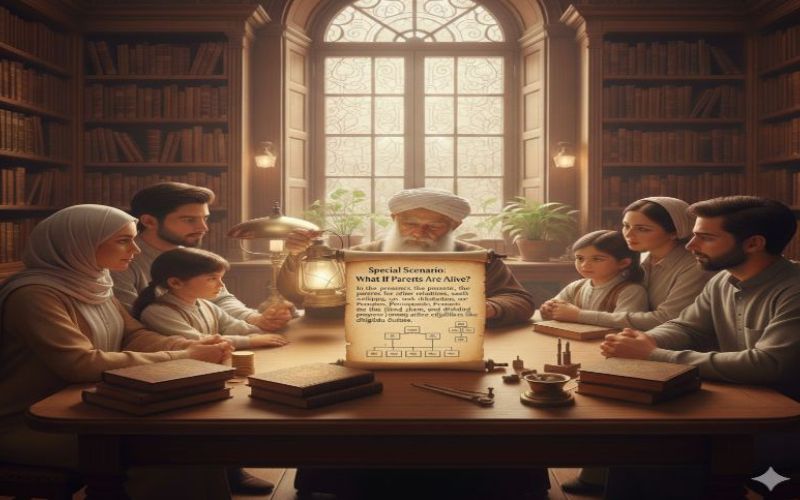
Special Scenario: What If Parents Are Alive?
Parents hold a powerful position in Islamic inheritance.
When parents are alive:
- Each parent may receive 1/6 depending on circumstances
- Their shares may reduce children’s portions
- Parental rights are never ignored
This reinforces Islam’s strong emphasis on honoring parents even after death.
Role of Wasiyyah (Islamic Will)
Wasiyyah allows a Muslim to distribute up to one-third of their property to:
- Non-heirs
- Adopted children
- Charitable causes
Key rules include:
- Cannot exceed one-third
- Cannot benefit legal heirs without consent
- Takes effect only after death
Wasiyyah provides flexibility without violating divine limits.
Common Misconceptions About Islamic Inheritance
Many cultural practices are wrongly attributed to Islam.
Some common myths include:
- “Sons always take everything”
- “Women inherit less in all cases”
- “Adopted children inherit like biological children”
- “A will can override Qur’anic shares”
In reality, Islamic inheritance is balanced, structured, and protective when understood correctly.
Why Islamic Inheritance Promotes Justice
Islamic inheritance is not about equality in numbers but equity in responsibility. Men inherit more in certain cases because they are financially obligated, while women’s shares are theirs alone, with no duty to spend on others.
This system:
- Prevents concentration of wealth
- Protects vulnerable family members
- Reduces long-term disputes
- Preserves family structure
Divine wisdom ensures fairness beyond emotional judgment.
Practical Advice to Avoid Family Disputes
Understanding the law is only part of the solution. Application matters.
To avoid disputes:
- Learn Islamic inheritance rules early
- Write a Shariah-compliant Wasiyyah
- Clear debts transparently
- Consult scholars for complex cases
- Avoid cultural shortcuts
Preparation protects families from conflict.
Final Thoughts: Wisdom Behind Property Distribution After Death in Islam
Property distribution after death in Islam is not a human-made system,it is a divine framework designed to uphold justice, compassion, and balance. Whether the deceased is male or female, married or unmarried, with children or without, Islam provides clear answers for every scenario.
Key takeaways:
- Gender does not determine worth,responsibility does
- Multiple wives share collectively, not competitively
- Adopted children are cared for, not ignored
- Parents’ rights remain central
- Wasiyyah offers flexibility within limits
When followed correctly, Islamic inheritance laws do not divide families,they protect them.
For complex or disputed cases, consulting a qualified Islamic scholar is always recommended, ensuring that Allah’s commands are fulfilled with knowledge and sincerity.


