

Yes, agricultural land can be converted into a residential plot, but only after meeting specific legal conditions and obtaining approvals from relevant authorities. Conversion is generally allowed when land falls near expanding urban limits or approved development zones.
However, conversion is not guaranteed. Authorities consider multiple factors before approval, including:
- Location and zoning status
- Master or development plans
- Availability of access roads and utilities
- Environmental and planning regulations
Because of these conditions, conversion should always be approached as a planned legal process, not an assumption.
Authorities Involved in Land Conversion
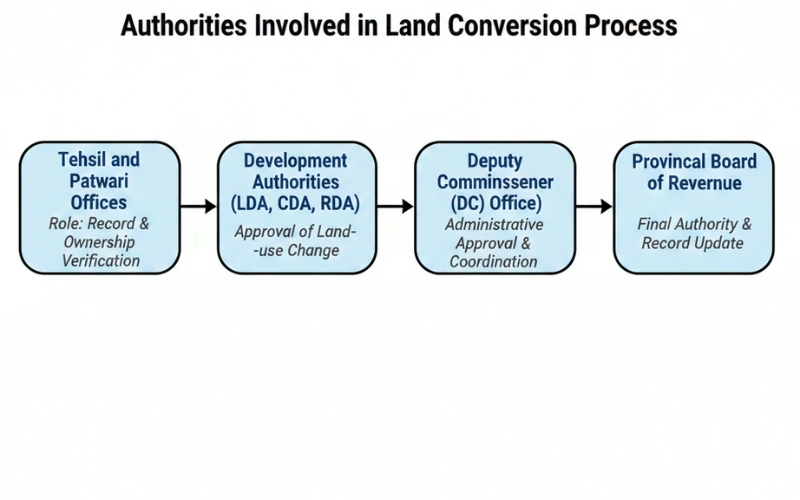
Land conversion is not handled by a single office. Multiple departments are usually involved, depending on the location of the land.
Common authorities include:
- Deputy Commissioner (DC) Office
- Provincial Board of Revenue
- Development Authorities (such as LDA, CDA, RDA)
- Tehsil and Patwari offices for record verification
Each authority plays a different role, from verifying ownership to approving land-use change. Missing even one approval can delay or reject the entire process.
Step-by-Step Process to Convert Agricultural Land into Residential Plot
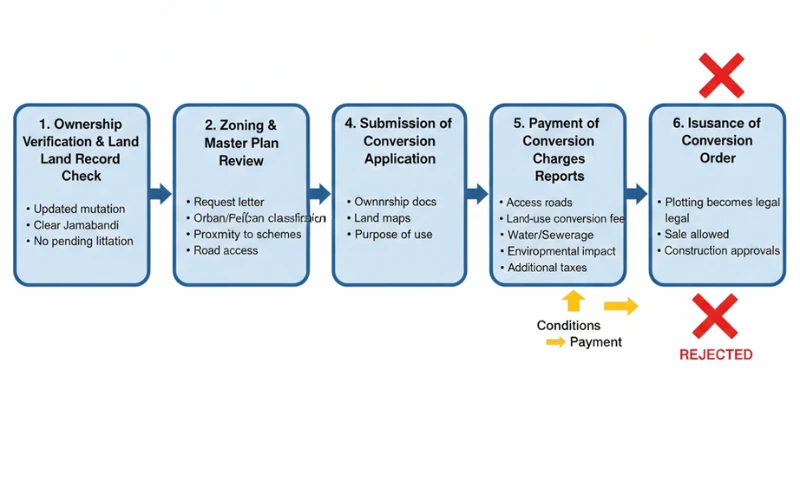
Understanding the process step by step helps avoid confusion and unnecessary delays. While exact steps may vary slightly by province or city, the core process remains similar.
1. Ownership Verification and Land Record Check
Before applying, land ownership must be clear and updated in official records. This includes mutation entries, title verification, and confirmation that no disputes exist.
Key checks usually include:
- Updated mutation in owner’s name
- Clear Jamabandi records
- No pending litigation or claims
Incomplete records often lead to outright rejection.
2. Zoning and Master Plan Review
Authorities review whether the land falls within an area eligible for residential use. This is done by checking zoning maps and master plans.
Important considerations include:
- Urban or peri-urban classification
- Proximity to approved residential schemes
- Road access and planned infrastructure
If the land lies in a protected agricultural or green zone, conversion may not be allowed.
3. Submission of Conversion Application
Once eligibility is confirmed, a formal application is submitted to the DC office or relevant authority.
Applications usually include:
- Conversion request letter
- Ownership documents
- Land maps and site plans
- Purpose of residential use
Accuracy at this stage saves months of follow-ups.
4. Departmental Inspections and Reports
After submission, multiple departments may inspect the land. These inspections assess feasibility, compliance, and impact.
Departments may evaluate:
- Access roads and right of way
- Water, sewerage, and electricity feasibility
- Environmental and drainage impact
Negative inspection reports often result in conditions rather than outright rejection.
5. Payment of Conversion Charges
If approval is granted, authorities issue a demand for conversion fees. These charges vary widely depending on location and land size.
Common charges include:
- Land-use conversion fee
- Development or betterment charges
- Additional taxes or penalties
Payment is mandatory before final approval is issued.
6. Issuance of Conversion Order
After fees are paid, a formal conversion order is issued. This document legally changes the land status from agricultural to residential.
Only after this stage:
- Residential plotting becomes legal
- Sale as a residential plot is allowed
- Construction approvals can be sought
Skipping this step creates long-term legal problems.
Documents Required for Land Conversion
Documentation plays a central role in land conversion. Missing or incorrect documents are the most common reason for delays.
Typically required documents include:
- CNIC copies of landowner
- Ownership deed or mutation copy
- Latest Jamabandi
- Site plan and location map
- No-objection certificates (if applicable)
Some authorities may ask for additional affidavits or undertakings depending on land nature.
Cost of Converting Agricultural Land into Residential
The cost of conversion is not fixed and depends on multiple factors. Location plays the biggest role in determining charges.
Cost components may include:
- Government conversion fee
- Development authority charges
- Survey and mapping costs
- Legal and documentation expenses
Urban-adjacent land generally costs more to convert than rural land. Budget planning should include a margin for unexpected fees.
Time Required for Land Conversion Approval
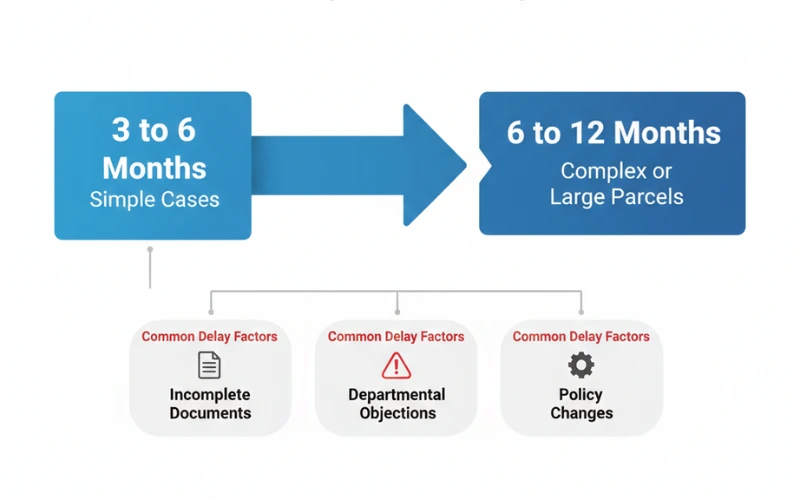
Land conversion is rarely quick. Even straightforward cases require patience.
Average timelines range between:
- 3 to 6 months for simple cases
- 6 to 12 months for complex or large parcels
Delays often occur due to incomplete documents, departmental objections, or policy changes.
When Conversion Is Not Allowed
Not all agricultural land qualifies for residential conversion. Authorities may reject applications outright in certain cases.
Common rejection reasons include:
- Land located in protected agricultural zones
- Proximity to canals, rivers, or forest land
- Violation of master plan restrictions
- Environmental or security concerns
Understanding these limitations early prevents wasted time and money.
Risks of Illegal or Unapproved Conversion
Some landowners attempt informal conversion by selling plots without approval. While this may appear profitable initially, the risks are severe.
Illegal conversion can result in:
- Cancellation of land records
- Heavy fines and penalties
- Demolition notices
- Inability to register sale deeds
Buyers increasingly verify approvals, making unauthorized plots difficult to sell.
Practical Scenarios: Is Conversion Worth It?
Consider a few realistic scenarios to understand decision-making better.
- A farmer near a growing city wants to divide land into plots. Legal conversion increases value but requires upfront cost and patience.
- An investor buys farmland far from urban limits. Conversion may not be allowed, making agricultural use the only option.
- A family plans to build a single home. In some areas, partial residential permission may be granted under local rules.
These scenarios show that context matters more than intention.
Common Mistakes Landowners Make
Many conversion attempts fail due to avoidable mistakes.
Frequent errors include:
- Assuming construction equals conversion
- Relying on verbal assurances
- Ignoring zoning restrictions
- Underestimating costs and timelines
Avoiding these mistakes saves years of legal trouble.
When Professional Help Becomes Necessary
While small cases may be handled independently, professional help is essential when:
- Land area is large
- Multiple owners are involved
- Development authorities are part of approval
- Investment value is high
A qualified land lawyer or consultant ensures compliance at every stage.
Final Thoughts: How to Convert Agricultural Land into Residential Plot Safely
Converting agricultural land into residential use can significantly increase land value and usability,but only when done legally and strategically.
To summarize clearly:
- Conversion requires formal government approval
- Zoning and location determine eligibility
- Costs and timelines vary widely
- Illegal shortcuts carry long-term risks
If you approach the process with proper planning, verified records, and legal compliance, land conversion can be a smart and secure investment decision rather than a costly gamble.
Understanding how to convert agricultural land into residential plots is not just about paperwork,it is about protecting your asset for the future.