
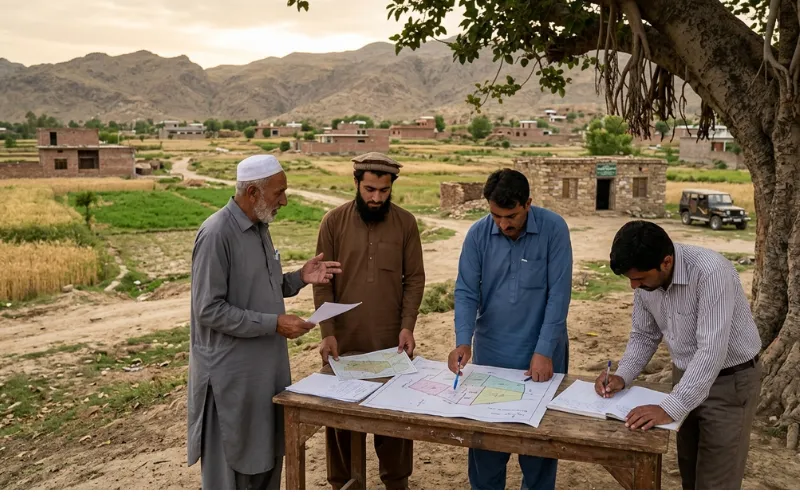

Converting land from rural to urban classification in KPK is not a single application but a two-track process. The first track is obtaining planning authority approval, which means getting a No Objection Certificate or development approval from the relevant authority confirming that the land can lawfully be used for non-agricultural, residential, or commercial purposes. The second track is the revenue record update, where the change is reflected in the Khasra Girdawari and Jamabandi after the planning approval is in hand. You cannot complete the second track without completing the first, and completing the first without the second leaves your property classified as agricultural in the revenue record, which creates practical problems for building permits, utilities, and future sales.
In KPK, the responsible authority for planning approval depends on where the land is located. For land within Peshawar’s jurisdiction, it is the Peshawar Development Authority (PDA). For other district urban areas, it is the relevant Development Authority or Tehsil Municipal Administration. For land that will be developed as a housing scheme or subdivision, it is the PDA Act 2017 framework. The revenue record update after approval is handled by the Board of Revenue KPK through the Tehsildar and Patwari at the relevant revenue estate level.
Why the Rural vs Urban Distinction Matters
Land classified as rural or agricultural in the KPK revenue record carries specific legal and practical consequences. Agricultural land is governed by the Agricultural Income Tax Act 2025 and Land Tax framework rather than the Urban Immovable Property Tax. It is assessed under the Khasra Girdawari as cultivated, fallow, or uncultivated land based on seasonal crop inspection conducted by the Patwari every six months. Building on agricultural land without prior conversion approval is illegal under the PDA Act 2017 and local building bylaws, and any structure built without approval can be demolished by the relevant authority.
When the Khasra Girdawari continues to show land as agricultural even though construction has taken place or is planned, the property owner faces several problems. Utility connections for electricity, gas, and water are typically not extended to structures built on unconverted agricultural land. Future buyers and their lawyers will flag the agricultural classification as a defect in the title. Banks will not extend mortgage loans against agricultural land intended for residential use. Revenue authorities may also raise objections during any future mutation process.
The rural to urban conversion therefore serves three functions simultaneously: it legalises the intended use, clears the path for building permits and utility connections, and updates the revenue record to reflect the property’s actual character.
Track One: Planning Authority Approval
For land within Peshawar city and its surrounding growth zones, the Peshawar Development Authority is the relevant planning authority. The PDA was established under the Urban Planning Ordinance 1978, restructured under the PDA Act 2017, and operates under the administrative control of the Physical Planning and Housing Department of KPK. Its contact is at info.pda@kp.gov.pk and 091-9217026.
For land to be converted from agricultural to residential or commercial use within the PDA jurisdiction, the landowner must submit an application to the PDA demonstrating that the proposed use aligns with the approved land use plan or master plan for the area. The PDA Act 2017 requires that any scheme or development covering 160 kanals or more obtain PDA approval, while schemes under 160 kanals require approval from the relevant Tehsil Municipal Administration. Individual plots seeking reclassification as residential follow a similar approval pathway but at the individual parcel level rather than as a scheme.
The application to the PDA or TMA for change of land use typically requires the following documents, which mirror the standard practice for DC Conversion across Pakistan as confirmed by government document services providers:
The owner’s CNIC and proof of ownership, which means the current certified Fard showing ownership in the Jamabandi. The Khasra and Khewat number details from the revenue record confirming the exact parcel. A site map or sketch plan showing the location of the land within the Mauza, prepared by a licensed surveyor or engineer. A copy of the relevant Shajra Kishtwar (cadastral map) showing the parcel in relation to surrounding land. A declaration that the land is free from encumbrances, including any mortgage, litigation, or government notice. Any previous NOCs or clearances from the local government authority if the area has been partially developed.
Once the application is submitted, the relevant authority verifies the documents, conducts or commissions a site inspection, and checks whether the proposed use is consistent with the notified land use plan for the area. If the proposed conversion is consistent with the plan, it should be approved. If the land is in a zone designated for agricultural use or green belt under the approved plan, conversion may be refused or may require a formal plan amendment, which is a separate and more complex process.
The Peshawar Development Authority’s forensic audit experience, which found 295 housing societies operating illegally in KPK, demonstrates that the most common failure is proceeding with development without this approval rather than going through the proper channel. Land that has been developed without PDA or TMA approval cannot be retrospectively legitimised by a revenue record change alone.
Track Two: Revenue Record Update through the Collector
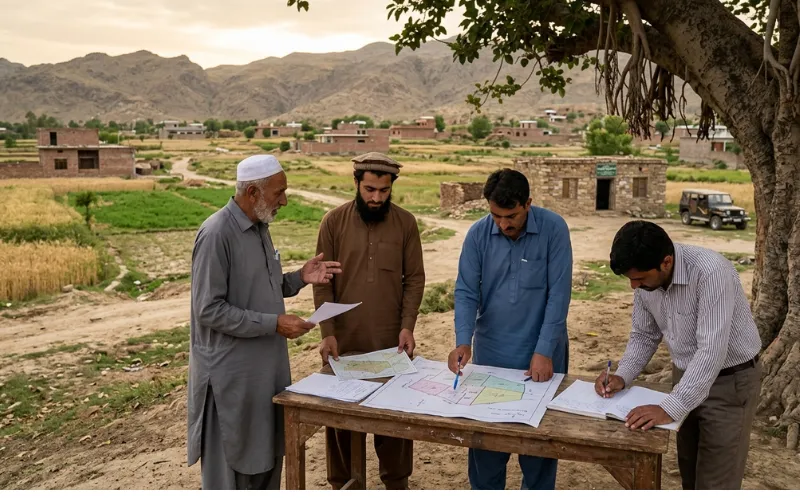
Once the planning authority has issued its approval or NOC for the change of land use, the second step is updating the revenue record to reflect the new classification. This is handled through an application to the Deputy Commissioner (Collector) of the district, who is the head of the revenue hierarchy at the district level and holds authority over land use entries in the revenue record.
The Deputy Commissioner is the chief revenue officer of each district in KPK and has supervisory authority over all revenue officers including Tehsildars, Naib Tehsildars, Kanungos, and Patwaris. A DC Conversion Order, as it is commonly called, is the formal revenue record instrument that changes the land use classification from agricultural to non-agricultural and is required before the Patwari can update the Khasra Girdawari entry for your parcel.
The application to the Deputy Commissioner for a conversion order includes the planning authority’s approval or NOC, the ownership documents, the Fard confirming current classification, and a formal request letter identifying the Khasra numbers to be reclassified. The Deputy Commissioner or the designated revenue officer will verify the documents and, if satisfied that the planning approval is in order and there are no outstanding revenue dues or litigation against the land, will issue the conversion order.
This order is then used to instruct the Patwari to update the Khasra Girdawari entry for those Khasra numbers, changing the classification from cultivated agricultural or uncultivated land to abadi (residential) or ghair zara’at (non-agricultural). The Patwari records this change in the Roznamcha Waqiati daily diary and makes the notation in the next cycle’s Girdawari inspection record. The Jamabandi is updated at the next four-yearly revision to reflect the changed use, though the Girdawari update is the operative record change.
Districts Outside PDA Jurisdiction
Not all of KPK falls within the Peshawar Development Authority’s jurisdiction. Each district has its own development planning framework. For urban areas in districts like Mardan, Abbottabad, Kohat, Swat, Haripur, and others, the relevant local authority is the Tehsil Municipal Administration or the relevant District Development Authority where one exists.
For land outside any formally notified urban area, the concept of rural to urban conversion is inherently linked to whether the area has been notified as urban by the KPK Local Government Department. Land is classified as rural or urban in Pakistan’s revenue system partly based on its location within or outside a formally notified urban area. The KP Local Government and Rural Development Department issues notifications expanding or contracting urban area boundaries, and these notifications trigger the re-categorisation of estates from rural to urban in the revenue record.
If your land falls in an area that has been physically absorbed by urban expansion but has not yet been formally notified as urban, the reclassification may require first obtaining a gazette notification from the Local Government Department extending the urban area boundary to include your estate. This is an administrative process initiated by the relevant TMA or District Government rather than the individual landowner, and it typically requires engagement with the local elected representatives and district administration.
The Khasra Girdawari as the Operative Record
The Khasra Girdawari is the bi-annual harvest inspection register in which the Patwari records the current use of every parcel in a revenue estate. It is conducted twice per year corresponding to the Rabi (winter) and Kharif (summer) crop seasons. The Girdawari entry shows the Qism Zamin (type of land use), which for agricultural parcels lists the crop or fallow status, and for non-agricultural parcels records the use as abadi, jungle, sailab, or other non-cultivated category.
For a rural to urban reclassification to be complete in the revenue record, the Patwari’s Girdawari entry for the relevant Khasra numbers must be changed from an agricultural classification to abadi or a comparable non-agricultural entry. This change can only be made after the DC Conversion Order or equivalent authority. Without that order, the Patwari has no authority to alter the Girdawari classification, regardless of what has physically happened on the ground.
After the Girdawari is updated, the next four-yearly Jamabandi revision will incorporate the new classification into the permanent revenue record. In the interim, the Girdawari entry itself serves as the operative documentary evidence of the changed use for purposes of building permits, utility applications, and property transactions.
What Happens if You Build Without Converting
Building on agricultural land in KPK without obtaining the PDA or TMA approval and DC Conversion Order first creates a legally vulnerable situation. The structure has no building permit. The Khasra Girdawari continues to show agricultural use, which contradicts the actual state of the land. Utility companies and WAPDA treat the site as agricultural and may refuse connections or disconnect existing ones. The PDA has demonstrated willingness to register FIRs and initiate demolition proceedings against illegal construction on agricultural land.
When the property is eventually sold, the buyer’s verification of the revenue record will reveal the agricultural classification, which will either deter the purchase or depress the price significantly. The buyer’s lawyer will flag the absence of a conversion order as an unresolved encumbrance on the title. Any sale mutation process may be flagged at the SDC level if the Girdawari shows the land as agricultural while a residential sale deed is being presented.
Retrospective regularisation is sometimes possible if the area has since been included in a notified urban zone or if the PDA runs a regularisation scheme, but these are not guaranteed and carry their own fees and conditions.
Agricultural Land Conversion to Residential
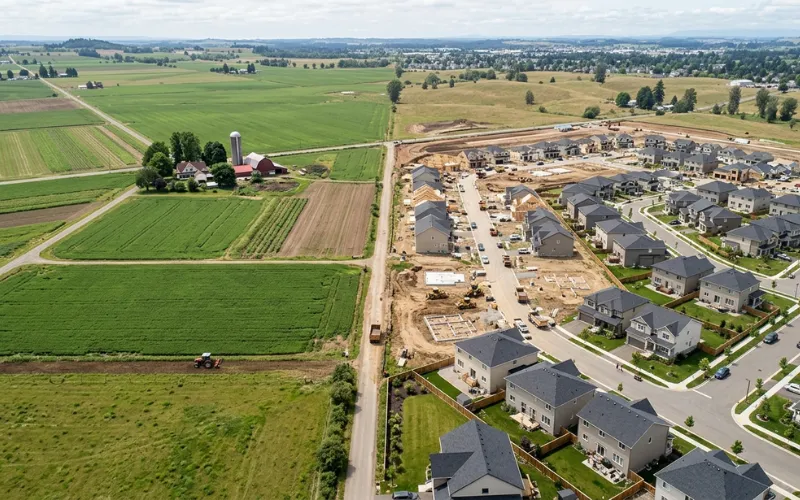
The conversion of agricultural land to residential use is the most common form of the rural to urban process in KPK and reflects the province’s rapid peri-urban expansion, particularly around Peshawar, Mardan, Nowshera, and Abbottabad. The key legal constraint is that agricultural land intended for residential development cannot simply be subdivided into plots and sold without PDA or TMA approval regardless of the plot size or the buyer’s intentions.
Where the proposed residential use is consistent with the area’s approved land use plan and the land is not in a restricted zone (agricultural belt, green belt, flood plain, or government-reserved land), the conversion process follows the two-track approach described above and is a procedural rather than substantive challenge. Where the land is in a zone marked for continued agricultural use in the master plan, conversion requires either a formal plan amendment or waiting for the next master plan revision to bring it within a residential zone.
Frequently Asked Questions
Who approves the change of land use in KPK?
For Peshawar district, the Peshawar Development Authority (PDA) is the planning approval authority. For other districts, the relevant Tehsil Municipal Administration or District Development Authority holds this function. The Deputy Commissioner then issues the DC Conversion Order for the revenue record update after the planning authority’s NOC is in hand.
What documents are needed to convert agricultural land to residential in KPK?
You typically need the current Fard confirming ownership and current land use, the Khewat and Khasra numbers identifying the exact parcel, a site plan prepared by a licensed surveyor, proof that the land is free from encumbrances, and your CNIC. Once planning approval is obtained, you also need that NOC to present to the Deputy Commissioner for the revenue record conversion order.
Can I sell agricultural land as residential before getting a conversion order?
You can sell agricultural land as agricultural land. Selling it as residential without a conversion order is misrepresentation and creates a defective title. The buyer’s revenue record check will reveal the agricultural Girdawari classification. Any subsequent dispute will be resolved against the seller’s representations, and the buyer may rescind the transaction or claim damages.
How long does the rural to urban conversion process take in KPK?
There is no fixed statutory timeline for the PDA NOC or DC Conversion Order in KPK comparable to the 30-day or 60-day timelines in some other jurisdictions. In practice, the process can take weeks to several months depending on the district, the workload of the relevant authority, and whether the proposed use is unambiguously consistent with the approved land use plan.
Does the Khasra Girdawari automatically update after a sale deed registers the land as residential?
No. The Khasra Girdawari is updated by the Patwari based on actual land use and authorized instructions, not by the existence of a registered deed. A deed registering a sale for residential use does not by itself change the Girdawari entry. The DC Conversion Order and the Patwari’s subsequent Girdawari update are the steps that change the revenue record classification.