


The total cost of transferring land in KPK for a filer buying and selling at the DC rate breaks down into three provincial fees and two federal advance taxes. The provincial fees are stamp duty at 3% of the DC rate value, registration fee at 1%, and mutation fee at 0.5%, totalling 4.5% of the DC rate on the provincial side. The federal advance taxes are Section 236K paid by the buyer at 1.5% (filer, up to Rs 50 million) and Section 236C paid by the seller at 4.5% (filer, up to Rs 50 million), both calculated on the higher of the DC rate or FBR valuation. A local government transfer tax of 1% of the property value also applies. Capital Gains Tax on profit is a separate obligation for the seller that depends on the holding period and acquisition date.
All rates on this page are verified against the Finance Act 2025, effective from July 1 2025, and the KPK Revenue and Estate Department’s FY 2024-25 provincial fee schedule. Verify the current DC rate for your specific property with the relevant Tehsildar before calculating.
Understanding DC Rate vs Market Value
Every provincial fee in KPK is calculated on the DC rate, not the market price you actually negotiate. The DC rate is the official valuation set by the Deputy Commissioner for each area and property category. It is typically 30 to 50 percent lower than actual market value. This gap is significant for budgeting purposes: a property worth Rs 10 million in the market may have a DC rate of Rs 5 to 7 million, and your stamp duty, registration fee, and mutation fee will all be calculated on that lower official figure.
The FBR separately maintains its own valuation of immovable properties in major cities. For the advance taxes under Sections 236C and 236K, the calculation uses the higher of the DC rate or the FBR valuation. In some urban areas of KPK, particularly Peshawar, the FBR rate is higher than the DC rate, which means the federal advance tax base is larger than the provincial fee base. In rural areas and districts where FBR has not published a separate valuation, the DC rate applies to both.
The stamp duty is a non-adjustable, non-refundable sunk cost. The advance taxes under 236C and 236K, by contrast, are adjustable, meaning both buyer and seller can offset them against their annual income tax liability. If your total income tax for the year is lower than the advance tax you paid, you can claim a refund.
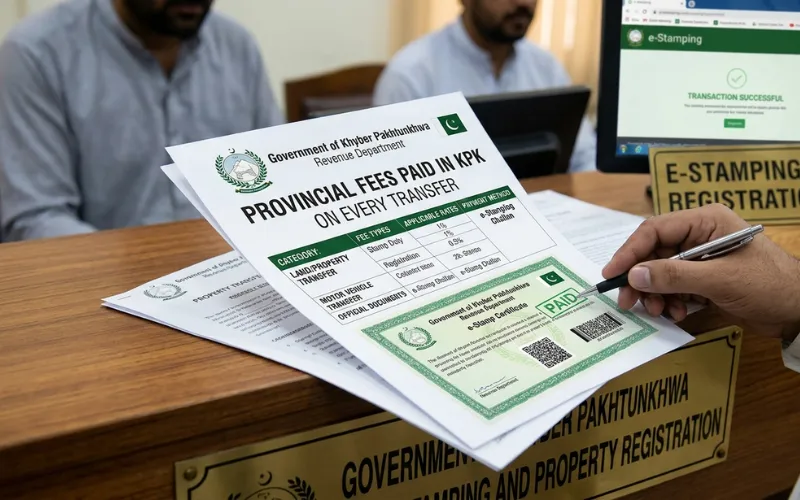
Provincial Fees Paid in KPK on Every Transfer
KPK’s provincial transfer fees are lower than Punjab and Sindh’s. The combined stamp duty, registration fee, and mutation fee in KPK total 4.5% of the DC rate, compared to Punjab’s combined rate which includes higher individual components.
Stamp duty in KPK is 3% of the DC rate value. This was confirmed by TaxToday.pk’s Finance Act 2025 verified calculator and is lower than Punjab and Sindh at 5%. Stamp duty is paid through Challan Form 32-A before the sale deed is executed at the Sub-Registrar. Since December 2025, Peshawar’s e-registry system integrates stamp duty payment directly into the e-registration workflow through the e-stamping portal at estamping.kp.gov.pk.
Registration fee in KPK is 1% of the DC rate value. This is paid at the Sub-Registrar office at the time of deed registration and goes to the provincial government.
Mutation fee in KPK is 0.5% of the DC rate value. This is paid to the Revenue Department when the mutation application is submitted after the registered deed is obtained. Mutation updates the revenue record to show the new owner’s name in the Jamabandi.
The local government transfer tax, also called the Transfer of Immovable Property tax or TIP, is 1% of the property value in KPK. This was reduced in KPK’s recent budget from a higher rate. It is collected by the relevant local government authority and is a separate charge from the provincial stamp duty and registration fees.
Together, the four provincial and local charges amount to 5.5% of the property value base in KPK, which is significantly lower than the combined provincial transfer cost in Sindh and only slightly higher than Punjab’s reduced rates.
Federal Advance Tax on the Buyer: Section 236K
Section 236K of the Income Tax Ordinance 2001 requires the buyer of immovable property to pay advance income tax at the time of transfer or registration. These rates apply from July 1 2025 under the Finance Act 2025 and differ based on the buyer’s filer status on the FBR Active Taxpayer List.
For active filers, the 236K rates are 1.5% for properties up to Rs 50 million, 3.5% for properties between Rs 50 million and Rs 100 million, and 4% for properties above Rs 100 million. For late filers, the rates are 3.5%, 6.5%, and 8% respectively. For non-filers, the rates are 12%, 16%, and 18.5% respectively. Non-filers are also barred entirely from property transactions above Rs 100 million under Section 114C of the Income Tax Ordinance, which was introduced in the Finance Act 2025.
The Finance Act 2025 reduced the 236K filer rate from 3% to 1.5% for the under-Rs-50-million bracket. This is a significant reduction and one of the most buyer-friendly changes in the 2025-26 tax year.
Section 236K is an adjustable advance tax. The buyer can offset the amount paid under 236K against their annual income tax liability. If the total income tax owed for the year is less than the amount paid, a refund can be claimed.
Federal Advance Tax on the Seller: Section 236C
Section 236C requires the seller of immovable property to pay advance income tax at the time of transfer. Unlike the 236K reduction, the Finance Act 2025 increased the seller-side advance tax rate for filers.
For active filers, the 236C rates are 4.5% for properties up to Rs 50 million, 6.5% for properties between Rs 50 million and Rs 100 million, and 7% for properties above Rs 100 million. For late filers, the rates are 7%, 9%, and 11% respectively. For non-filers, the rate is a flat 11.5% across all value brackets.
Like 236K, Section 236C is an adjustable advance tax. The amount paid under 236C is offset against the seller’s Capital Gains Tax liability. If the Capital Gains Tax owed on the profit is greater than the 236C already paid, the seller pays the difference. If 236C exceeds the CGT liability, the seller can claim a refund when filing the annual income tax return.
Overseas Pakistanis holding a POC, NICOP, or valid Pakistani passport who have been abroad for 182 days or more in a tax year qualify for the filer rate under both 236C and 236K, even if they are not on the FBR Active Taxpayer List. They must access the FBR portal through the Overseas Pakistanis link to generate the PSID and process the payment at the filer rate. This provision is confirmed in the FBR’s own FAQ on overseas Pakistani advance tax rates.
Capital Gains Tax on the Seller
Capital Gains Tax applies to the profit the seller makes on the sale, not to the full sale price. The rules differ depending on when the property was originally purchased.
For properties purchased on or after July 1 2024, a flat 15% CGT applies to the profit regardless of how long the property was held. This means a seller who bought a property in August 2024 and sells it in 2026 owes 15% of whatever profit they made. For active filers, the rate is 15%. For non-filers and late filers, higher rates apply as part of the general income tax slab structure.
For properties purchased before July 1 2024, the old sliding scale continues to apply. The CGT starts at 15% in the first year of ownership and decreases by 2.5% each year until it reaches 0% after six years of holding. A seller who bought before July 2024 and has held the property for four years owes CGT at 5% of the profit, for example.
CGT is adjusted against 236C. The advance tax paid under 236C is credited against the CGT liability. If the 236C paid is Rs 450,000 and the actual CGT on profit is Rs 600,000, the seller pays only the Rs 150,000 difference. If the 236C exceeds the CGT, a refund is due.
What Buyers Pay vs What Sellers Pay
It helps to separate the costs into who owes what:
The buyer’s obligations are stamp duty at 3% of the DC rate (non-adjustable), registration fee at 1% of the DC rate (non-adjustable), local government TIP tax at 1% of the property value (non-adjustable), Section 236K advance tax at 1.5% to 18.5% depending on filer status and value (adjustable), and the mutation fee at 0.5% of the DC rate (non-adjustable) typically paid after possession. In total, excluding the adjustable 236K, a filer buyer’s non-recoverable outlay on provincial and local fees is 5.5% of the DC rate value.
The seller’s obligations are Section 236C advance tax at 4.5% to 11.5% depending on filer status and value (adjustable), and Capital Gains Tax on profit, adjusted against the 236C paid. The seller bears no stamp duty, registration fee, or mutation fee in a standard sale.
A Worked Example
For a filer-to-filer transaction on a property with a DC rate of Rs 5 million and an FBR value also of Rs 5 million, the costs at the time of transfer are as follows. The buyer pays stamp duty of Rs 150,000 (3%), registration fee of Rs 50,000 (1%), local government TIP of Rs 50,000 (1%), and 236K advance tax of Rs 75,000 (1.5%). The buyer’s total outlay at transfer is Rs 325,000, of which Rs 75,000 is recoverable against the annual tax return. The non-recoverable cost to the buyer is Rs 250,000, or 5% of the DC rate.
The seller pays 236C advance tax of Rs 225,000 (4.5%). The CGT depends on the actual profit and holding period. If the property was bought for Rs 3.5 million and the market sale is at Rs 5 million, the profit is Rs 1.5 million, and CGT at 15% is Rs 225,000. Since 236C already paid equals Rs 225,000, the net additional CGT payment at filing is zero.
The mutation fee of Rs 25,000 (0.5%) is paid after the transfer, usually by the buyer.
KPK vs Punjab: Why KPK’s Costs Are Lower Provincially
KPK’s stamp duty of 3% is lower than Punjab and Sindh at 5%. This makes KPK one of the more affordable provinces for the non-recoverable provincial component of a property transfer. The World Bank Land Sector Review of KPK noted that the province’s combined transfer taxes including provincial and local charges stood at 6% of asset value at the time of that report, compared to Punjab’s 2%, though subsequent budget cuts to local government rates have since narrowed that gap.
The provincial government has made deliberate cuts in KPK’s transfer tax structure over recent budget cycles, including reducing local council transfer taxes to 1% and cutting commercial property holding taxes. The e-stamping and e-registry systems launched in 2025 and 2026 also reduce informal costs such as deed writer fees and agent facilitation payments that previously added to the effective cost of transfer outside the official fee schedule.
Checking Your Stamp Duty Before Transfer
The e-stamping portal at estamping.kp.gov.pk provides a DC valuation calculator for KPK property that allows you to determine the stamp duty amount based on the registered DC rate for your property location before visiting the Sub-Registrar. Generating an e-stamp through the portal and paying through PSID via any bank or mobile wallet removes the need to purchase physical stamp papers from vendors and reduces the risk of under-stamping.
For the FBR valuation applicable to your property, check the FBR’s immovable property valuation table for the relevant city at fbr.gov.pk. Where the FBR rate exceeds the DC rate for your area, use the FBR figure as the base for calculating 236C and 236K.

Filer Status and Its Impact on Total Cost
The difference between filer and non-filer costs in KPK property transfers has widened significantly under the Finance Act 2025. On a Rs 10 million property, a non-filer buyer owes 12% under 236K versus 1.5% for a filer, a difference of Rs 1,050,000 on a single transaction. The non-filer seller owes 11.5% versus 4.5% for a filer under 236C, a further difference of Rs 700,000. Together, non-filer status adds Rs 1.75 million in advance tax costs to a Rs 10 million transaction compared to filer status.
Checking and maintaining your filer vs non-filer status before any property transaction is one of the highest-value actions a KPK property buyer or seller can take. Verify your status on the FBR Active Taxpayer List at fbr.gov.pk before signing any agreement.
Frequently Asked Questions
What is the stamp duty rate in KPK?
Stamp duty in KPK is 3% of the DC rate value of the property, as confirmed by the Finance Act 2025 verified sources. This is lower than Punjab and Sindh which charge 5%. Stamp duty is non-adjustable and non-refundable.
Who pays the mutation fee in KPK?
The mutation fee of 0.5% of the DC rate is conventionally paid by the buyer, as the mutation updates the revenue record to the buyer’s name. It is paid to the Revenue Department when the mutation application is submitted to the SDC after the registered sale deed is obtained.
Can overseas Pakistanis avail filer rates on Section 236C and 236K in KPK?
Yes. Overseas Pakistanis who hold a POC, NICOP, or valid Pakistani passport and can demonstrate foreign residence of at least 182 days in a tax year qualify for filer rates under both Section 236C and Section 236K, regardless of whether they are on the FBR Active Taxpayer List. They process this through the Overseas Pakistanis link on the FBR portal when generating the PSID for payment.
Are Section 236C and 236K refundable?
Both are adjustable advance taxes. They can be offset against the taxpayer’s annual income tax liability when filing the annual return. If the amount paid exceeds the actual tax liability, a refund can be claimed. They are not automatically refunded at the time of transaction.
What changed in KPK property transfer taxes under the Finance Act 2025?
The Finance Act 2025, effective July 1 2025, reduced the Section 236K filer rate from 3% to 1.5% for properties up to Rs 50 million, increased the Section 236C filer rate from 3% to 4.5%, abolished the Federal Excise Duty on property transfers, and barred non-filers from transactions above Rs 100 million under Section 114C. Stamp duty rates and provincial fees were not changed by the Finance Act 2025.