
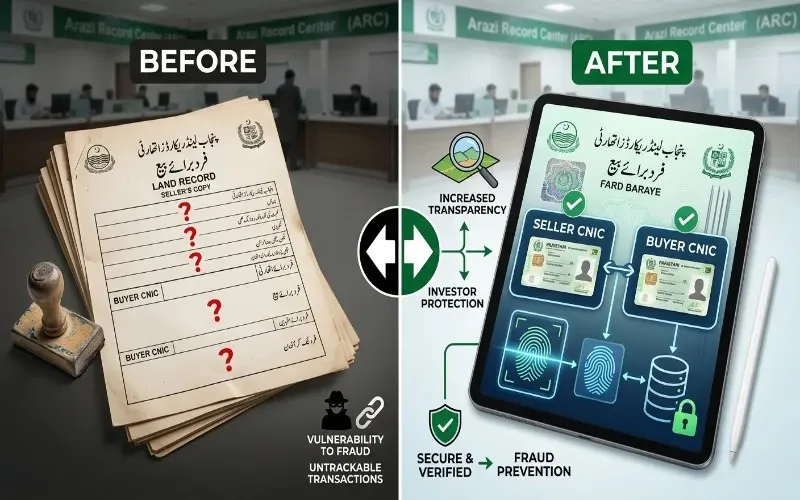

The Punjab Land Records Authority made it mandatory in January 2026 for the buyer’s full name and CNIC number to be included on the Fard Baraye Bay at the time of its issuance. No Fard Baraye Bay can now be processed without the buyer’s identity being entered into the PLRA system, creating a permanent digital link between the sale document and the specific person it was issued for.
This single requirement, simple on the surface, closes one of the most exploited loopholes in Punjab’s property transaction system. A Fard Baraye Bay issued without a named buyer was a blank-slate document that could be reused, duplicated, or transferred to a different buyer than the one intended. That flexibility made it a tool for fraud. The new rule eliminates that flexibility entirely.
What the Fard Baraye Bay Actually Is
Before understanding what changed, it is worth being clear about what this document is and where it sits in a property sale. The Fard Baraye Bay, also referred to as Fard-e-Bay or Sale Fard, is an official document issued by the PLRA that confirms a seller’s legal ownership of a piece of land and verifies that the property is free of disputes, encumbrances, or other legal complications that would prevent a lawful transfer.
This is not an optional document. PLRA officials have been emphatic that without a valid Fard Baraye Bay, no property transaction in Punjab can be legally completed. The Sub-Registrar’s office requires it before processing a sale deed or registry. If this document is missing, incomplete, or outdated at the time of registry, the transaction cannot proceed. It is the seller’s document in the sense that the seller applies for it, but its content and legal standing directly protect the buyer too, because it confirms the seller’s right to transfer.
What the Old System Allowed and Why It Was a Problem
Under the system that existed before this rule, a Fard Baraye Bay was issued in the seller’s name confirming their ownership but without specifying who the buyer was. The document was then used to complete the registry at the Sub-Registrar’s office. In a straightforward, honest transaction, this worked reasonably well.
The problem was what could happen in between. A seller could obtain a Fard Baraye Bay and then use it in negotiations with multiple prospective buyers simultaneously. A fraudulent seller could take a deposit from one buyer, show them the Fard Baraye Bay as proof of intent to sell, and then use the same document to complete a registry with a different buyer. Duplicate Fards could be produced using the original as a template. A Fard obtained for one transaction could be repurposed for another. The absence of a named buyer on the face of the document made all of these abuses much easier.
Property fraud in Punjab’s land records system has historically involved exactly these kinds of document manipulation patterns. The traditional Patwari system, which PLRA has been systematically replacing, was particularly vulnerable because paper-based records could be altered, duplicated, or backdated without generating any auditable digital trail.

What the New Rule Requires
From January 2026 onward, when a seller applies for a Fard Baraye Bay through the PLRA portal at punjab-zameen.gov.pk or at an Arazi Record Centre, they must provide:
- The full legal name of the intended buyer, exactly as it appears on their CNIC
- The buyer’s 13-digit CNIC number
These two pieces of information are entered into the PLRA system at the time the Fard Baraye Bay is generated. They are embedded in the document itself and linked to the buyer’s CNIC record in NADRA’s national identity database from the point of issuance.
The result is that every Fard Baraye Bay in the system now carries a named buyer. The document is no longer a general confirmation of the seller’s right to sell. It is a transaction-specific document tied to a specific seller and a specific buyer. Sharing, reusing, or presenting it in connection with any other buyer or any other transaction is immediately detectable.
How the Digital Record Changes the Accountability Structure
The buyer’s CNIC being entered into the PLRA system at issuance does more than just print a name on the document. It creates a traceable, verifiable, time-stamped digital record in the PLRA database linking the Fard Baraye Bay to both the seller’s property record and the buyer’s CNIC at the moment the document was generated.
This means several things in practice. Any party, including the Sub-Registrar processing the registry, can verify online whether the Fard Baraye Bay presented matches the buyer who is actually present at the registry. If the buyer presenting the document at the registry office does not match the CNIC recorded in the system when the Fard was issued, the discrepancy is immediately visible. A buyer in a genuine transaction also benefits because they can verify through the PLRA portal that the Fard Baraye Bay obtained by the seller is specifically tied to their name and CNIC, giving them confidence that the document has not been used or shown to any other party.
PLRA officials have specifically highlighted that this mechanism will discourage duplicate Fards and prevent unauthorized use of ownership records, because the digital trail connecting each Fard Baraye Bay to a specific buyer CNIC makes the document’s intended purpose traceable from creation to completion.
The Connection to the Broader Fraud Prevention Framework
This rule did not emerge in isolation. It is one part of a broader set of reforms introduced through the Punjab Land Revenue (Amendment) Ordinance 2026 and related PLRA policy changes aimed at eliminating paper-based manipulation and reducing dependence on the traditional Patwari system.
Other reforms introduced around the same period include the mandatory e-registration of all land transfers, the restriction of Patwari authority to inheritance-only mutations, and the introduction of digital summons and electronic notice procedures. Together these reforms are designed to remove the informal, person-to-person paper chain that historically characterized property transactions in Punjab and replace it with a system where every step generates a verifiable, unalterable digital record.
The Fard Baraye Bay buyer CNIC requirement is the point in this chain where the buyer enters the official record. Before registry, before mutation, before possession, the buyer’s identity is now formally anchored in the PLRA system at the point the sale document is prepared.
What This Means for Buyers Practically
For anyone buying property in Punjab, this rule changes what you should verify and when. A Fard Baraye Bay presented to you by a seller that does not carry your name and CNIC is not valid under the new requirement. It cannot be used to complete your registry. Either it was obtained before the new rule came into effect, or it was issued for a different buyer entirely.
Before proceeding with any payment or commitment in a property purchase, confirm the following:
- The seller has applied for or obtained a Fard Baraye Bay specifically with your name and CNIC number entered at issuance
- The CNIC printed on the Fard Baraye Bay matches your own 13-digit CNIC exactly, with no digit transpositions or name spelling variations
- You can independently verify the document’s details through the PLRA portal at punjab-zameen.gov.pk, where the digital record linked to that Fard should reflect your information
The QR code on every digitally issued Fard Baraye Bay can be scanned to check its authenticity and the details recorded in the PLRA database against what appears on the printed or PDF document. If the scan confirms your name and CNIC are correctly linked, you have a verified, transaction-specific document. If there is any mismatch, stop the transaction and seek clarification before proceeding further.
What This Means for Sellers Practically
The new rule means a seller can no longer obtain a Fard Baraye Bay speculatively and then shop it around to multiple buyers. The moment they apply for the document, they must commit to a specific buyer by entering that person’s name and CNIC. Obtaining a Fard Baraye Bay with one buyer’s CNIC and then attempting to complete a registry with a different buyer creates a verifiable discrepancy in the PLRA database.
This shifts the sequence of a property sale in a meaningful way. A seller and buyer must have reached an agreement on identity before the Fard Baraye Bay can be applied for. In practice, this means the buyer’s CNIC should be shared and confirmed with the seller before the Fard application is submitted. The old practice of the seller obtaining the Fard first and then presenting it to whichever buyer they find is no longer compatible with the system.
PLRA has advised property owners and sellers to obtain the Fard Baraye Bay well in advance of the intended registry date to avoid last-minute delays, particularly as property market activity has been rising across the province. Advance preparation also means the buyer’s identity is locked in and verified before the registry appointment is booked.
Benami Transactions and the Practical Deterrent
One of the less-discussed but significant effects of requiring the buyer’s CNIC is its impact on benami property dealings. A benami transaction is one where property is purchased in someone else’s name, either to conceal ownership or to avoid regulatory scrutiny. Under the old Fard Baraye Bay system, the absence of a named buyer made it easier to complete a transaction without creating a clear CNIC-linked record of who was actually acquiring the property.
With the buyer’s CNIC now mandatory on the Fard Baraye Bay from the point of issuance, the identity of the party acquiring the property is formally embedded in the system before registry. This does not make benami transactions impossible, but it creates a documented record that connects a specific CNIC to each acquisition, making such arrangements more traceable if they are later investigated.
For checking land ownership and verifying transactions that occurred before this rule, the absence of a buyer CNIC on an older Fard Baraye Bay is expected and not itself a sign of fraud. The rule applies prospectively from January 2026 onward.
How to Apply for the Fard Baraye Bay Under the New Rule
The application process follows the same channels as before, with the buyer identity step added. Through the PLRA portal at punjab-zameen.gov.pk, the seller logs into their account, selects the Fard Baraye Bay option, enters their property details including district, tehsil, mauza, khewat and khasra numbers, and then enters the buyer’s full name and CNIC number as the new mandatory fields. Payment is made online, and the document is issued as a downloadable PDF with the buyer’s details embedded.
At an Arazi Record Centre, the same information is required. The seller attends with their own CNIC and the buyer’s CNIC details, submits the application form with both parties’ information, pays the fee, and receives the printed Fard Baraye Bay with the buyer’s name and CNIC recorded on it.
Buyers who are overseas Pakistanis and cannot be physically present should ensure their representative or the seller has their accurate CNIC number before applying. The CNIC used must be the one on the buyer’s valid, unexpired CNIC card. Discrepancies between the CNIC number entered at the Fard stage and what appears at registry will block the transaction.

Frequently Asked Questions
What is the Fard Baraye Bay and why is it needed?
The Fard Baraye Bay, also known as the Sale Fard or Fard-e-Bay, is an official PLRA document that confirms the seller’s legal ownership and verifies the property is free of disputes and eligible for transfer. It is mandatory for completing any property registry at the Sub-Registrar’s office in Punjab. Without a valid Fard Baraye Bay, no land transaction can be legally concluded.
What changed in the Fard Baraye Bay rule?
From January 2026, the Punjab Land Records Authority made it mandatory to include the buyer’s full name and 13-digit CNIC number on the Fard Baraye Bay at the time of its issuance. The buyer’s details are entered into the PLRA database when the document is generated, creating a permanent digital record linking the sale document to a specific buyer from the point it is issued.
Why did PLRA introduce this rule?
The rule was introduced to prevent duplicate Fards, stop unauthorized reuse of ownership documents, and eliminate the old practice of obtaining a Fard Baraye Bay without a committed buyer and then presenting it in multiple or fraudulent transactions. It creates a verifiable, traceable digital record that makes document misuse immediately detectable.
Can a seller use one Fard Baraye Bay for multiple buyers?
No. Because the buyer’s CNIC is now embedded in the document and the PLRA database at issuance, a Fard Baraye Bay is tied to one specific buyer from the moment it is generated. Presenting it at registry with a different buyer creates a verifiable mismatch in the system. A fresh Fard Baraye Bay with the correct buyer’s details must be obtained for any change in buyer.
How does a buyer verify that the Fard Baraye Bay is correctly issued in their name?
Every Fard Baraye Bay issued digitally carries a QR code. Scanning the QR code retrieves the record from the PLRA database and displays the buyer name and CNIC entered at issuance. The buyer should scan this before committing to any payment or attending the registry office, to confirm the document is correctly linked to their identity.
Does this rule apply to agricultural land as well as residential property?
Yes. The mandatory buyer CNIC requirement applies to all Fard Baraye Bay issuances across Punjab, covering residential, commercial, and agricultural land transactions. The rule applies to all property types that require a Fard Baraye Bay to complete a registry, regardless of land use category.