
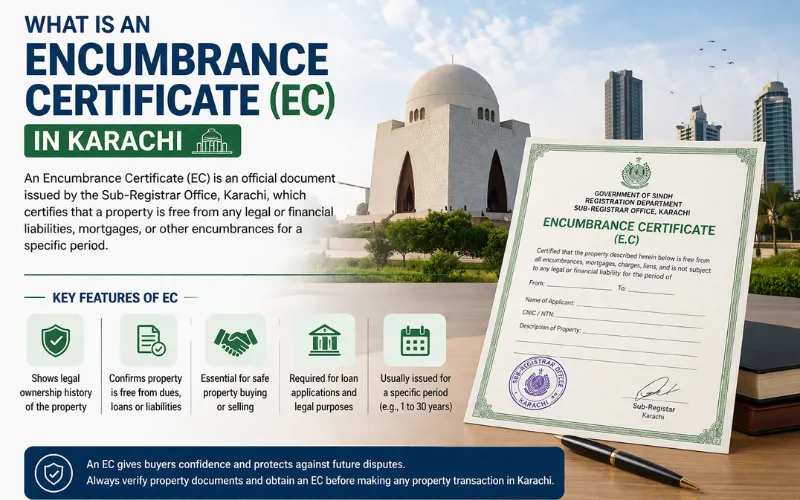

An Encumbrance Certificate in Karachi is an official document that confirms whether a property has any legal or financial liabilities registered against it, such as a mortgage, lien, court order, or pending charge. If the certificate shows no encumbrances, the property is considered clear for sale or transfer. If it shows one or more encumbrances, those must be resolved before any transaction can safely proceed.
Why This Document Matters Before Any Property Deal
Buying property in Karachi without checking for encumbrances is one of the most avoidable financial risks in the city’s real estate market. A property can appear clean on the surface, with a title document in the seller’s name and a seemingly straightforward ownership history, while carrying a registered mortgage, a court-imposed freeze, or a government demand that the buyer inherits the moment ownership transfers.
The Encumbrance Certificate is the document that surfaces those hidden liabilities. It is not a proof of ownership. It is a record of what claims or charges are attached to a property in the official register, and it is obtained separately from the title or ownership document. Understanding what a Fard document is in revenue helps clarify this distinction: the Fard confirms who owns the land, while the Encumbrance Certificate confirms what burdens, if any, are placed on it.

What Types of Encumbrances Are Recorded
Not every liability against a property is automatically visible without a formal check. The types of encumbrances that appear on a certificate in Karachi include several distinct categories, each arising from a different legal process.
The most common type is a mortgage. When a property owner borrows money from a bank or private lender and offers the property as collateral, a mortgage is registered against the title. That registration appears as an encumbrance until the loan is fully repaid and the mortgage is formally discharged. The mortgage mutation process in Pakistan explains how this registration is handled at the revenue level.
Court orders are another significant category. A civil court can issue an injunction or attachment order against a property involved in litigation, preventing any transfer until the case is resolved. These orders are registered with the relevant authority and will appear on an Encumbrance Certificate. Revenue courts can similarly issue orders that freeze a property involved in a mutation dispute or ownership contest.
Other encumbrances include government demands for unpaid property taxes, development charges levied by Karachi’s building authorities, and any registered lease or lien that gives a third party a legal interest in the property. Fraud and manual errors in property records are a separate issue from registered encumbrances, but both create problems during transactions and both require formal verification before a purchase.
Where to Get an Encumbrance Certificate in Karachi
Karachi’s property landscape is more complex than most Pakistani cities because multiple authorities maintain separate registration systems depending on the type and location of the property. The correct place to obtain an Encumbrance Certificate depends entirely on which authority registered the title of the property in question.
For properties registered under the Sindh Registration Act through the Sub-Registrar’s office, the Encumbrance Certificate is obtained from the Sub-Registrar of the relevant district. Karachi is divided into multiple registration districts, each with its own Sub-Registrar office. The certificate is issued after a search of the registered documents for the property over a specified period.
For land falling under the revenue record system, meaning agricultural or peri-urban land recorded in the Patwari’s register, encumbrances are reflected in the Fard and the ownership register maintained at the Tehsildar’s office. In this case, the relevant record search is conducted at the revenue office rather than the Sub-Registrar.
Properties in Karachi’s urban areas that fall under the jurisdiction of the Karachi Development Authority, Defence Housing Authority, or other schemes have their own internal record systems. Encumbrance checks for these properties typically require a No Demand Certificate or clearance letter from the relevant authority rather than a traditional Encumbrance Certificate from the Sub-Registrar.
How to Apply for an Encumbrance Certificate at the Sub-Registrar’s Office
The application process at the Sub-Registrar’s office follows a standard sequence that is consistent across Karachi’s registration districts. Having the right documents ready at the start prevents unnecessary delays.
The following information and documents are required for the application:
- The complete address of the property and its survey number or plot number
- The name of the registered owner as it appears on the title document
- The period for which the encumbrance search is required, typically 12 to 30 years depending on the purpose
- A copy of the title document, sale deed, or any previous registration document
- CNIC of the applicant
- Payment of the prescribed fee, which varies based on the search period and property value
Step 1: Identify the Correct Sub-Registrar Office Determine which registration district your property falls under. Karachi’s main registration districts are typically organized by administrative divisions such as South, East, West, Central, and Malir. The Sub-Registrar’s office for your district holds the registered documents relevant to your property.
Step 2: Submit the Application Fill out the prescribed application form and submit it along with the required documents and fee. Ask for an acknowledgment receipt and record the reference number of your application.
Step 3: Search Period Matters When specifying the search period, err on the longer side. A 12-year search is common for straightforward purchase verification, but a 30-year search provides greater protection by covering more of the property’s transactional history. Mortgages, court orders, or registered leases from earlier periods that were never formally discharged will appear only if the search period covers the time when they were originally registered.
Step 4: Review the Certificate Carefully When you receive the certificate, read every entry. A clear certificate states that no encumbrances were found during the search period. An encumbered certificate lists each registered document, its nature, the date of registration, and the parties involved. Every listed encumbrance must be investigated and resolved before the transaction proceeds.
Reading an Encumbrance Certificate: What Each Entry Means
An Encumbrance Certificate that comes back with entries is not necessarily a transaction-stopper, but each entry must be understood and accounted for before signing any agreement.
A mortgage entry that is current and active means the bank or lender has a first charge on the property. If the seller is paying off the loan as part of the sale proceeds, a formal discharge document from the lender must be registered before or simultaneously with the sale. Without that discharge, the buyer inherits the mortgage. The difference between registry and mutation of property is relevant here because the discharge must be formally registered, not just informally settled.
A court order entry requires verification directly with the relevant court to determine whether the case is ongoing or has been resolved. A resolved case with a court order still appearing on the EC means the order was never formally vacated in the registration record, which requires a further step to clear.
A registered lease entry means a third party has a legal right to occupy or use the property for a defined period. Purchasing a property with an active lease means buying subject to the lessee’s rights, which can affect the buyer’s ability to take possession immediately. The practical implications of such entries connect directly to issues of possession and encroachment covered under land encroachment law in Pakistan.
How Long Does the Process Take
The time to receive an Encumbrance Certificate from the Sub-Registrar’s office in Karachi varies depending on the district office’s workload, the length of the search period, and whether the records are digitized or still held in physical registers.
In districts where records have been digitized, the turnaround can be as short as a few days. In offices that rely on manual searches of physical registers, the process can take several weeks, particularly for longer search periods covering decades of registered documents. Planning this step early in the due diligence process, rather than leaving it until just before signing, avoids the risk of a transaction being held up while waiting for the certificate.
Why Banks and Lawyers Always Require This Certificate
Anyone who has taken a home loan in Pakistan is familiar with the bank’s insistence on a clear Encumbrance Certificate before releasing any funds. Banks require it because they need to confirm that no prior mortgage or charge exists on the property before registering their own. A bank that finances a purchase without checking for prior encumbrances could find its own mortgage ranked second in priority behind an existing charge, significantly weakening its security.
Lawyers handling property transactions similarly require the certificate as a standard part of their due diligence. It forms part of the documentation package alongside the registered sale deed, the ownership title, and proof of cleared dues before a transaction is cleared for completion. Experienced property lawyers in Karachi treat a clean EC as a non-negotiable pre-condition for advising a client to proceed.
This is equally important in inheritance situations. Before dividing inherited property among heirs, obtaining an Encumbrance Certificate for each inherited property confirms whether the deceased had any outstanding mortgages, loans against the property, or court disputes that the heirs are about to inherit alongside the asset itself.
The EC in the Context of Karachi’s Dual Property System
One of the most important things to understand about Encumbrance Certificates in Karachi is that the city does not operate on a single unified property registration system. Karachi has a dual structure: urban properties registered under the Sindh Registration Act go through the Sub-Registrar, while agricultural and peri-urban land recorded in revenue registers sits with the Tehsildar and Patwari system under the Board of Revenue Sindh.
Properties in the city that straddle both systems, plots in areas that were once agricultural land but have since been developed, are the most complex cases. For these, both a Sub-Registrar encumbrance search and a revenue office record check are necessary to get a complete picture. The functions of the Board of Revenue and the Sub-Registrar’s office overlap in Karachi’s transitional zones, and relying on only one of the two systems leaves potential liabilities unchecked.
For any property falling under a housing scheme or development authority, the clearance process involves checking with the relevant authority directly. For example, e-stamp paper verification in Pakistan is one component of verifying registered documents in the broader due diligence process, particularly where stamp duty paid on earlier transactions is a question.
What to Do If the Certificate Shows an Encumbrance
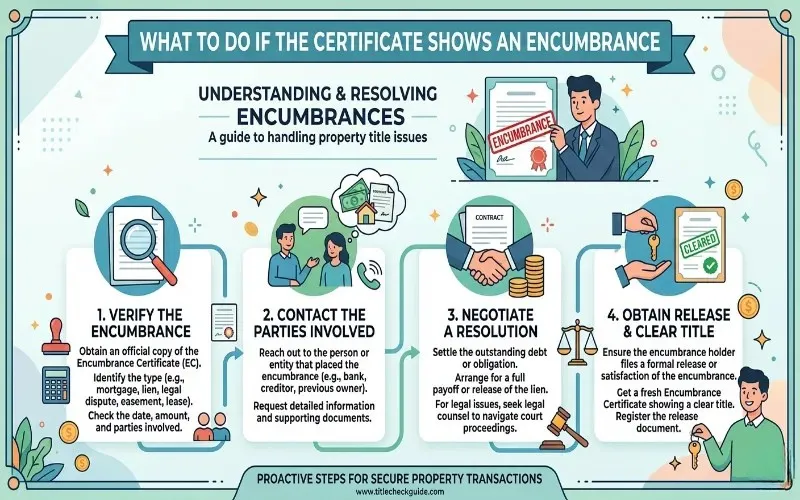
A certificate with encumbrances should not be treated as a reason to abandon a transaction immediately, but it must be treated seriously. The first step is to identify the nature of each encumbrance and confirm its current status directly with the relevant court, bank, or authority.
If the encumbrance is a mortgage that the seller is clearing at the time of sale, insist on receiving the discharge document from the bank and verify that it has been registered with the Sub-Registrar before finalizing the transaction. If the encumbrance is a court order, obtain a certified copy of the current status from the court before proceeding.
Purchasing property without resolving listed encumbrances is one of the most direct paths to a land dispute that can last years. The cost of verifying and resolving encumbrances before a purchase is always lower than the cost of disputing them afterward.
Frequently Asked Questions
What is an Encumbrance Certificate in Karachi and what does it confirm
An Encumbrance Certificate in Karachi is an official document issued by the Sub-Registrar’s office that records all registered transactions, charges, and liabilities attached to a property over a specified search period. It confirms whether a property carries any mortgages, court orders, registered leases, government demands, or other legal burdens that could affect the buyer’s ability to take clear title. A clean certificate means no such liabilities were registered during the search period. An encumbered certificate lists each registered charge and requires investigation and resolution before any sale can proceed safely.
Where do I get an Encumbrance Certificate for a property in Karachi
The Encumbrance Certificate is obtained from the Sub-Registrar’s office of the registration district in which the property falls. Karachi has multiple registration districts organized by administrative division. For revenue land recorded in the Patwari’s register rather than the Sub-Registrar’s system, the encumbrance check is conducted through the revenue office at the Tehsildar level. Properties under housing schemes or development authorities require a separate clearance letter from the relevant authority rather than a traditional EC from the Sub-Registrar.
How long should the search period be on an Encumbrance Certificate
For routine pre-purchase due diligence, a minimum search period of 12 years is commonly accepted, but 30 years provides significantly greater protection. Mortgages, court orders, or registered leases from earlier periods that were never formally discharged remain as valid encumbrances regardless of age. A longer search period captures liabilities that may have been created decades ago and never resolved, which is particularly important in Karachi where many properties have complex ownership histories spanning multiple generations.
What happens if I buy a property in Karachi without checking for encumbrances
If you purchase a property without obtaining an Encumbrance Certificate, you risk inheriting any registered mortgages, court orders, or other legal charges that exist against the property. Under Pakistan’s property law, a buyer takes the property subject to any registered encumbrances unless they were specifically disclosed and resolved before the transfer. This means a bank that had registered a mortgage can pursue its claim against the new owner, and a court order freezing the property remains in effect despite the sale. The buyer’s only recourse in such cases is typically a claim against the seller for misrepresentation, which itself requires litigation.
Is an Encumbrance Certificate the same as a title document
No. An Encumbrance Certificate and a title document serve completely different purposes. A title document, such as a registered sale deed or a Fard, confirms who owns a property and how ownership was acquired. An Encumbrance Certificate confirms what liabilities or charges are registered against that property, regardless of who owns it. Both documents are required for proper due diligence before a property transaction. The title document tells you the seller has the right to sell. The Encumbrance Certificate tells you whether the property they are selling comes with any strings attached.